
Getting started
Italian genealogy for beginners
How to find Italian ancestors in a sensible order: collect home-country clues, identify the comune, search Antenati and FamilySearch, then write for what is missing.
Affiliate disclosure.Some links on this page go to genealogy companies. If you buy through them, we may earn a commission, at no extra cost to you. We recommend a site only where it helps this kind of research. Read the full affiliate disclosure.
Finding Italian ancestors is a sequence, not a single search box. The sequence is the same whether the family left in the 1880s or the 1950s, and whether you are the first person in the family to try. You gather records created after emigration, you extract a place, you prove that place is a municipality, you browse the civil registers, and you write a focused letter only for what those registers do not show.
If you do the sequence backwards, you will browse the wrong province and then decide the records “burned.” Sometimes they did. More often they are under a spelling you have not tried, in a year you have not opened, or still at the comune because that decade was not filmed.
Step 1. Make a one-page profile
Pick one person who was born in Italy, not the whole family at once. On the ancestor worksheet, write the last name and given names as they appear in each document, not as the family prefers to spell them now. Add a birth year or a range. Add the father’s name and the mother’s last name if you have them. Add the spouse. Leave blanks empty.
A blank is useful. A guess written as a fact will send you into the wrong annual index and, later, into a letter that the clerk cannot match.
Note which fact comes from a person who knew the immigrant, and which fact comes from a record. Family stories are leads. They are allowed to be wrong about the town, the year and the ship.
Step 2. Work from the country they sailed to
The town of birth is most often written down when a government in the new country asked for it. In the United States, the strongest ordinary sources are:
- A passenger list. New York lists are covered in the Ellis Island guide and the free Arrival Records search at the Statue of Liberty—Ellis Island Foundation. Earlier New York arrivals are discussed on the Castle Garden page. The National Archives explains passenger arrival records at archives.gov/research/immigration.
- A naturalization petition or declaration. After 1906, federal forms asked for specific biographical detail. See the naturalization guide and the National Archives page on naturalization records.
- An obituary or a death certificate in the state where the person died. The town, if it appears, may be in a parent’s biography rather than in the decedent’s own line.
- A Social Security application for a person who has died. The Social Security Administration explains how to request a deceased person’s SS-5 or Numident on its FOIA request page. The fee is whatever that page and Form SSA-711 say when you apply. Do not rely on a number remembered from a blog.
You are looking for a place name, a birth date or age, parents’ names, and a spouse. Copy them as written, including the clerk’s spelling.
Step 3. Identify the comune
Italian records are filed by the comune, not by the last name and not by the region. “Calabria” is a region. “Cosenza” may be a city or a province. “Naples” on a ship list may be the port of departure. The hometown guide shows how to test those strings against a gazetteer.
FamilySearch’s Italy wiki links to gazetteer help at Italy Gazetteers. Use a gazetteer that distinguishes a frazione (a hamlet) from the comune that kept the records. The hamlet is where the family lived. The comune is where the civil act was written. The parish may be in either place.
Write down the province. Catalogs at Antenati and FamilySearch are organized by the state archive, which usually follows the province. If a modern province was created later, also try the older province. The Calabria and Abruzzo pages flag that problem. Basilicata was often called Lucania; the Basilicata guide tells you to search both.
Step 4. Search Antenati like a clerk, not like a search engine
The Portale Antenati is the Ministry of Culture’s site for civil registers, conscription lists and related material kept in the state archives. The portal’s own research guide tells you to choose a tool based on what you know:
- A name, and an indexed register: try Cerca per nome.
- An event and a place: try Cerca nei registri.
- A town or a province, and you need to see what exists: open Esplora gli Archivi.
The Antenati walkthrough and the name-search page go through the clicks. The rule that matters most is this: a failed name search does not mean the act is absent. It means that register may not be indexed. Browse the year.
Read the ten-year index, the indice decennale, if the archive filmed one. It is the alphabetical or chronological finding aid at the front or the end of a decade. Then open the annual register and go to the act number. Do not stop at the index. Indexes mis-hear names.
Step 5. Repeat the search on FamilySearch
FamilySearch and the Italian archives have a long digitizing agreement. The portal’s history page describes the 2011 agreement between the Direzione generale Archivi and FamilySearch. The same volumes often appear in both places, but the catalogs, the indexes and the access locks are not identical.
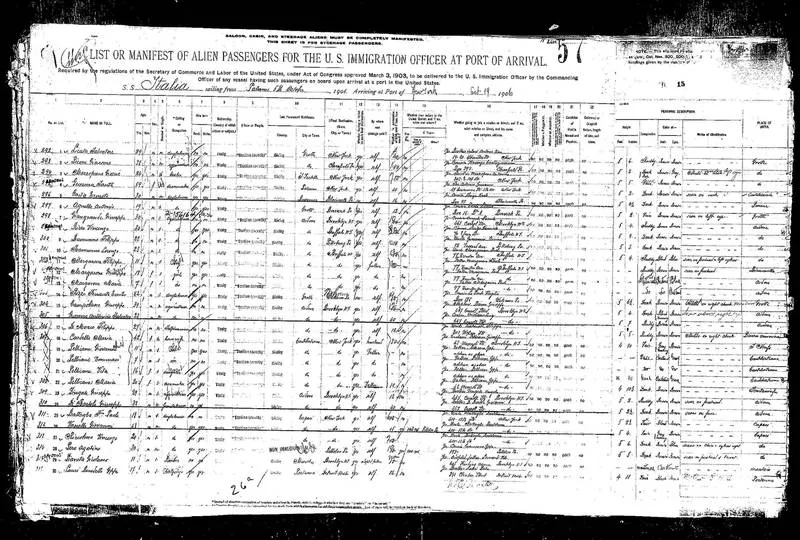
Ellis Island passenger manifest for a group recorded as Italy (South), including towns in Sicily. The file title says 1903; the Commons date field says 19 October 1906. Public domain.
Use the FamilySearch Italy guide. Search the catalog for the comune, not only the global search box. Open “Italy, Civil Registration” style collections when they exist for the province, and also browse unindexed image groups. If the viewer says the images are available at a FamilySearch Center or affiliate library, that is a real limit. A home login will not remove it.
There is no FamilySearch affiliate program. Linking there is not a paid recommendation. It is where the images are.
Step 6. Read the act before you hunt the next one
A birth act is not a modern certificate. It is a statement, usually by the father or a midwife, made before an official, with witnesses. The birth reading guide and the birth records overview list the lines that matter: the child’s names, the parents, their ages or occupations, the residence, and the date of the declaration, which is not always the date of birth.
Marriage acts and their processetti or allegati (the packet of supporting papers) are often richer than the birth. Death acts name a surviving spouse or parents, and they are full of people who died far from the town of birth. Read the marriage and death reading pages before you decide a word is a last name.
Copy parents exactly. The mother’s surname is the bridge to her family. Italian women kept their own family names in the civil acts.
Step 7. Write only for the missing year
When the portal’s listing for that comune stops short of your year, or the book is too damaged to read, use the not-online guide. The request guide explains a genealogical request for a birth act. The wording for the letter is on the template page. For a baptism, use the parish letter.
Say that the request is for family history. Ask whether they hold the act, what a copy costs, and how they want to be paid. Do not send cash. Do not ask the office to “send everything on the last name.”
What beginners can ignore at first
Military lists, notarial deeds and census fragments are real, and they have their own pages: military and census. They are poor first searches if you do not yet have a town. A coat of arms sold by last name is not evidence. The surname origin page says why.
DNA can wait until you have a paper hypothesis, or until you are stuck on which of two cousins’ trees is right. Start with the DNA overview when you get there, and treat the region label as a hint.
A beginner schedule that fits real evenings
Week one: profile, passenger list, naturalization. Stop when you have a place string and a parent’s name, or when you have honestly failed to find either. Write down the failure.
Week two: gazetteer. Produce one comune and one province, plus the runner-up spelling. Look at the region page if the town is in Sicily, Campania, Calabria, Abruzzo or Basilicata.
Week three: Antenati and FamilySearch for one event, one year, one town. If you find the act, transcribe it with the word list before you search the parents. If you do not, log the volumes you opened.
Week four: one letter, to one office, about one event. Track it on the correspondence rows of the worksheet.
That pace is slower than a search box and faster than a year of the wrong province. When the repetitive parts, the Italian letters and the glossary, are what you want in a folder, the kit is the download that holds them. The research order stays the one on this page.
Sources
Questions readers actually ask
Where do I start if I only know a last name?
Do not start in an Italian register. Start with records in the country the family moved to, and look for a town of birth or last residence. A surname alone matches too many people.
Are Italian birth records online?
Many civil registers filmed from state archives are on the Portale Antenati and on FamilySearch. Coverage is by comune and by year. If your year is not in the listing, it is not "online" for you, even if the next town is complete.
Should I write to Italy first?
Write after you have checked the free portals for that town and year. Offices are the right address for the gap, not the first search.