
DNA
Best DNA test for Italian ancestry
How to choose a DNA test for Italian research by the job it does: cousin matches, a direct-line test, or records.
Affiliate disclosure.Some links on this page go to genealogy companies. If you buy through them, we may earn a commission, at no extra cost to you. We recommend a site only where it helps this kind of research. Read the full affiliate disclosure.
“Best” is a question about what you are missing. It is not a score. For Italian research, a DNA test is useful when it does one of three jobs: it shows you cousin matches, and the trees or messages attached to them; it tests a direct paternal or maternal line, which is a different laboratory product; or it comes tied to a record subscription you were going to use anyway. A test that does none of those jobs for your particular stuck point is not made better by a colorful map of the peninsula. Ethnicity labels are models that the companies revise. They do not name a comune. This page will not crown a test, and it will not quote a breakdown.
The paper trail remains the way a town is identified. The beginner guide and the hometown guide are that work. Antenati is free. A swab does not unlock an archive that was never filmed. Buy a test when the people who might know the town are cousins you cannot find on paper, or when a last name question is specifically about an unbroken line of fathers and sons.
Cousin matches and trees
An autosomal test reads the DNA you inherit from both sides of the family, in the recent generations those tests are built to see. The genealogical product is the match list: other customers who share enough DNA that the company estimates a relationship, plus whatever those customers have attached.
AncestryDNA is an autosomal test sold with cousin matches and with the trees and records on Ancestry. For an American family, that combination matters because many Italian-American researchers already keep trees there. A match’s tree that cites a town in Sicily or Calabria is a lead. You still have to test the lead in the registers of that town, using the region guides when one of them covers the province. A public tree is not an act. Ancestry also sells a record subscription. The subscription and the test are different products even when a promotion puts them on one screen. Read the current offer on Ancestry’s own site before you assume a kit includes records. This page does not quote a price.
MyHeritage DNA is an autosomal test with cousin matches. It is often used by European testers, which is a research reason to care about it when the cousins who stayed in Italy, or who went to another European country, are the people you need. MyHeritage also sells record subscriptions. The same caution applies: records and the test are not the same purchase, and the comparison with Ancestry is the page that refuses to declare a winner. Both are optional next to Antenati.
FamilyTreeDNA’s Family Finder is the autosomal test at FamilyTreeDNA. It produces matches. The reason to start there, rather than only to compare it with the two larger autosomal databases, is that the same company sells the direct-line tests. If you already know you will want Y-DNA, keeping the autosomal test and the Y-DNA test at one company can make the correspondence easier. It does not make the autosomal database identical to Ancestry’s or MyHeritage’s. People who tested elsewhere are not in it unless they also tested or uploaded there, subject to whatever upload rule the company is using when you read this.
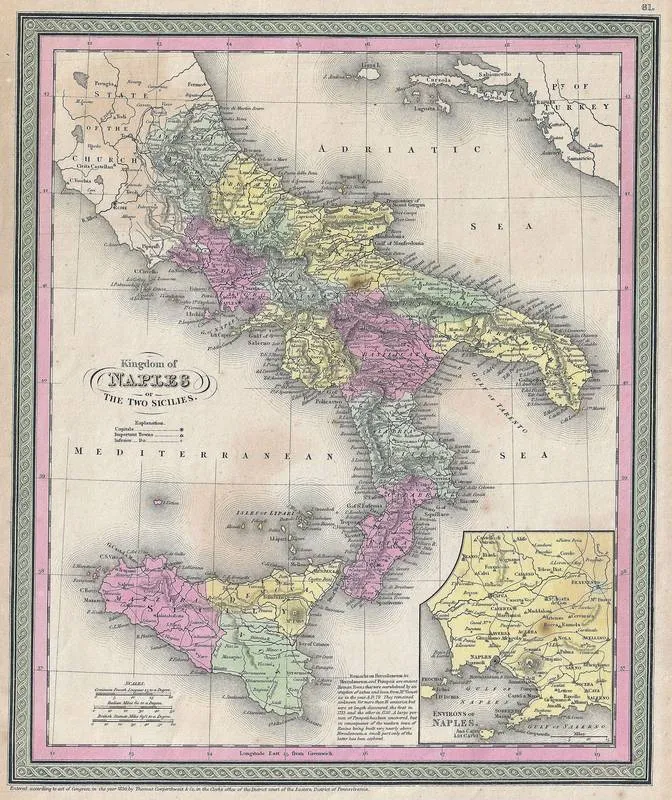
Map of southern Italy and Sicily by S. A. Mitchell, plate 61 in the 1853 New Universal Atlas. Public domain.
Living DNA sells an autosomal test whose genealogical emphasis, for the purpose of this page, is the regional report. A regional report is still a model. It does not name a comune, and it does not replace a match list if what you needed was cousins. Read the current description on Living DNA’s site for what the report claims to show. Do not treat a screenshot in a forum as permanent.
Direct lines, when the last name is the actual question
Y-DNA is inherited along an unbroken line of fathers and sons. It can be relevant to a surname for that reason, and only for that reason. It says nothing about the other ancestors: not the mother, not the father’s mother, not any line that passed through a woman. A woman who wants Y-DNA evidence for her father’s last name needs a male relative in that direct paternal line to take the test. The result still does not prove a province. Two men can share a paternal-line signal and have paper trails in different regions, or no paper trail at all. You use the match to find a man who has a documented town, then you test that town in the records. You do not paint a province onto a haplogroup.
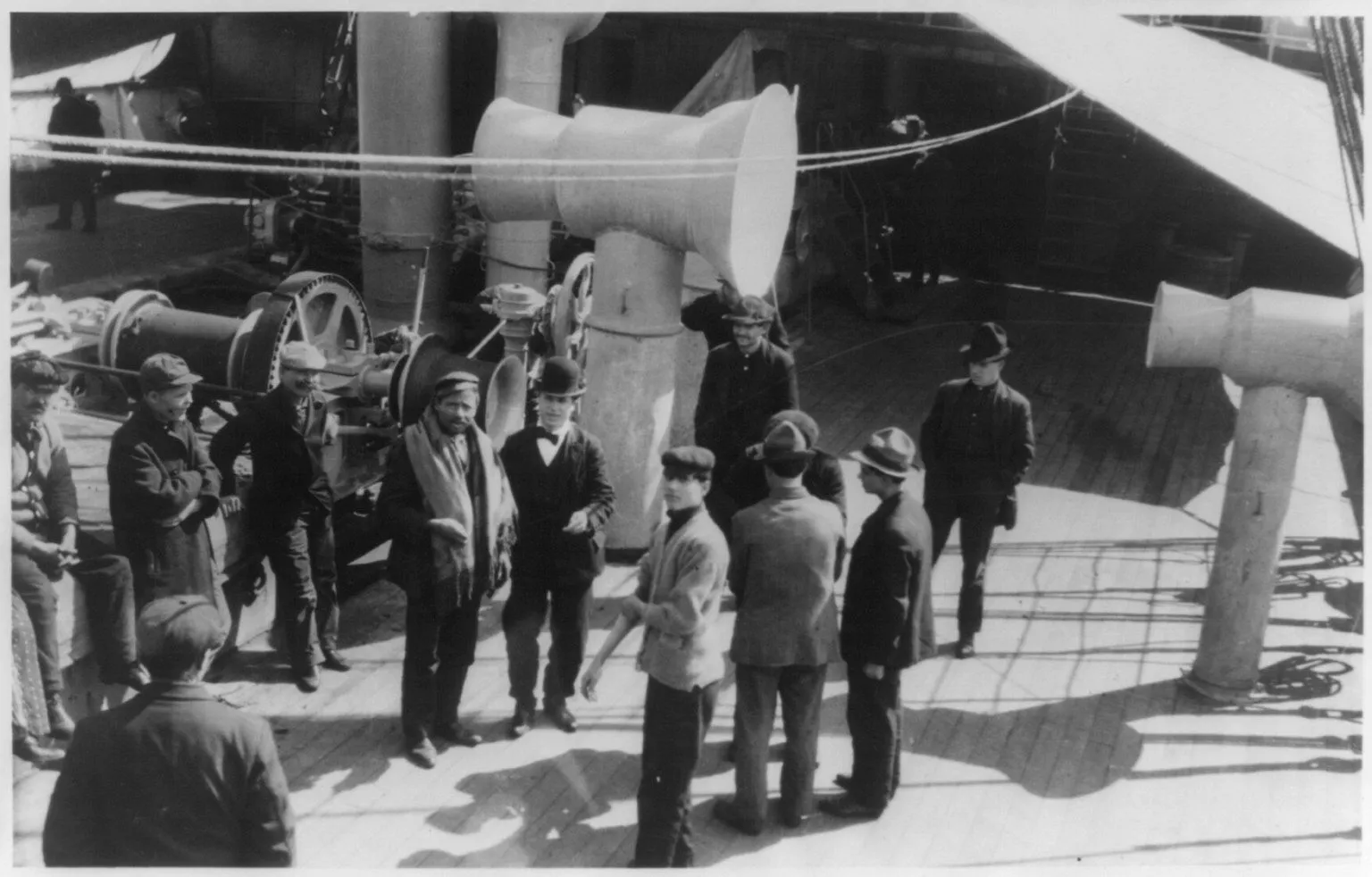
Immigrants on the steerage deck of the Friedrich der Grosse. George Grantham Bain Collection, Library of Congress.
Mitochondrial DNA follows an unbroken maternal line. It is the right test only when the question is that line. It is a poor test for a last name, because surnames in Italian civil records stick to the father in the way children are indexed, while the mother’s surname is her own and changes lines each generation. FamilyTreeDNA is the company, among those named here, that sells these direct-line tests alongside Family Finder. Order the test that matches the line. Do not order all of them because a bundle looked complete.
The record subscription attached to a test
Sometimes the useful purchase is the records, and the test is what the advertisement put in front of them. Ancestry’s Italian civil images, where a province has them, often come from the same filming projects as the free portals. MyHeritage’s record side is the same kind of optional index and image set. A subscription can be the right tool when an index saves you a day of browsing, or when a cousin’s tree is documented there. It is the wrong tool when you buy it expecting a town the film does not contain.
Separate the three purchases in your notes: the autosomal test, the direct-line test, and the record subscription. “Best” is whichever of the three fills the hole you wrote down before you opened a checkout page. If the hole is “I do not know the comune,” none of the three fills it by itself. A match might. A manifesto might. The Ellis Island guide is still a DNA-free way to a town.
Labels, including 23andMe
23andMe publishes an autosomal report and a relative list. Its affiliate program is paused. This site mentions it so the comparison is not silently missing a well-known company, and this site does not earn a commission if you buy a kit there. The ethnicity-style labels on 23andMe, as on the other companies, are models that get revised. They do not name a comune. This page does not discuss medical reporting from any company.
Southern and northern labels are coarse on every platform that uses them. A southern label does not choose Sicily over Campania or Calabria. A northern label does not name a province either. The label page is the longer explanation. Do not screenshot a label into a tree as a birthplace. Do not average two companies’ labels into a town. If they disagree, the models differ. The registers are how you settle a place.
What not to expect from any of them
A test will not confirm a coat of arms, a noble story, or a dictionary’s claim that a spelling is Norman or Arabic or Greek. The Sicilian surnames page explains why a spelling does not prove an origin. A test will not draw the telephone-directory maps described on the distribution page. Those maps are listings, not DNA. A test will not tell you which of two towns in a gazetteer kept the civil register. That is the hometown guide’s job.
Invented example. A researcher wants the “best Italian test” and has a grandfather born in Pennsylvania and a great-grandfather whose death certificate says Italy. There is no town. An autosomal test at Ancestry shows a southern label and a match whose tree says Enna. An upload or a second autosomal test at MyHeritage shows a match in Sweden whose tree says the family left Catania province. Y-DNA is not relevant yet, because the question is not confined to the father’s last name; the Swedish match may be through a maternal line. The practical choice was an autosomal test in a database where American trees exist, plus attention to a database where European matches exist. The labels did no filing. The towns in the trees are candidates. The Sicily guide tells you that Enna and Catania are different provinces and different archives, and that Enna was also called Castrogiovanni. You do not merge them because one test said “southern.” You look for a paper record that names one of them, then you browse that archive on Antenati.
If the match lists had been empty of any Italian place, the test would still not have failed an accuracy contest. It would have failed to know a fact nobody in the database wrote down. The next step would be a passenger list or a petition, not a third ethnicity model.
A way to decide without a ranking
Write the missing fact in one sentence. If the sentence is “I need cousins who may have the town,” compare AncestryDNA and MyHeritage DNA and Family Finder as autosomal match lists, and weigh where your relatives are likely to have tested. If the sentence is “I need only my father’s last name, along that one line,” look at Y-DNA at FamilyTreeDNA and ignore the peninsula maps. If the sentence is “I need Italian civil images and I already want a subscription,” compare the record collections and remember that Antenati is free. If the sentence is “I want to know the village,” no kit on this page is the best kit. The village is in a record. The website comparison and the free-records guide are how you get to that record before you pay anyone, including a DNA company.
Sources
Questions readers actually ask
Should I pick a DNA test by how Italian the report looks?
No. This page does not rank tests by a score, and it does not crown a product. Ethnicity labels are models. The companies revise them. A label can say something broad about a southern or northern Italian cluster and still fail to name a comune, a province or a household. A single score for "Italian" is not something this site compares across companies, and this site does not print those breakdowns. Choose by the research job. If you need cousin matches tied to trees, look at an autosomal test from a company whose users build trees. If you need a last name along an unbroken paternal line, look at Y-DNA. If you need a record subscription, notice when a company sells that subscription beside the test, and notice that Antenati is free either way.
Will a DNA test tell me the town in Italy?
No test described here names a comune. AncestryDNA and MyHeritage DNA and FamilyTreeDNA's Family Finder and Living DNA's regional report are autosomal products. They compare your sample with reference sets and with other customers. A cousin match may have a tree that already names a town, and that town is a lead you test in the civil registers. The lead can be wrong. Y-DNA and mitochondrial DNA follow one direct line each and still do not print a municipality. If you do not have a town, use the hometown guide on passenger lists and petitions first, or use matches only to decide which relative might know the town. Then open Antenati. A test is a way to meet cousins. It is not a gazetteer.
Do I have to test with the same company as my cousins?
You will see the people who tested at the company you test with, plus anyone that company lets you compare through a file upload if it offers one. This page does not promise that every company accepts every other company's file, or that an upload is free. Read the current help page before you pay twice. If the cousins who already hold the Italian photographs tested at one company, there is a practical reason to test there or to upload there, if uploads are allowed. If nobody has tested, you are choosing a database, not a winner. Ancestry is often where American trees are. MyHeritage is often where European testers show up. FamilyTreeDNA is where you go when the question is a direct line. Those are research reasons. They are not a ranking of laboratories.