
Vital records
Italian birth records: how to find the act
What an Italian birth act records, how to find the register on Antenati or FamilySearch, and when to write the comune for a copy.
Affiliate disclosure.Some links on this page go to genealogy companies. If you buy through them, we may earn a commission, at no extra cost to you. We recommend a site only where it helps this kind of research. Read the full affiliate disclosure.
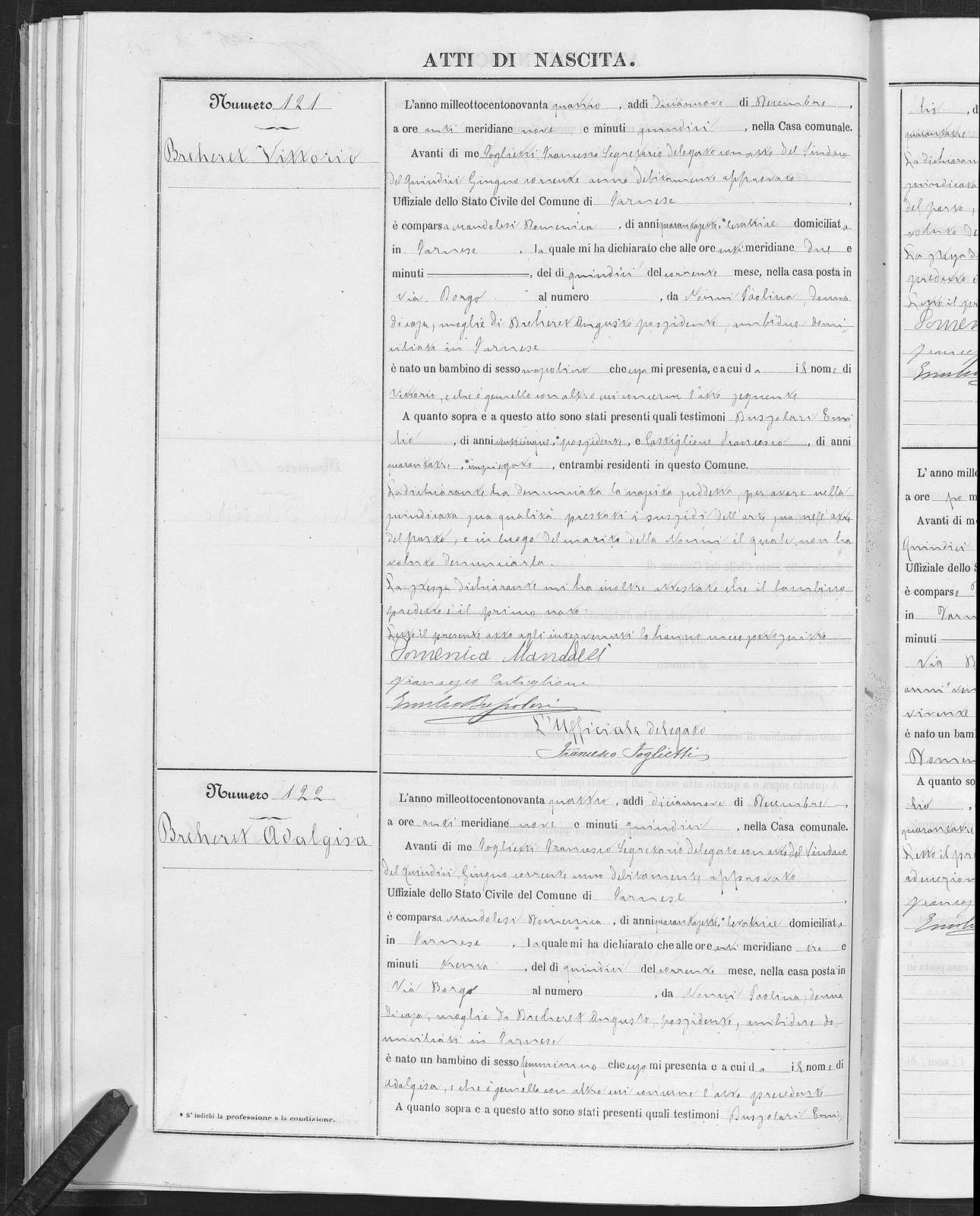
An Italian birth record, for family history, is the atto di nascita in the civil register of a comune. It is the page written when someone stood before the civil official and declared that a child had been born. Later extracts and certificates are copies made from that page. If you can see the register, read the register.
The civil registration overview explains how the books were kept through the Napoleonic years, the Restoration series in places that continued that style, and the unified Italian series. This page stays on the birth act: what to copy, where the image usually sits, and when a letter is the right next step.
What a birth act is
The declaration was often made by the father. When he was absent, the midwife, the levatrice, commonly appeared instead. Two witnesses were part of the ordinary form. The entry names the official, the declarant, and the witnesses, then the child and the parents.
The mother is recorded under her own family name. She does not take her husband’s surname in the act. That single habit is why a birth act reaches her family when every American document has already dropped her name. Copy her last name letter for letter, including a double consonant a clerk might have softened.
Parents’ ages or occupations are commonly stated, and so is their residence. The residence may be the town or a frazione, a hamlet of the comune. The hometown guide shows why the hamlet and the comune are different searches. A stated age chooses a range of birth years, not a birthday. If the father did not acknowledge the child, the act may name only the mother or leave the parents unknown. Copy that blank until a later record fills it.
Two dates, and a margin
The date in the heading is the date of the declaration. The child’s date of birth is a separate clause, often the same day or the day before, sometimes earlier if the declarant was delayed. People who type only the heading date into a tree will miss the act in any index that stored the other date. The reading guide takes the clauses in order. Words such as dichiarante, comparente, and the occupations are in the Italian word list.
Witnesses were often neighbors. A shared last name is a lead, not a place in the tree. Copy the names and leave the relationship blank until another record states it.
Look at the margin. A later clerk sometimes noted a marriage, a death, or a correction, with a date and an act number. Open that volume. A clean margin does not mean the person never married. Annotation was local, and rebinding has dropped notes.
The years are general until you open the town
FamilySearch’s account of Italian research resources is the map most English-language researchers use, and it should stay a map. Napoleonic civil registration, as a general rule, falls about 1806 to 1815 in some areas. In the Kingdom of Naples, Napoleonic-style registration was introduced in January 1809 under Joachim Murat and reintroduced in 1816 by the Bourbons. That style was not introduced in Sicily until 1820. Unified Italian civil registration is generally from 1866, and in the province of Rome from 1871.
Those ranges describe a pattern. The comune’s own volumes control. One town can begin later than its neighbor, skip a year, or keep a book the next town lost. Before you decide a birth was never recorded, read the listing for that comune. The region guides help you see the province. They do not replace the volume list.
Where the registers are published
The Portale Antenati publishes stato civile kept in the state archives, together with liste di leva and ruoli matricolari. The Istituto Centrale per gli Archivi states that access is free and that registration is not required.
The portal’s research guide matches the tool to what you know:
- A name, and an indexed register: Cerca per nome.
- A place, a year, and a type of act: Cerca nei registri.
- A need to see what exists: Esplora gli Archivi.
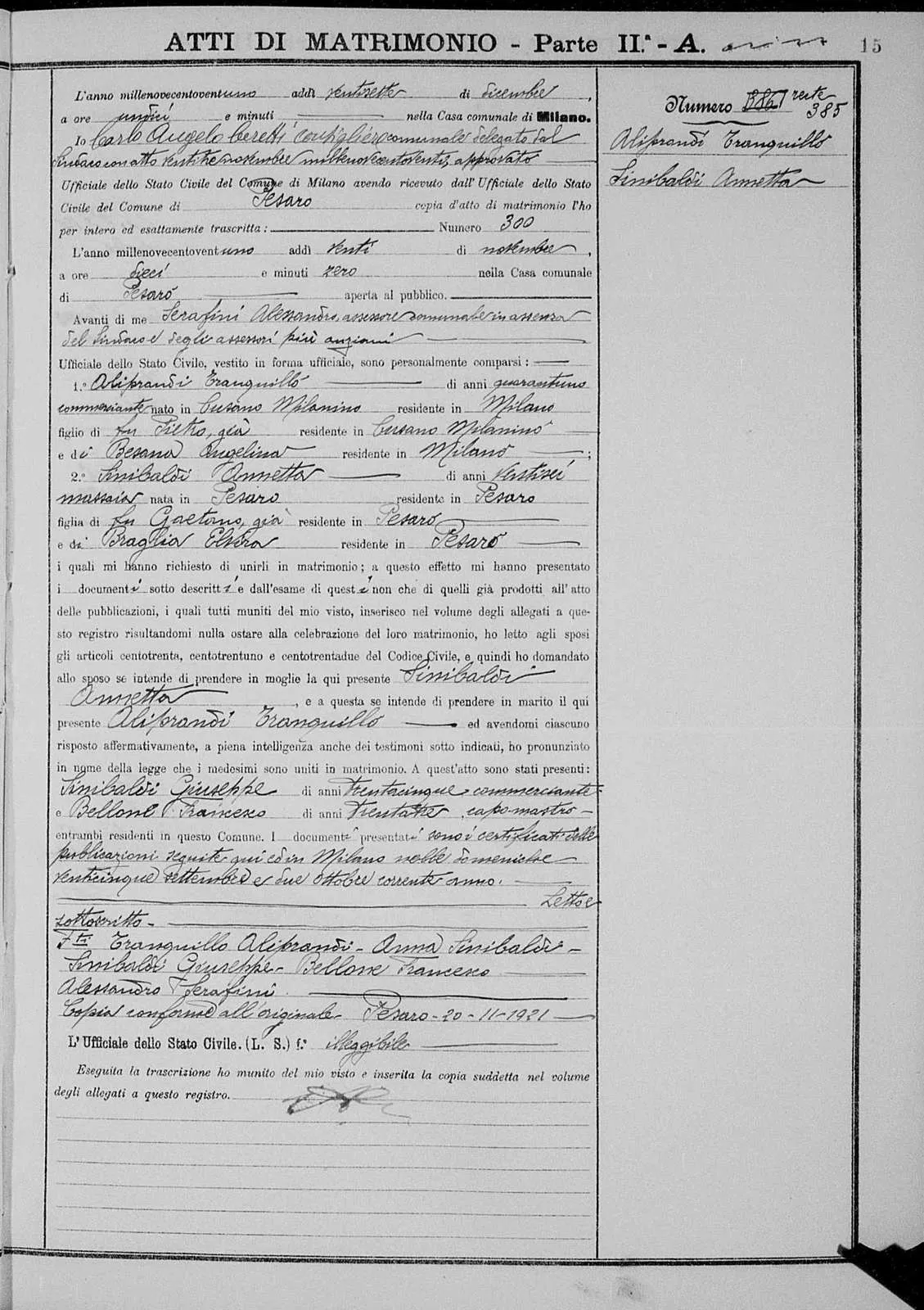
Marriage act of Tranquillo Aliprandi and Annetta Sinibaldi, Milan, 20 November 1921. Civil register of the Comune di Milano. Public domain.
Name search works when the register has been indexed. An empty result means you browse the year. The Antenati walkthrough and the name-search page cover the clicks.
Many of the same volumes are on FamilySearch. The portal’s history page describes the digitization agreement of June 2011 between the Direzione generale Archivi and FamilySearch. The two catalogs still differ in indexing and in which images a home login can open. Follow the FamilySearch Italy guide. If the viewer says an image is available at a FamilySearch Center or an affiliate library, that restriction is real for that set.
Some of the same films are on Ancestry. A subscription does not add a year the archive never filmed. Check the comune and the year. The website comparison and the free-records guide sort the overlap.
Without a town, there is no volume to open. Find the place in Ellis Island passenger lists or naturalization records, then follow the beginner sequence.
Index first, act second
The annual births are the atti. A ten-year index is an indice decennale. It may sit at the front or the back of a decade, or in a volume of its own. Some indexes are alphabetical, some are grouped only by the first letter, and some follow the order of registration. However it is arranged, it is a finding aid. It points at an act number. It is not the birth record.
Open the annual register and read that number. Indexes drop a second given name, file a child only under the father, and sometimes cite the wrong number. If the family in front of you is wrong, read the neighboring acts and try the mother’s last name. Then record the citation on a worksheet: archive, comune, register title, year, act number, both dates, both parents with ages and occupations, residence, declarant, witnesses, and any margin note.
When the year is not on the portal
When the listing stops short of your year or the scan is unreadable, use the not-online guide. Write to the Ufficio di Stato Civile. The request guide is the sequence, and the sentences are on the letter template.
Ask for a copia integrale or an estratto for family history, per ricerca genealogica. The glossary defines the words. The office sets the fee and the form. Do not send money until the reply states the amount and the method. Ask for one event.
A marriage packet sometimes contains a copy of the birth acts of the spouses. If you know the wedding, search marriage records before you pay for a guessed birth year. For a birth before the civil series in that town, move to church records and the parish letter.
A practical search order
- On the worksheet, write the child’s names, a year or a range, the father, and the mother’s last name. Leave unknown fields blank.
- Turn the place string into one comune and one province. Keep a second spelling if the gazetteer disagrees with the ship list.
- In Antenati, open Esplora gli Archivi, then the state archive, then the comune, then births. Write down the years the listing actually shows.
- Try Cerca per nome only if that year is indexed. Browse the year either way if the name does not appear.
- Use the indice decennale to get an act number. Open the annual atti and read the act, not just the index line.
- Copy both dates, both parents, ages, occupations, residence, and margin notes. Look up words you cannot read before you decide a letter is a different last name.
- If the page is missing or damaged, check FamilySearch for the same book, then send one letter to the Ufficio di Stato Civile.
- From the parents’ ages, set a range for their births and repeat the same order. One act, then the next.
Invented example
The family and the town in this section are invented.
A passenger list says Maria Conte was born about 1888 in “Castelnovo.” A naturalization file names her father Giuseppe Conte and her mother Anna Greco. You test the string and settle, for this exercise, on an invented comune called Castelnovo del Colle. Antenati lists birth registers for that comune through the 1880s. The ten-year index for 1881–1890 shows Maria, daughter of Giuseppe Conte and Anna Greco, at act 47 of 1888.
Act 47 is a declaration on 12 March by Giuseppe, age 34, a shoemaker, resident in the frazione of San Lio. He states that his wife, Anna Greco, age 29, gave birth on 11 March to a daughter named Maria Luigia. You keep 11 March as the birth and 12 March as the declaration. A margin note mentions a marriage in 1912. You do not treat the note as the marriage. You open the 1912 marriage volume and read the act. Anna’s age points at a birth around 1859, so Greco becomes the next search, in a range, not in a single year.
If act 47 had been another family, you would finish the index and try the mother before writing to the comune. The letter and the glossary are in the kit if you want them together. The search order stays the list above.
Sources
Questions readers actually ask
Are Italian birth records searchable by name?
On Antenati, name search returns a birth act when that register has been indexed. If the name search is empty, browse the year. An empty search is not proof the birth was never written down.
Is the date at the top of the act the birthday?
Often it is the date of the declaration, made by the father or the midwife before the official. The birth date is a separate statement in the act. Copy both, and do not collapse them into one field until you have read the page.
Who do I write to if the birth is not online?
Write to the Ufficio di Stato Civile of the comune, one event at a time, and ask for a copy for family history. Ask the fee before you pay. The office sets the form and the amount.