
Vital records
Italian military records: leva lists and rolls
How Italian conscription lists and service rolls can name a birthplace and parents, and how to see whether Antenati has the volume.
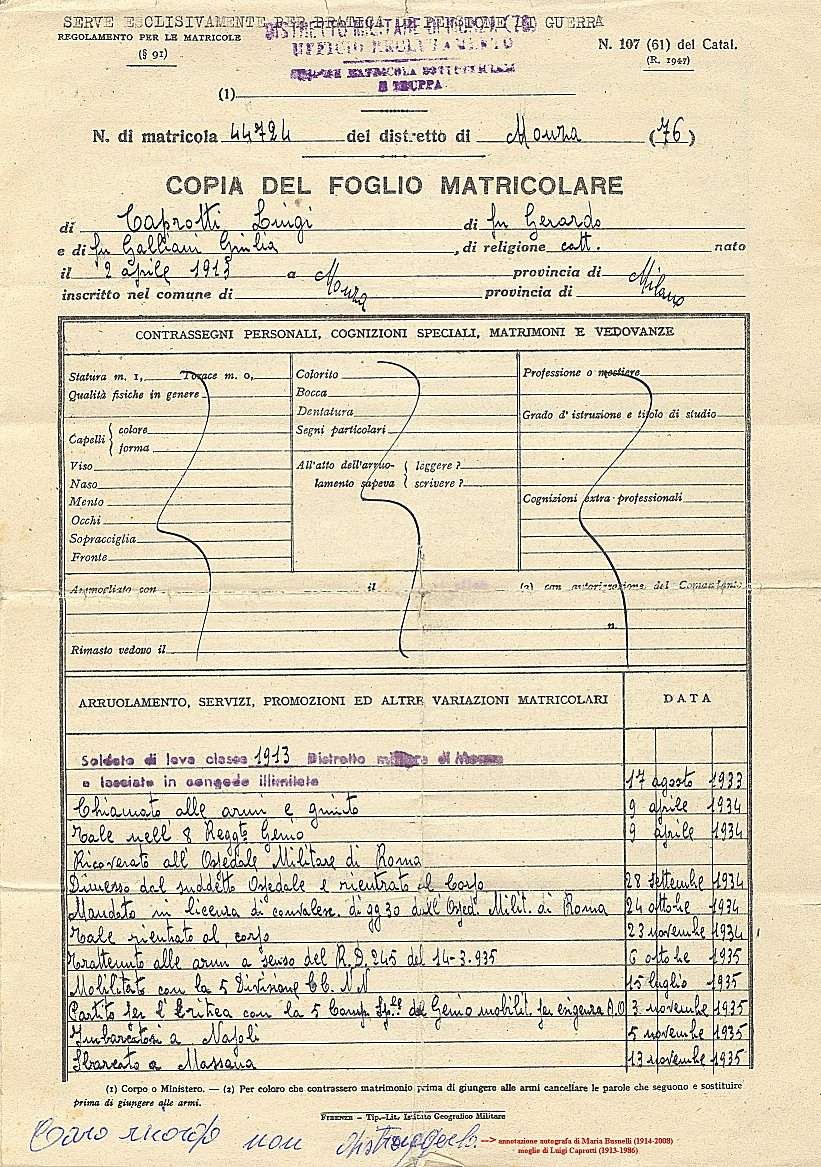
Italian military records, for genealogy, are useful because the army wrote down where a man was born and who his parents were. The two series you will meet first on the state-archive portals are the liste di leva and the ruoli matricolari. The Istituto Centrale per gli Archivi names both among the records the Portale Antenati publishes from the Archivi di Stato, beside the civil acts of birth, marriage, and death.
The FamilySearch Wiki page on Italy military records is the wider map, including material that never went onto Antenati. This page stays on the two series you can actually browse, and on the rule that a class year you need is present only if the archive’s listing says so.
Liste di leva
A lista di leva is a conscription list: the men of a call-up class, a classe, associated with a birth year, drawn up for the military district. The class number is your way in. If you know a man was born about 1884, you look for the class of 1884, and you look in a range around it, because a declared age on a passenger list can be off. You do not need a regiment to open a leva list. You need the town, or at least the district that covered the town, and the class.
When the register survives, the line can give the birthplace, the parents, and a physical description. Copy the headings on the page you are reading. A description separates cousins of the same name. The parents, including the mother’s own family name, do the heavier work.
The list does not include the women, and it does not include every man. A missing name can mean a missing book, a different district, or a man who was not entered. Check the archive. Do not invent an exemption to explain the gap.
Ruoli matricolari
A ruolo matricolare is the roll kept for a man once he was enrolled. It follows him by a matriculation number. Where a leva list is the doorway, the ruolo is the service. It may repeat the birth and the parents, and it may add units and movements. How much it adds depends on the form and on whether the volume survived. Read the pages that belong to his number. Do not stop at the alphabetical index of the roll if the index only gives the number.
Twentieth-century service lives in these rolls and in related files when the archive has them. Antenati’s listing is what that portal has digitized, not a complete roll of everyone who served. A class missing from the portal may still be on paper at the Archivio di Stato, or it may not be there at all. The portal research guide and Esplora gli Archivi show what was published. Check the current listing before you call a class lost.
What you need before you search
You need a man, an approximate birth year, and a place. The place has to become a comune and a province, because districts follow geography. The hometown guide is the conversion. A province name on a ship list is a start. A hamlet has to be matched to the comune that would have listed him.
You do not need his Italian military unit. If a family story names a regiment and nothing else, keep the regiment in your notes and search the leva by class and town anyway. The regiment, if it appears, will appear on the roll. Searching by regiment first is how you browse the wrong army.
Women and children will not be in these books. A man who left as a teenager may still be listed, sometimes with a note that he had gone abroad, and the entry may still name his parents. If he is absent, return to the birth acts.
How to browse Antenati
Antenati is free, and the Istituto Centrale per gli Archivi states that registration is not required. Military registers are published there from the state archives alongside stato civile. In Esplora gli Archivi, open the state archive, then look for liste di leva and ruoli matricolari. They may be arranged by district and class rather than by the small comune. Read the titles. A volume for the district that covers several towns is still the right volume if your town is one of them.
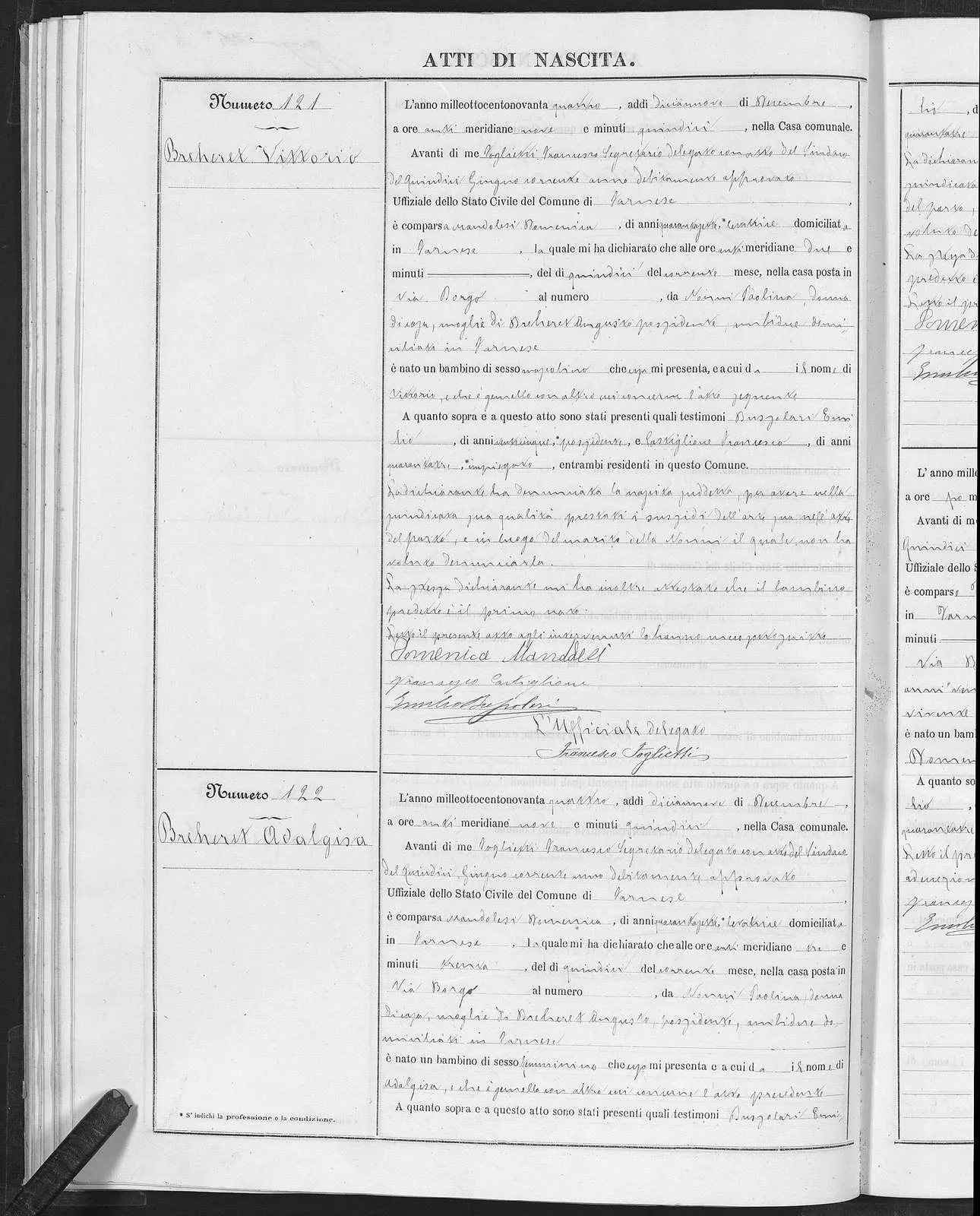
Birth act of Vittorio Breheret, Farnese (Viterbo), 15 December 1894. Civil register published through Portale Antenati. Public domain.
Cerca per nome works when that register is indexed. Many military books are not. Browse the class. The digitization agreement of June 2011 is why FamilySearch often has the same images. Use the FamilySearch Italy guide and the Antenati walkthrough, and open both listings if they disagree.
Antenati is not every military office that stored a file. If the portal and the state archive inventory are both empty, ask the Archivio di Stato where the ruoli for that district are held, and write down the answer.
From the military line back to the civil act
The payoff is a birthplace and a pair of parents you can take into the civil registers. The civil overview is the system those births belong to. A leva entry that cites a birth act number is a finished citation: open that number. An entry that only gives a town and a date still cuts the birth search from a range of years down to a day, which you then confirm in the birth register, because military clerks copied, and copies can slip.
Put the physical description on the worksheet so two candidates stay distinct. Matching height does not prove the conscript is the immigrant. A matching birth date, father, and town does.
If the leva list names a different town from the ship list, test the new town. The birth act is the check.
When the class is not online
Write to the Archivio di Stato that covers the district. Name the man, his parents if you know them, the comune, and the class. Ask whether they hold the lista di leva or the ruolo matricolare. Ask for the cost of a copy and the way they want to be paid. Do not send money until they state the amount and the method. The not-online guide is the same discipline you use for a missing birth.
The comune sometimes kept a local copy of the leva list. It is reasonable to ask the Ufficio di Stato Civile, or the comune office they point you to, whether a local list exists. It is not reasonable to assume it does. The comune letter can carry that question if you change the request from a birth act to a leva extract and you keep it to one man. One class, one name.
A practical search order
- Pick one man. Write his name, a birth year or a range, his parents, and the comune. Leave the regiment blank if you do not know it.
- Confirm the province and the likely military district with a gazetteer and the hometown guide. District boundaries changed. If a search fails, try the neighboring district before you quit.
- On Antenati, open the state archive and find liste di leva for the class. Check ruoli matricolari for the same man if the list gives you a number or if the rolls are browsable for that class.
- Use name search only when the register is indexed. Otherwise browse the town inside the class.
- Copy birthplace, birth date, parents, description, and any act number. Note the archive and the volume title from the listing.
- Open the civil birth at that place and date. Compare parents. The birth reading guide is the checklist for the act.
- If the class is not in the listing, ask the Archivio di Stato what they hold. Record a negative answer with the date.
- Do not repeat the search for the women in the family. Use their birth and marriage acts.
Invented example
The family and the town in this section are invented.
Pietro Lanza is on an invented 1896 birth in Marina di Sopra as a father, but you cannot find his own birth. His son’s act says Pietro was 28 and born in Pontecorvo Marina. You look for the leva class of 1868, and you also open 1867 and 1869, under the district that covers Pontecorvo Marina.
The 1868 list for that invented district includes Pietro Lanza of Pontecorvo Marina, son of Salvatore Lanza and Rosa Vitale, with a birth on 4 February 1868 and a note of birth act 30. The description says he was tall for the page and had a scar on his left hand. You copy all of that. You open Pontecorvo Marina births for 1868, act 30, and you find the same parents. The scar never comes up again. The act number did the work.
A second Pietro Lanza in the same class has a different mother. The parents decide the line. His wife, Caterina Russo, is not in the leva volumes. Her birth stays a civil search.
If class 1868 had been absent, you would have asked the Archivio di Stato to name the volume. The kit has the worksheet and the letter. The archive either has the book or it does not.
Sources
Questions readers actually ask
What is the difference between a lista di leva and a ruolo matricolare?
A lista di leva is the conscription list for a call-up class. A ruolo matricolare is the service roll kept once a man was enrolled. Antenati publishes both from the state archives when those volumes have been digitized. The listing shows which classes are actually there.
Will every man in the town appear?
No. These registers follow men of a call-up class whose names were entered in a book that still exists. A missing name can mean the volume is lost, the class is filed elsewhere, or he was not entered. Check the archive before you explain the absence.
Can a conscription record replace a birth act?
It can supply a birthplace, the parents, and a description when the register survives, which is enough to find the birth act. It is still a military entry. Open the birth register when you have the year and the town.