
U.S. and emigration records
Naturalization records for Italian immigrants
How to find a declaration or petition for an Italian immigrant, and which birth and arrival facts the court file may hold.
Affiliate disclosure.Some links on this page go to genealogy companies. If you buy through them, we may earn a commission, at no extra cost to you. We recommend a site only where it helps this kind of research. Read the full affiliate disclosure.
A naturalization file is often the American document that finally names an Italian town. It is also a document that sometimes names only the country. Both outcomes are normal. This page is about finding the declaration and the petition and reading them for family history. It is not a guide to anyone’s legal status, and it does not promise that a town will be written down.
The National Archives explains the records on its naturalization page. Read that page when you need the official map of federal records. Use this page for the practical sequence: which paper to want, how 1906 changes the search, and what to do when the place of birth is missing.
Two papers, plus a certificate
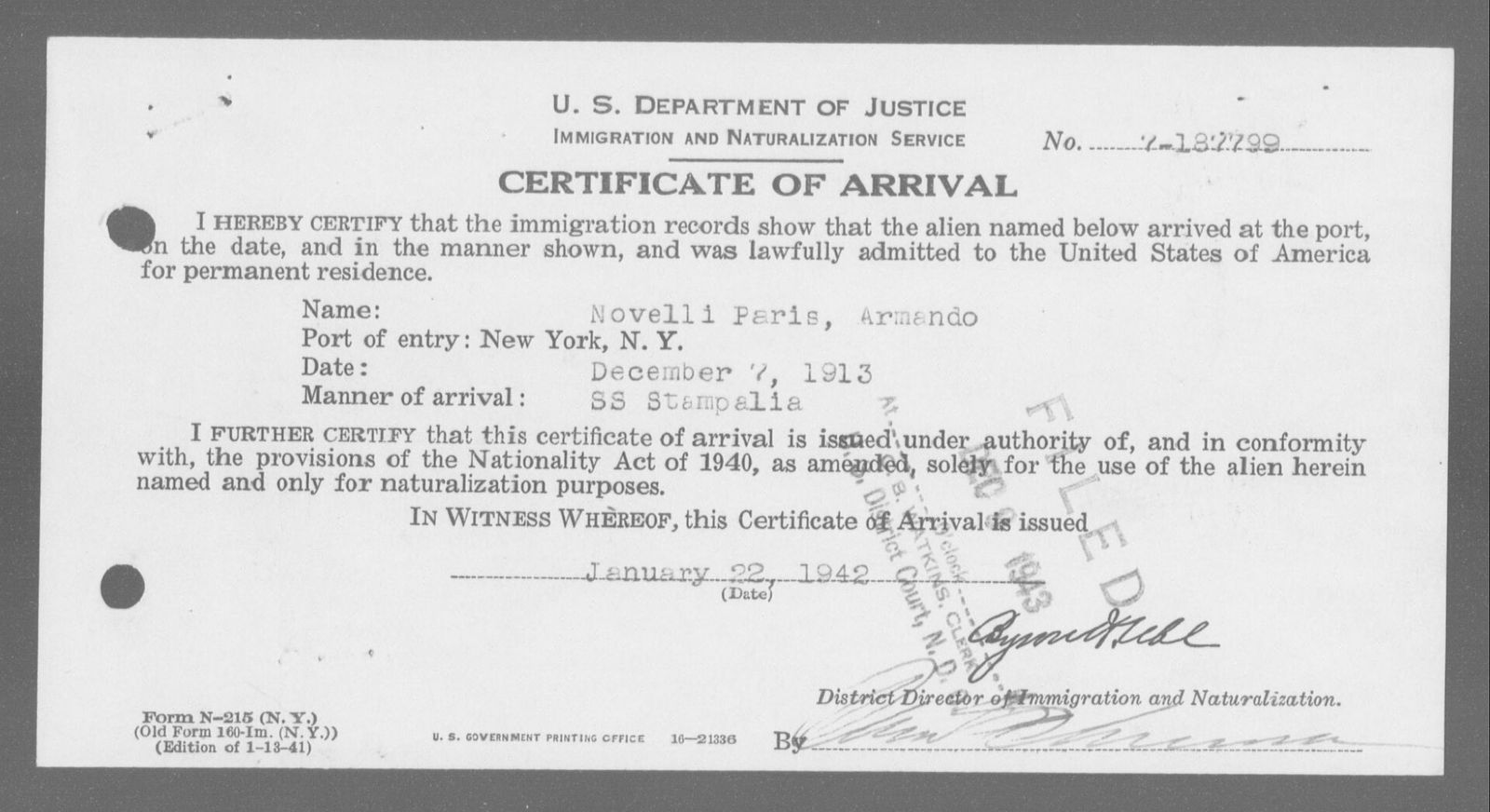
Researchers talk about first papers and final papers. The first paper is the declaration of intention, the statement filed earlier in the process. The final paper is the petition, filed later, closer to the oath. The certificate is the document the person could show afterward. For genealogy, the declaration and the petition are the files to hunt. The certificate is a clue to the court and the date when the other two are not in the family’s folder.
The declaration and the petition were not filed on the same day. Years can separate them. A man might declare in one court and petition in another after he moved. Search both document types. If you find only one, log the absence of the other instead of assuming it said the same thing. Arrival information sometimes sits on the declaration. A spouse and children sometimes sit on the petition. The split depends on the form in use that year.
Write the court, the petition or declaration number, and the filing date on the worksheet. Those three facts are the citation. A name alone will not get you back to the right packet in a city full of people who share it.
What changed in 1906
In 1906, federal administration of the process changed with the Bureau of Immigration and Naturalization, and courts began using more detailed federal forms. The year 1906 is the standard dividing line genealogists use. You do not need a legal history of the bureau to use the line correctly. You need to know that a file from after that change is more likely to ask for a town of birth, a date of birth, a port and date of arrival, and, on many forms, a spouse and children. A file from before that change is more likely to be short, local, and inconsistent.
Pre-1906 naturalizations were handled in courts of record. The paper could be a few lines. One court recorded a town. The next recorded “Italy” or the name of a kingdom or region as the clerk understood it. There is no point pretending those courts all asked the same questions. Read the page you have. If it has no town, it has no town.
After 1906, do not swing to the other extreme. More detailed forms are not a guarantee. A petitioner gave the answers he gave. A clerk wrote Italy when he did not catch the village. A later form revision added or moved questions, so two petitions from 1912 and 1928 are not column-for-column identical. The headings on the form are the authority, just as the headings on a manifest are the authority. The passenger-list guide makes the same point about ships.
Facts you hope to find
Read with a short list of hopes, and check each one off only if the file states it.
You hope for a town or village of birth, and you hope it is distinct from a country. You hope for a date of birth or an age that you can convert carefully into a year. You hope for a port and a date of arrival, which you can take back to a New York list or to another port. You hope for a spouse’s name and, sometimes, the spouse’s birthplace. You hope for children, with ages or birthplaces, because a child born in Italy points you at a marriage and a birth act before the voyage, and a child born in the United States points you at a state record.
Not every file has all of those. Some have none of the place details. Copy blanks as blanks. A researcher who types a town from memory into the empty space of a petition will spend months in the wrong comune and will not know why the registers fail.
Invented example: a 1918 petition for “Angelo Martino” states he was born on 12 March 1888 at “San Giovanni, Italy,” that he arrived at New York on 4 May 1906, and that his wife Giulia was born in Italy. San Giovanni is a common place name. The file has given you a phrase, an arrival, and a wife’s name. It has not given you a unique comune. The hometown guide is the next step, together with the passenger list for May 1906. If the manifest’s last residence is a fuller name, prefer that fuller name as the candidate and keep San Giovanni in the note.
How to find the court
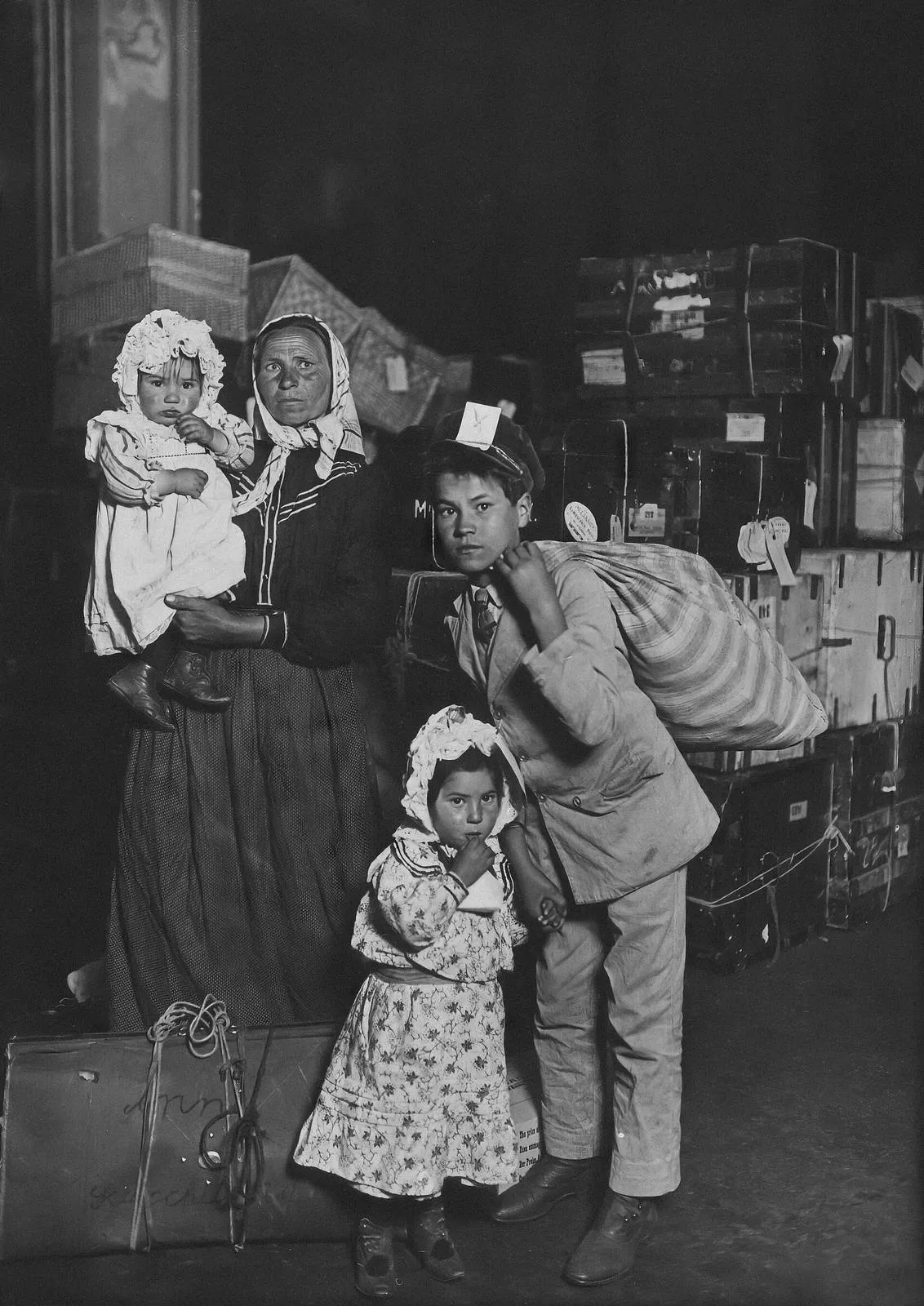
Italian family in the baggage room at Ellis Island, 1905. Photograph by Lewis Hine. The Commons author field spells the surname Hines. Public domain.
Start with the census, if you have it, for the years when the form asked about naturalization. The 1900, 1910, 1920, and 1930 censuses include a naturalization column that was filled with marks such as “Na” for naturalized, “Pa” for first papers, and “Al” for alien. They also asked for a year of immigration. Treat both answers as leads. People reported a year that was approximate. Enumerators ticked the wrong box. A year of immigration plus or minus two years is a search range, not a fact, until a list or a petition confirms it.
The census place of residence tells you which courts to try. Look at federal courts for that district and at the county or city courts that heard these cases. The National Archives page is the guide to records in federal custody. County and municipal courts may still hold older packets, or they may have transferred them. The catalog entry or the court’s own finding aid is the answer for that county. There is no national rule that puts every pre-1906 file in the same building.
If the person moved, search each county where the census puts them. A declaration in one state and a petition in another is a common pattern. Search a wife under her own name, especially after 1922, when married women more often have petitions of their own. Before that, her status often followed her husband’s, and she may have no separate file. That is a search hint. Also try a maiden name and a husband’s last name. A minor child may appear on a parent’s petition and have no file. Do not copy a parent’s town onto a child born after the voyage.
Indexes that help, and their limits
The Italian Genealogical Group has built long-running indexes of many New York naturalization records. If the family lived in New York City or in other New York counties the group has covered, search there early. Do not describe the index as complete. The group’s site is the place to see which courts and years it has actually indexed. A missing name means you try another spelling and another court. It does not mean the person never filed.
Fold3 holds some naturalization sets and a large body of military records. Search it when you suspect service, and search the naturalization collections it carries. It is not every court’s petitions. A failed search describes that site’s holdings, not the court. This page has an affiliate relationship with Fold3. Read the petition image if one is attached.
Ancestry indexes many federal and local collections, unevenly by state. A subscription is convenient when your court is in the catalog. It is not a promise that the court has been digitized. If it has not, use the National Archives page and the local finding aid. Ancestry is an affiliate here. FamilySearch, which is not an affiliate, has images for some courts. Search its catalog by county and the word naturalization, without a collection number copied from a blog.
Reading the place of birth
When a town appears, copy every word, including a province or a region written beside it. “Calabria” is not a comune. “Provincia di Cosenza” is not a village. A saint’s name without a province may match many towns. Take the string to the hometown guide before you browse Antenati.
When the arrival port and date appear, search that arrival. New York dates point you at the Ellis Island or Castle Garden material, depending on the year. Another port means another list. The petition’s date and the manifest’s date should be close. If they are years apart, consider a second voyage, a misremembered date, or the wrong petition. Do not “correct” the petition to match the ship you wish were true.
Spouse and children are identifiers and also the next generation. A wife’s maiden name may be in the file, or it may not. If it is, you have a second Italian family to research once the town is known. If the children are listed with birthplaces in Italy, those birthplaces can confirm the town or reveal that the family moved inside Italy before they sailed. Italian birth records are the browse you open after the town survives that test.
If the file does not exist
Some immigrants never filed. Some filed and the packet was lost or is not indexed. Some died with first papers only. A census mark of “Al” year after year is a hint that a petition may not exist. Search anyway if the family story insists there was a certificate, because stories and census marks both fail. When you have truly found no file, use the other sources on the immigration records page: the passenger list, a newspaper obituary, a death certificate, and a deceased person’s Social Security application.
Write “no declaration found” and “no petition found” as separate log lines, with the courts and years you searched. The beginner guide puts this search beside the passenger list. Either document may name the town. Let the file you actually find set the next step.
Sources
Questions readers actually ask
The petition says only Italy. Did I get the wrong file?
Not necessarily. You may have the right person and a thin file. Before 1906, courts were not using one federal form, and many files name a country without a town. After 1906 the forms asked for more biographical detail, and a town is more often present, but a clerk could still write Italy, or the petitioner could give a province. Copy the place as written. Then compare the age, the spouse, and the arrival date with the passenger list and the census. If those agree, keep the file and look elsewhere for the town: a child's birth record, an obituary, or a Social Security application. If the age and the spouse disagree, you may have a different person with the same name. Invented example: two petitions for Giuseppe Greco in the same city, one with a wife named Maria and one with a wife named Angela, are two men until a record ties your family to one of them.
Where do I look for a New York naturalization?
New York naturalizations were filed in more than one court: federal courts and a variety of state and local courts, depending on the year and the borough or county. There is no single drawer. The Italian Genealogical Group has long-running indexes to many New York naturalization records. Use them. Do not treat them as complete. A missing name can mean the court was never indexed, the spelling is off, or the person filed in another county after moving. The National Archives naturalization page explains federal court records and how naturalization research is organized. Search a declaration and a petition separately. They were often filed years apart, and the town can be on one and not the other. If the person lived in New Jersey or Connecticut while working in New York, search those courts too.
What if I find the certificate and almost nothing else?
The certificate the person kept at home is often a short proof that the court granted the petition. The biographical detail, when it exists, is more often on the declaration of intention and on the petition left with the court. A certificate number, a court name, and a date are still worth a great deal, because they tell you which court to ask or which index to open. Look up that court on the National Archives page if it was a federal court, and in local court indexes if it was not. Fold3 and Ancestry hold some naturalization sets and can be a faster index if you already have access. They do not hold every court. When you only have a certificate, search those sites for the certificate number and the name, then go back to the court if the petition is not online.