
Getting started
Italian genealogy records online free
Which Italian genealogy records you can use free, including Antenati, FamilySearch locks, and catalog descriptions.
A large part of Italian genealogy can be done without a subscription. The town still has to be known, the year still has to have been filmed, and a free website can still lock an image to a library. This page lists what is actually free, what the catch is on each door, and where a subscription is optional rather than required. It does not claim that every ancestor is online. The website comparison includes the paid sites. The beginner guide is the order of work. Use this page when you want to know whether to open your wallet.
Antenati
The Portale Antenati is free. It publishes digital copies of civil registers and related series held by the state archives. You reach the archives through Esplora gli Archivi. The portal’s research guide is also free, and it is the instruction manual you should read instead of a paid course on “secret Italian databases.” There is no secret database behind it. There is a catalog of archives, comunes, registers and years.
The walkthrough on this site shows the clicks. Browse when name search fails. A failed name search usually means the book is not indexed, not that the person was not born. Log the archive and the year. If you need the name of the archive for a letter, take it from Esplora or from archivi.cultura.gov.it. Do not pay a third party for an address the Ministry already posts.
FamilySearch’s overview of important Italian research resources gives the general ranges of the books you will meet: Kingdom of Naples style from 1809, Bourbon continuation from 1816, Sicily from 1820, unified civil registration generally from 1866. Those ranges are free to know. They are not a substitute for the listing of your comune. The region guides apply them to Sicily, Calabria, Campania, Abruzzo and Basilicata.
FamilySearch, with the access caveat
The Italy Genealogy wiki is free. A FamilySearch account is free. The catalog guide explains how to find a comune’s civil registration in that catalog. This site does not earn a commission from FamilySearch. Linking there is not a paid recommendation.
The caveat is the lock. Some images open at home. Some are restricted to a FamilySearch Center or an affiliate library. You have to read the banner on the set you care about, because the banner is not the same for every province or every year. Planning a trip to a center is still a free method. Paying Ancestry because a FamilySearch image is locked is a choice, not an obligation, and only a useful choice when Ancestry actually holds a viewable copy of that year. Often the underlying film is the same project. Sometimes Antenati already shows it from your kitchen table.
Unindexed image groups are free too, and they require the same patience as Antenati: comune, year, page. The global search box will not reliably surface them. Free does not mean instant.
The Ellis Island Foundation search
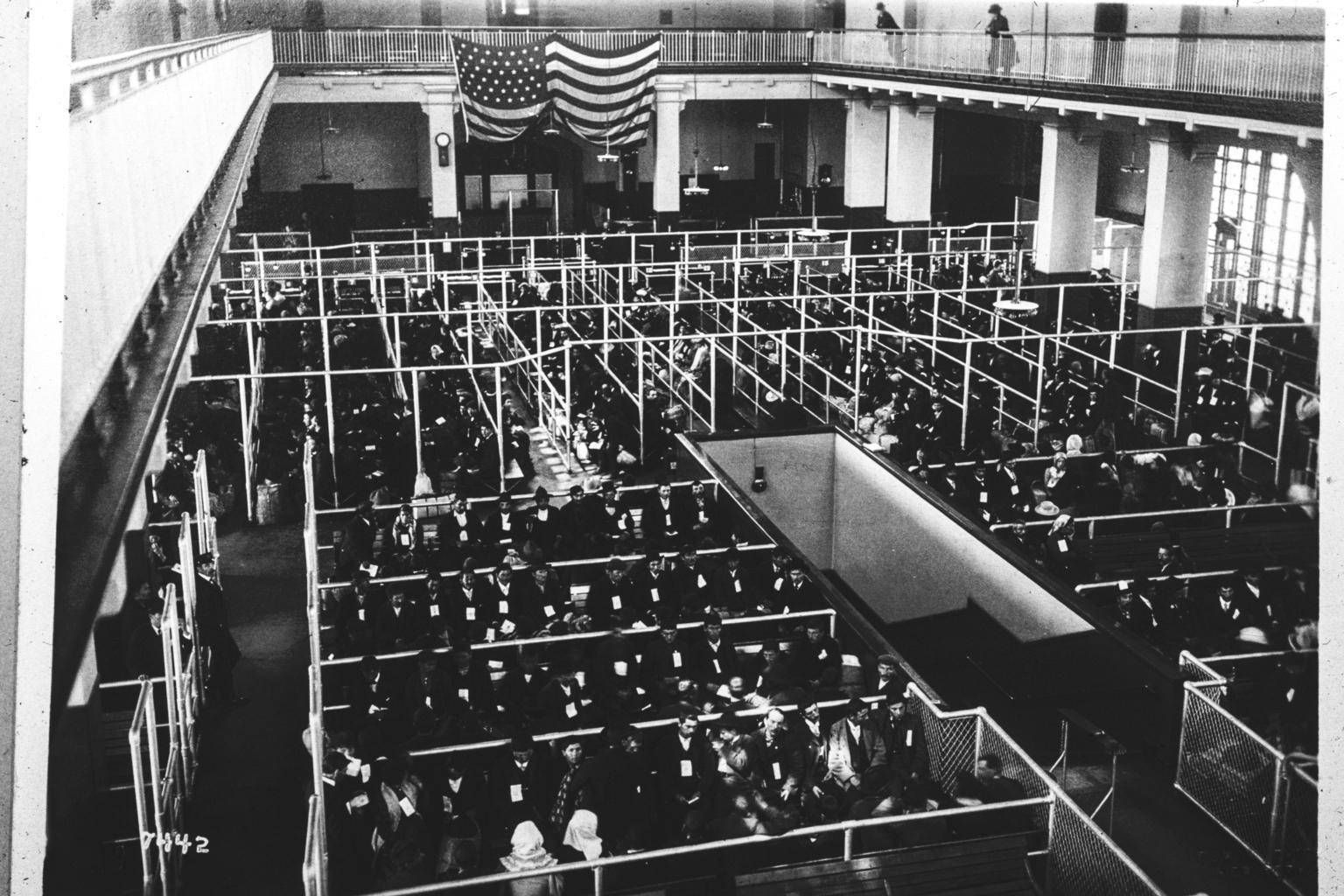
The Statue of Liberty—Ellis Island Foundation’s Arrival Records Collection is a free search of passenger manifests for Ellis Island and the Port of New York, and the Foundation describes a wider set of arrival records as well. Ellis Island was the New York station from 1892 to 1954. Castle Garden was the earlier New York station, from 1855 to 1890. The passenger-list guide and the Castle Garden guide explain how to read what you find. The free search is not a complete list of every Italian who crossed the Atlantic. Other ports and other decades exist. Free access to this search does not require Ancestry.
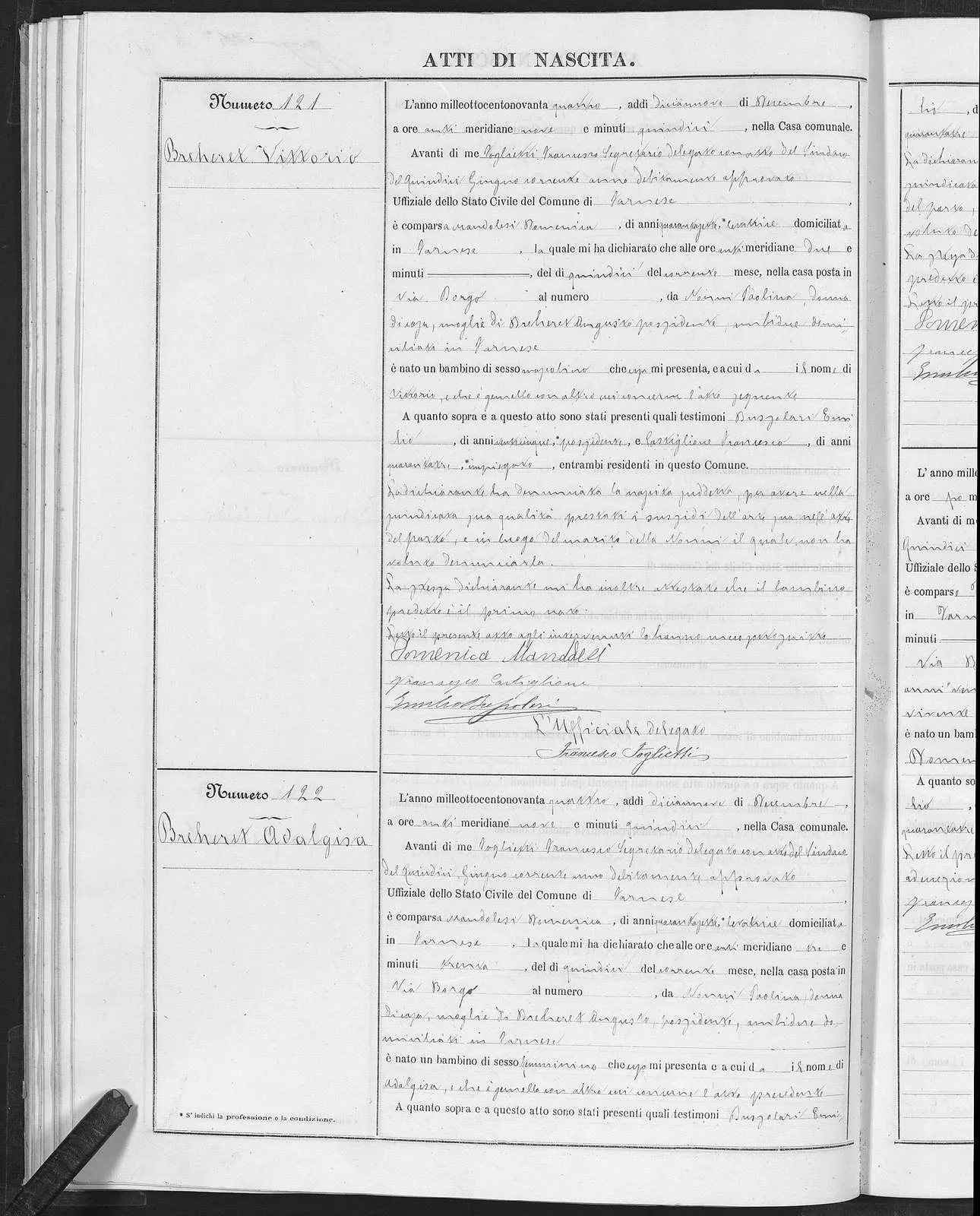
Birth act of Vittorio Breheret, Farnese (Viterbo), 15 December 1894. Civil register published through Portale Antenati. Public domain.
Use the Foundation search to harvest a place string, then take the string to the hometown guide. A last residence is a candidate. A port is not a birthplace. Copy the spelling. Do not pay for a rewritten version of a list you can read yourself.
Chronicling America
Chronicling America is the Library of Congress collection of historic American newspapers, and it is free. Obituaries and local notices sometimes name an Italian town, a ship, or a brother still “in the old country.” Coverage is whatever the collection holds for that paper and that year. A miss is not proof that no obituary was printed. It is proof that this free collection did not retrieve one. Subscription newspaper sites cover other papers. They are optional. Try the free collection with the American city and the name before you buy a newspaper subscription. Put any place string you find through the gazetteer. Newspapers mishear towns, and they still beat a blank.
National Archives catalog descriptions
The National Archives Catalog lets you read descriptions of series, including passenger-arrival series, without a subscription. The National Archives’ immigration research page explains the shape of those records: which ports, which kinds of lists, how the New York stations fit. Descriptions are not the same thing as a digitized image of your ancestor’s line. A catalog entry can tell you that a series exists, which years it covers, and which identifying number a reference uses. It may link to images, and it may not. When it does not, you have still learned where the list lives. Ordering a copy, if images are not online, follows the agency’s instructions. Any charge for reproduction is the agency’s charge. This page does not quote one.
Catalog descriptions are the free answer to “does this port even have lists for that decade?” They are a poor answer to “what town did he say?” unless the image is attached or you obtain it. Read the description before you assume a subscription is the only door. The Foundation search and FamilySearch may already hold the image the catalog describes.
Subscriptions are optional
Ancestry, MyHeritage and Findmypast sell subscriptions. Ancestry and MyHeritage also sell DNA tests. None of those purchases is required to read Antenati, to open a free FamilySearch image, to search the Foundation’s arrival records, to search Chronicling America, or to read a NARA catalog description. Buy a subscription when you can name the hole: a locked image that the company shows, an index you have checked is not free elsewhere, a cousin’s tree, a British record on Findmypast. Findmypast is stronger for United Kingdom and Irish records than for Italian civil registers, which the website comparison explains. Do not buy it to replace Antenati.
DNA tests are optional in the same way. They do not name a comune. The test comparison is there if a match list is the hole. A southern or northern label is not a free record and not a paid record. It is a model. It does not belong in the birthplace field.
Letters and the kit are not these websites
When the free images stop, the next record may be a letter to the comune or the parish about one event. That letter is not a website, and the office sets the fee. Ask what they charge. The worksheets include free forms for keeping the search straight. The kit is a paid file of Italian letter templates, a glossary and logs, for people who want them assembled. It does not contain the civil registers, and it does not make a free portal less free. Use the portals first. Pay the office only for a copy they have agreed to make. Pay for the kit only if you want the templates in one download.
Invented example. A researcher is told that Italian records are “all behind a paywall” and almost buys a subscription before looking up the town. A free Foundation search shows last residence Bisignano and port Napoli. A gazetteer places Bisignano in the province of Cosenza. Antenati’s Archivio di Stato di Cosenza listing shows the birth year, free. FamilySearch shows the same year with a library lock. The lock does not matter, because Antenati is open. Chronicling America has no obituary. The NARA catalog describes New York passenger lists and does not ask for a fee to read the description. No subscription was required for the birth. A subscription might still be useful later for an American census. It was not the door to Cosenza.
Free, in this craft, means those doors. It does not mean every book, every parish, or every port. It does mean you can get a long way, town in hand, before anyone sends you a bill.
Sources
Questions readers actually ask
Is Antenati really free?
Yes. The Portale Antenati is the Ministry of Culture's portal for civil registers and related material from the state archives, and you do not buy a subscription to browse it. The research guide on the portal explains the tools. Name search finds a person when the register has been indexed. Many volumes are browsed by archive, comune and year through Esplora gli Archivi. Free does not mean complete. If your year is not in the listing, the portal has not put that book on the public shelf. The book may still exist at the comune, or on FamilySearch, or in a gap nobody has filled. Free also does not mean "search the whole country by last name." You still need the town. The hometown guide is how you get it without paying for a database.
Why does FamilySearch ask me to visit a library if the account is free?
Because free and viewable-at-home are not the same condition. FamilySearch account creation does not require a fee. Some images of Italian civil registration are open in a browser at home. Some are marked for a FamilySearch Center or an affiliate library, under the terms attached to that digitization. The mark is on the image, and a home login will not remove it. That is the access caveat. It is not a hint that the record is reserved for subscribers of another company, and it is not a hint that you have the wrong town. The FamilySearch Italy guide on this site explains the catalog path. If Antenati shows the same year, use Antenati from home. If neither site shows it at home, a center visit is a free way to see a locked FamilySearch film. A subscription is optional, not required, for that film.
What will I still have to pay for?
A subscription, if you choose one, at Ancestry, MyHeritage, Findmypast, or a newspaper site beyond Chronicling America. Those purchases are optional. They can add an index, a tree, a DNA match list, or a paper the Library of Congress has not digitized. They do not replace Antenati. A letter to a comune or a parish is also outside the free websites. The office sets the charge for a copy, and this page does not quote one. Ask before you send money. The National Archives Catalog lets you read descriptions of passenger-list series without paying. Ordering a reproduction, if you need one, follows that agency's own instructions and its own charges. The kit on this site is a paid download of letter templates and logs, not a record. The worksheets are free.