
Regions
Calabria genealogy records
How to search Calabria civil registers, including towns later placed in Crotone or Vibo Valentia and the Reggio mix-up.
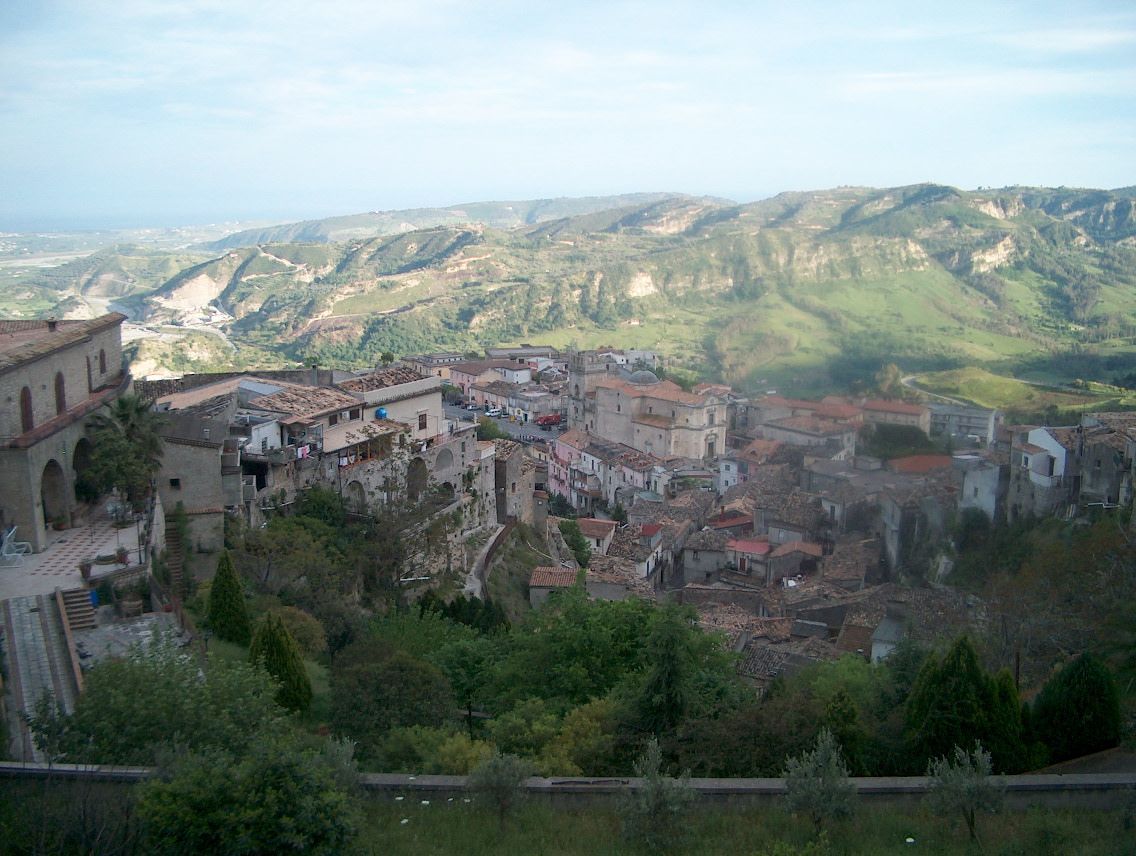
Calabria is a region of provinces, and the provinces are where the catalogs start. The current provinces are Catanzaro, Cosenza, Crotone, Reggio Calabria and Vibo Valentia. The state archives that correspond to them are the Archivio di Stato di Catanzaro, Cosenza, Reggio Calabria, Crotone and Vibo Valentia. You reach those archives from Esplora gli Archivi on the Portale Antenati and from archivi.cultura.gov.it. This page names the archives. It does not invent a website hostname for each one.
The region sits on the toe of the mainland. It is not part of Sicily, even when a family story says “the south” and a ship left from a Sicilian port or from Naples. Naples the port is not a Calabrian birthplace either. That problem is written out on the Campania page. Here, the distinctive problems are a provincial boundary that moved, and a city name that also exists in the north.
If the town is missing, try Catanzaro
Crotone and Vibo Valentia are newer provinces formed from territory that had been part of Catanzaro. If a town is missing from the catalog under Crotone or under Vibo Valentia, search Catanzaro. Do not wait for a year of the split. This page does not state one. Catalogs and films were arranged under the province used when the records were gathered, and a later provincial name does not rewrite the older heading.
Vibo Valentia itself can appear under an older town name, Monteleone. If one form is empty, try the other, and still try Catanzaro. Crotone is both a city and a province. The city has registers. The province has many other comunes. Choosing the archive of Crotone and then browsing only the city is how inland towns get declared “not online.”
Cosenza has the same double identity. The city of Cosenza is one comune. The province of Cosenza contains many more. A list that says only “Cosenza” may mean either. The hometown guide shows how to test that string against a second document and a gazetteer. The Italy Gazetteers wiki is the pointer for the gazetteer itself. You want a source that says “this is a comune in the province of Cosenza,” not a modern driving map that only shows a dot.
Reggio has to be pinned down
Reggio Calabria is a city and a province in this region. Reggio Emilia is not. English-language records often drop the second word. Before you open an archive, collect any other place word attached to the same person: a frazione, a parent’s town, the word Calabria, the word Emilia, a province, a neighboring town. One extra word is enough to stop a wasted evening.
Inside the province of Reggio Calabria, towns that sit near one another are still different comunes. A last residence in one town and a birth in the next town are two searches. Do not merge them because they share a valley. The FamilySearch wiki for Calabria is where collection titles are listed by province. Use it to see whether a state-archive series and a court series are both described. Then open the images, and read the access note. FamilySearch account creation is free. Some images are viewable at home and some are marked for a FamilySearch Center or an affiliate library. The note on the image is the rule. The FamilySearch guide on this site walks through browsing when the global search box finds nothing.
Which register the year falls in
The FamilySearch overview of important Italian research resources gives the general ranges for the southern mainland. Napoleonic-style civil registration in the Kingdom of Naples dates from 1809. The Bourbons continued that style of registration from 1816. Unified Italian civil registration begins generally in 1866. Calabria belongs to that mainland description. The Sicilian date in the same overview, 1820, is for the island, not for this region. Quoting the island’s date in a Calabrian search will make you skip a generation of books that may exist.
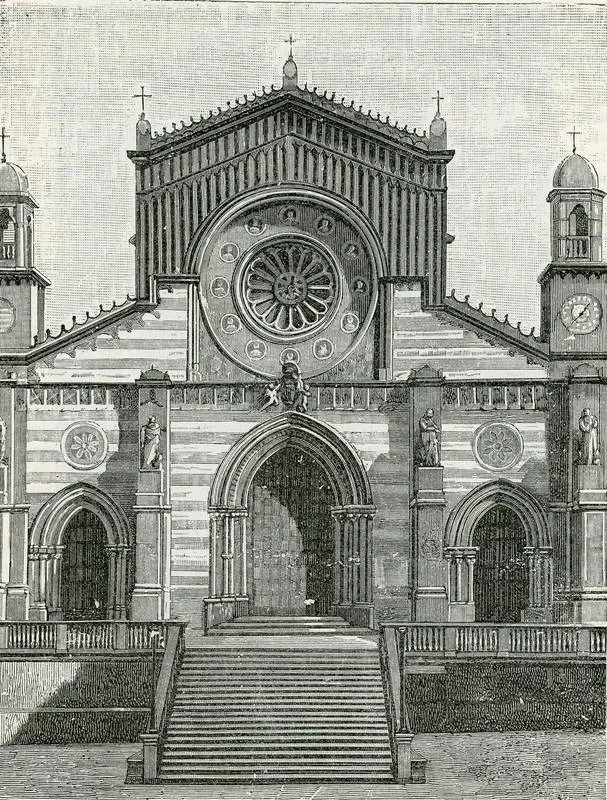
Wood engraving of Cosenza cathedral, from Gustavo Strafforello, La patria, 1900. The engraver is not named. Public domain.
General ranges are not a table of contents. Antenati’s own research guide expects you to look at what the archive holds for that place. Name search is for indexed registers. Browsing is for everything else, which is most of a first visit. Open the year. If there is a ten-year index, an indice decennale, use it to find an act number, then read the act in the annual book. Copy the parents as written. Italian women kept their own family names in the civil acts. The mother’s surname is not a married name you should “correct.”
Occupations in the act are evidence about that household. They are not the same thing as an occupational surname. The word Ferraro can mean a worker in iron when it is a vocabulary word, and it can be a last name that no longer described anyone’s job. The surname origins page keeps those ideas apart. A Calabrian birth act that calls a father a bracciale or a contadino is talking about the man in the room, not about the etymology of his name. The word list will get you through the formula.
When the film stops
If the listing ends before your year, or the book is too damaged to read, the duplicate at the archive is not your only copy in principle. The comune may still hold the series. Write for one event. Ask whether they have the act and what they charge. Do not send cash, and do not ask for every person of the last name. Track the letter on the worksheet. The kit packages the Italian letter, the glossary and the logs for people who want them in one folder. It does not change which archive you should have opened.
Parish registers cover baptisms, marriages and burials, including years before the civil series and years the civil film skips. There is no complete online set of Calabrian parish books. Search the FamilySearch catalog for the town and the diocese before you assume a letter is the first step. A letter to the wrong parish, in the right province, still fails.
Last names and the toe of the map
Southern last-name lists treat Calabria as one pot with Sicily and Campania. The archives do not. A spelling that clusters in the province of Cosenza on a telephone-directory map is a reason to look harder at Cosenza-area documents you already have. It is not a reason to assign a blank birthplace to the darkest comune on the map. The distribution guide explains those maps. The southern surnames page explains why “southern” is not a filing system. None of those tools is a census from the century people left.
Invented example
Invented example. A manifest prints the birthplace as “Reggio” and the port as Napoli. A child’s birth certificate in Ohio, in the father’s line, says the father was born in “Cittanova, Italy.” Cittanova is a comune in the province of Reggio Calabria. The port of Napoli only explains the ship, which is the lesson on the Campania page. The word Reggio, standing alone, could have sent you to Reggio Emilia. The second document prevents that. You open the Archivio di Stato di Reggio Calabria, then Cittanova, then the year. If Cittanova is missing under a newer arrangement, you have not met the Catanzaro problem: Cittanova is not in Crotone or Vibo Valentia. You would use the Catanzaro fallback for a town that the gazetteer places in one of those newer provinces and that the newer archive does not list.
Suppose, as a second invented detail, the only place word you had was “Monteleone.” You would test it as Vibo Valentia, search the Archivio di Stato di Vibo Valentia, and also search Catanzaro, and you would look for a second record before you wrote to a comune. One old name can sit on more than one Italian town. The gazetteer is the test. The region essay is not.
What to write in the log
Province tested, archive opened, comune, series, years seen, years missing. Note the spelling you refused, especially Reggio Emilia if you considered it and a second source ruled it out. Note whether FamilySearch showed a library lock. That lock is part of the result. It means you have not finished the images, not that the ancestor is absent.
When the act is found, stay with it long enough to copy witnesses and ages. A witness from a neighboring comune is sometimes the clue to the spouse’s family. Then stop and file the image. The beginner guide is the wider sequence, and the regions hub explains why the next region over is a different archive even when the dialect and the last names feel continuous. Calabria’s continuity with the towns across a ridge is real in family life. It is irrelevant to the catalog until a document names the other town.
Sources
Questions readers actually ask
Which state archives cover Calabria?
Name the archive that matches the province you have confirmed: the Archivio di Stato di Catanzaro, Cosenza, Reggio Calabria, Crotone or Vibo Valentia. Open them from Antenati's Esplora gli Archivi and from archivi.cultura.gov.it. Do not rely on a guessed hostname. Crotone and Vibo Valentia are newer provinces formed from territory that had been part of Catanzaro. If a town is missing from the Crotone or Vibo Valentia listing, search Catanzaro in the catalog as well. This page does not give a year for that provincial change. The catalog's silence is the signal to try the older heading, not a date you need to memorize.
Is Reggio the same as Reggio Calabria?
Only if a second detail says so. Reggio Calabria is a city and a province in this region. Reggio Emilia, also called Reggio nell'Emilia, is a city in the north. Passenger lists and death certificates often stop at the single word Reggio. Compare another record for the same person before you choose an archive. A parent's birthplace, a sibling's last residence, or a town name beside the word Reggio will usually decide. If you open the wrong Reggio, you can browse for a long time and conclude that the family was missed by the civil series. They were not missed. They were in the other catalog.
When do Calabrian civil records begin?
FamilySearch's overview of Italian research resources dates Napoleonic-style civil registration in the Kingdom of Naples from 1809, with a Bourbon continuation from 1816, and dates unified Italian civil registration generally from 1866. Calabria was part of that southern mainland pattern. Sicily, across the strait, is the place that overview treats differently, with civil registration of that style from 1820. Use the ranges only as ranges. The Antenati listing for the comune tells you which years of births, marriages and deaths are on the digital shelf. A missing year is a reason to check FamilySearch and then the comune, not a reason to switch regions.