
Surnames
Italian surnames and meanings
How to use an Italian surname as a clue: word meanings, telephone-directory maps, and the records those clues cannot replace.
Affiliate disclosure.Some links on this page go to genealogy companies. If you buy through them, we may earn a commission, at no extra cost to you. We recommend a site only where it helps this kind of research. Read the full affiliate disclosure.
A last name is a finding aid you do not have yet. It is the label on the person. It is not the shelf where Italy filed the birth. Italian civil registers are arranged by comune, province and year. A name search succeeds only where someone has indexed the book. Everything else on this part of the site is about using the last name without fooling yourself.
Four articles do the actual work. Italian surname origins explains the patterns in the words, and why a crest is not evidence. Italian surname distribution maps explains the telephone-directory tools and the number each site itself publishes. Sicilian surnames refuses the habit of sorting spellings into ancient ethnic bins. Southern Italian family names keeps “the south” from becoming a fake town. Read the one that matches the question you actually have. Then go back to a record that names a place.
What a last name can honestly do
It can help you recognize the same family when clerks respell it. Di, De and D’ get dropped on American forms. A final vowel gets cut. A double consonant becomes a single one. If you write every variant beside the document that used it, you will search the index for the spelling the clerk wrote, not the spelling the family uses now. The Italian word list helps with the words around the name. It does not translate a last name into a biography.
It can tell you, sometimes, where that spelling was common in late-twentieth-century telephone listings. That is a clue about where to hunt if you already suspect a region and you are choosing which province to try first. It is a bad clue if it is your only clue. The map article is strict about this because the sites are easy to over-read. Gens describes a database built from private telephone listings and, in its instructions, a file representing over 20 million private lines. Cognomix says it maps about 180,000 last names corresponding to 20,985,000 families, and that the figures are families, not individuals. Mappa dei Cognomi says it was inspired by Gens and used telephone directories from the 1990s, so it is not a current population map. None of the three is a census from the century of mass emigration. A dark patch is a place to look, not proof of one ancestor’s town.
It can also stop a pointless search. If every map shows the spelling scattered across the whole country, you have learned that the name will not narrow a province. That is useful. You stop browsing Italy by last name and you return to passenger lists, petitions and obituaries. The hometown guide assumes you will do that work.
What people want the surname to do
They want it to mean a village. They want it to mean a trade the ancestor practiced. They want it to mean a noble house, preferably with a printable shield. Those wants are understandable, and they are how surname websites get built. They are not how the archives were built.
The origins article walks through the patterns without assigning them to a reader’s family. A patronymic pattern, often visible in Di, De or D’, is a grammatical habit: “of” someone. A toponymic pattern echoes a place or a landscape word. An occupational pattern is the meaning of a word such as Ferraro or Pastore, the words for a worker in iron and for a shepherd. A nickname pattern tags a trait. Knowing which pattern the word resembles does not tell you that your ancestor was that worker, lived in that place, or looked like that trait. The pattern is about the word. The life is about the acts.
Heraldry is the sharpest version of the same mistake. Arms were granted to particular people and institutions. A shop that matches a spelling to a crest is matching letters to a picture. It has not consulted a grant, and it has not opened a register. If the crest arrives with a story about knights, treat the story as advertising. The origins page says the same thing at more length because the search is common.
Sicily and the south are not family-name systems
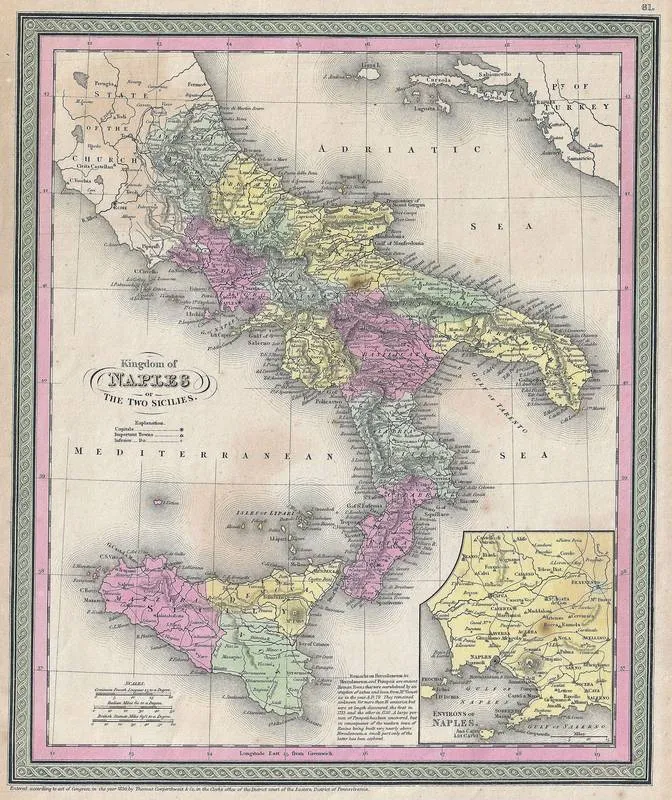
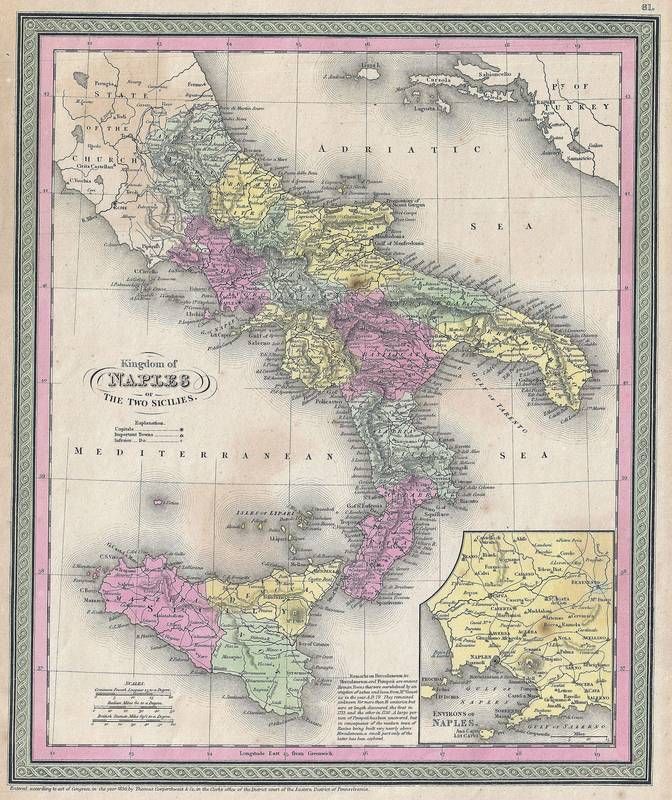
Map of southern Italy and Sicily by S. A. Mitchell, plate 61 in the 1853 New Universal Atlas. Public domain.
So many emigrant lists point at the south that “southern Italian surnames” has become a search of its own. The south is a set of regions with different archives. Sicily’s civil series starts on a different general range from the Kingdom of Naples mainland, which the regions hub explains. A spelling that is frequent in Sicily can also appear in Calabria, and a map is how you see that, not a label that says the name “is Sicilian.”
The Sicilian article is deliberately negative about ethnicity. The island’s history includes Greek, Arabic, Norman and Spanish periods, and some surname dictionaries discuss those layers. A discussion in a dictionary is not an identification of your family. This site does not publish a list of spellings sorted into those periods. A spelling does not prove an origin. If someone offers you such a list, ask which register they used. If the answer is “the name looks like it,” you are done with that page.
The southern article connects the name to the research problem American documents actually create. Naples the port is not a birthplace. A family called “from the south” still needs a comune in Campania, Calabria, Abruzzo, Basilicata, Sicily or a region this site has not yet written up. The last name does not choose among those for you.
Where Ancestry and MyHeritage fit, and where they do not
Both companies let you search indexed names and, for many provinces, browse Italian civil images that often come from the same filming projects as the free portals. Both also sell autosomal DNA tests that produce cousin matches. A match with a tree can suggest a town. The suggestion is a lead. You still open the year in Antenati, which is free, or in the FamilySearch catalog. A subscription does not contain a town that nobody wrote down.
Use a paid name index when you have a province and you are tired of browsing, or when relatives in another country have already attached records. Do not use it as a last-name encyclopedia. The website comparison and the Ancestry and MyHeritage comparison separate the record subscription from the test. The DNA overview is for the moment when the paper trail is stuck between two cousins’ trees, not for the moment when you want a meaning.
A practical way through
Pick one immigrant. Write the last name as each document spells it. If a document names a town, stop working on the surname and identify the comune. If no document names a town, gather another document. A sibling’s passenger list, a marriage record in the country of arrival, an obituary: those are the ordinary repairs. The Ellis Island and New York passenger lists are one place American researchers start. They are not the only port, and they are not a surname dictionary.
If you still have no place, look the spelling up on a distribution map and write down the provinces where it clusters. Treat that list as a set of places you will test only when a new document gives you a word you can check against them. Do not write to every comune in the darkest province. Clerks cannot search “everyone named this.”
Invented example. The passenger list says the last name is De Luca and the birthplace is blank. A crest website explains that the name is noble and Neapolitan. A telephone map shows the spelling in many provinces, with several southern clusters and a presence in the north. Nothing in that set of facts identifies a comune. De Luca has a patronymic shape, which is a statement about the words. The crest is a product. The map says the spelling is too widespread to pick a province, which is the one useful result. The next search belongs in another American record, not in a random year of the Archivio di Stato di Napoli.
When you do have a town, the last name becomes ordinary again. You use it to find the right line in an index, you watch for the mother’s surname, and you copy both exactly. The beginner guide is that sequence. The articles linked from this hub are the reasons not to skip it.
Sources
Questions readers actually ask
Can an Italian last name tell me the town my ancestor came from?
Not by itself. Some spellings are uncommon enough that a telephone-directory map shows a cluster in one province, and that cluster is a sensible place to look once a document has already pointed south, or north, or at a region. The cluster is not the town. Gens, Cognomix and Mappa dei Cognomi describe themselves from phone listings, not from a census of the century when people emigrated. Two families can share a spelling and have no common paper trail. The hometown guide is the page that turns a place string from a passenger list or a petition into a comune. Start there if you have any place at all. Start with American records if you do not.
Are last-name meanings and coats of arms useful?
A meaning is useful when it keeps you from over-reading the word. Patronymic particles, place names, occupational words and nicknames are patterns in the language. They describe how many Italian surnames were formed. They do not assign your family to a trade, a town or a title. A coat of arms sold for a spelling is a picture attached to letters. Heraldry belonged to particular grants, not to every person who shares a spelling. The origins article explains those limits. If a website offers a noble story and a crest in the same paragraph as a checkout button, you are looking at a product, not at a register.
Should I take a DNA test to identify a last name's origin?
Only if the question is a match list or a direct line, not a dictionary definition. An autosomal test can show cousin matches, and a match's tree might name a town you can test in the registers. A Y-DNA test is relevant to a last name only along an unbroken line of fathers and sons, and it says nothing about the other ancestors. Neither result names a comune, and a regional label does not prove a province. Read the DNA comparison before you buy, and keep the paper search moving. Antenati does not require a test.