
Reading the records
Italian genealogy word list
Italian words you meet in civil birth, marriage, and death acts: family terms, months, numbers written as words, and common occupations.
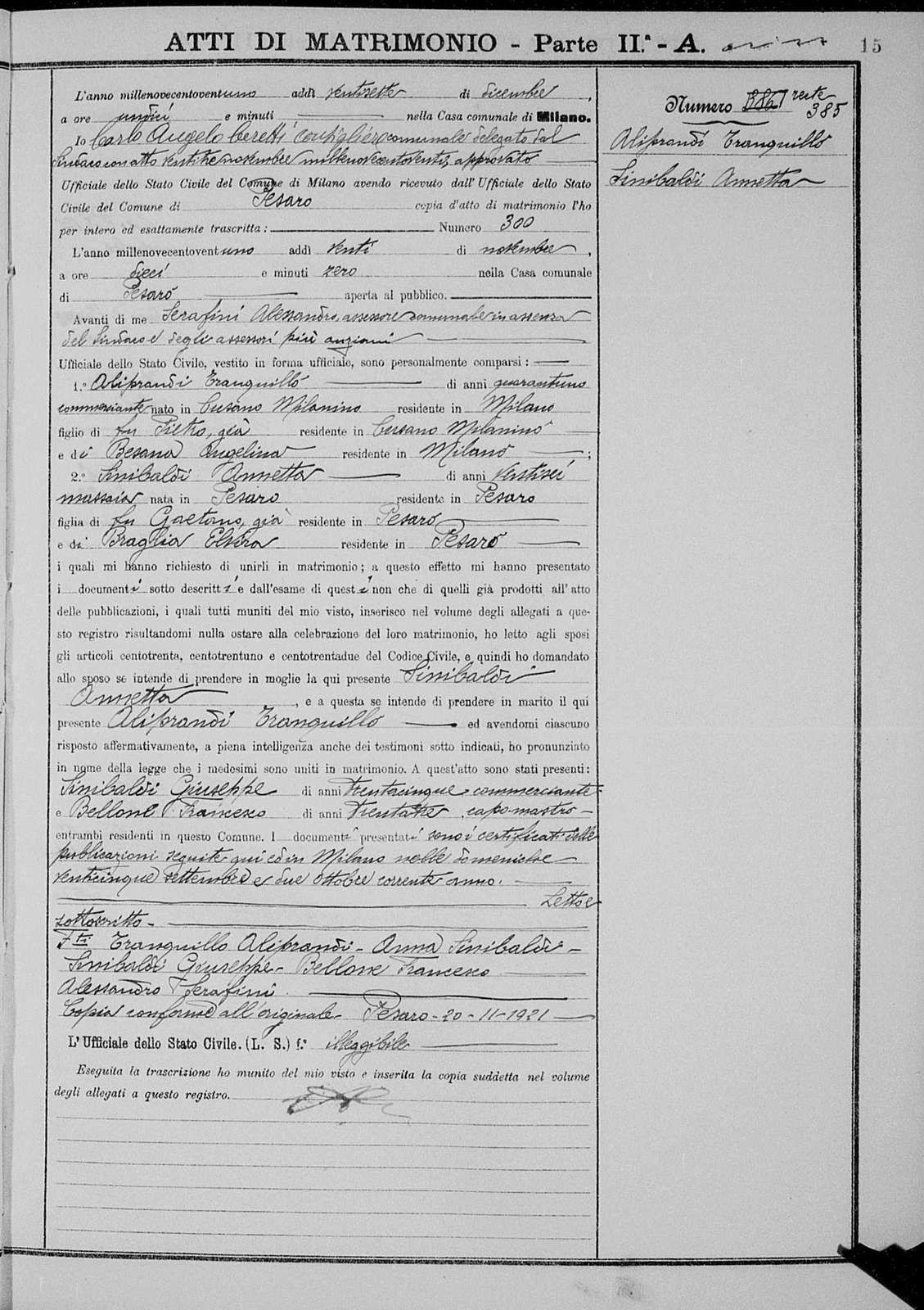
This is a working list for Italian civil registers: the words that mark a relationship, a date, a number, or a job. It is the list to keep beside an image from the Antenati portal or the FamilySearch catalog. It is not a dialect dictionary, and it is not a description of any one family. Occupations in the table are examples of words that appear often. Seeing contadino in the list does not mean your ancestor was a farmer. Seeing it in an act, on his line, means the clerk called him that on that day.
Civil acts are in Italian. Parish books are where Latin mostly appears. When the page says baptizatus or obiit, switch to the Latin word list and the church records overview.
How to use the list while the image is open
Copy the Italian first, on the worksheet, and translate in a second column. Look up only the word that is blocking you. The formulas repeat, so the same twenty words carry most birth acts. The reading pages show those formulas in order: births, marriages, deaths.
A few habits prevent the usual mistakes:
- Fu before a name means that person was already dead. Antonio fu Giuseppe is Antonio, son of the late Giuseppe. It is a lead to a death act, not a second given name.
- Nipote is ambiguous. It can be a grandchild or a nephew or a niece. Keep the Italian in the note until the act makes the generation clear.
- A woman’s last name is her own. Moglie tells you she is a wife. It does not rename her.
- Dote means dowry. It shows up in some marriage files and is missing from many others. If the word is not on your page, do not add it from this list.
- Clerks abbreviated. If a word is a stub, expand it only when the formula makes the expansion obvious, and mark the expansion in brackets. The year on the title page anchors a scribbled mille ottocento.
Invented example. On a birth act the phrase nata ieri means the girl was born yesterday, relative to the declaration date at the top of the page. If the top says 7 March, ieri is 6 March. The people in any sample on this site are invented. The word ieri is the part to learn.
Months and numbers are below because almost every act uses them, and because a year written as words is the line readers skip. Mille ottocento ottanta is 1880. Mille ottocento ottantaquattro is 1884. Mille novecento begins the 1900s. Units and tens combine. Ventotto is 28. Trenta is 30. Clerks shortened the year-words. When the middle is illegible, write the title-page year and the unreadable stroke, and say which is which.
The list
| Italian | English | Where it helps |
|---|---|---|
| padre | father | parents on any act |
| madre | mother | parents; her last name stays |
| figlio | son | relationship |
| figlia | daughter | relationship |
| figli | children | plural |
| genitori | parents | both parents |
| marito | husband | death and marriage |
| moglie | wife | her own family name remains |
| coniuge | spouse | either partner |
| sposo | groom | marriage act |
| sposa | bride | marriage act |
| sposi | the couple | marriage act |
| vedovo | widower | a previous spouse may be named |
| vedova | widow | a previous spouse may be named |
| celibe | unmarried man | marriage act |
| nubile | unmarried woman | marriage act |
| nonno | grandfather | when the act says so |
| nonna | grandmother | when the act says so |
| zio | uncle | when the act says so |
| zia | aunt | when the act says so |
| fratello | brother | relationship stated |
| sorella | sister | relationship stated |
| nipote | grandchild or nephew or niece | read the rest of the act |
| suocero | father-in-law | relationship stated |
| suocera | mother-in-law | relationship stated |
| cognato | brother-in-law | relationship stated |
| cognata | sister-in-law | relationship stated |
| genero | son-in-law | relationship stated |
| nuora | daughter-in-law | relationship stated |
| gemello | twin, masculine | birth |
| gemella | twin, feminine | birth |
| fu | the late, deceased | before a parent’s name |
| nato | born, masculine | birth act |
| nata | born, feminine | birth act |
| nascita | birth | series title and text |
| morto | died, masculine | death act |
| morta | died, feminine | death act |
| decesso | death | death act |
| matrimonio | marriage | series and text |
| atto | register entry | the page you are reading |
| atto n. | act number | margin and index |
| dichiarante | person who reported the event | birth or death |
| testimone | witness | one person |
| testimoni | witnesses | usually named with ages |
| levatrice | midwife | often the dichiarante |
| sindaco | mayor | official in the formula |
| ufficiale dello stato civile | civil-registration official | the “before me” speaker |
| professione | occupation | the label |
| residente | residing | address |
| domiciliato | domiciled | copy beside residente if both appear |
| comparso | appeared | the declarant entered |
| oggi | today | relative to the declaration |
| ieri | yesterday | often the real event date |
| alle ore | at the hour | then a number and morning or afternoon |
| antimeridiane | in the morning | with the hour |
| pomeridiane | in the afternoon | with the hour |
| indici | indexes | archive folder |
| indice | index | front or back of a volume |
| pubblicazioni | banns | before the wedding |
| allegati | attachments | marriage packet, when filmed |
| processetti | supporting marriage papers | same job as allegati |
| consenso | consent | a person named in the act |
| dote | dowry | only if the word is on the page |
| di anni | of years of age | then a number in words |
| illetterato | unable to write | why a signature is missing |
| comune | municipality | the unit of the register |
| frazione | hamlet | inside a comune |
| provincia | province | archive organization |
| registro | register | the book |
| anno | year | dates |
| giorno | day | dates |
| mese | month | dates |
| ora | hour | dates |
| presente | present | someone was there |
| assente | absent | someone was not |
| ignoto | unknown | a blank the clerk admitted |
| legittimo | legitimate | status word, copy as written |
| naturale | a child born outside marriage | status word, copy as written |
| gennaio | January | month |
| febbraio | February | month |
| marzo | March | month |
| aprile | April | month |
| maggio | May | month |
| giugno | June | month |
| luglio | July | month |
| agosto | August | month |
| settembre | September | month |
| ottobre | October | month |
| novembre | November | month |
| dicembre | December | month |
| uno | 1 | numbers in words |
| due | 2 | numbers |
| tre | 3 | numbers |
| quattro | 4 | numbers |
| cinque | 5 | numbers |
| sei | 6 | numbers |
| sette | 7 | numbers |
| otto | 8 | numbers |
| nove | 9 | numbers |
| dieci | 10 | numbers |
| undici | 11 | numbers |
| dodici | 12 | numbers |
| tredici | 13 | numbers |
| quattordici | 14 | numbers |
| quindici | 15 | numbers |
| sedici | 16 | numbers |
| diciassette | 17 | numbers |
| diciotto | 18 | numbers |
| diciannove | 19 | numbers |
| venti | 20 | numbers |
| trenta | 30 | numbers |
| quaranta | 40 | numbers |
| cinquanta | 50 | numbers |
| sessanta | 60 | numbers |
| settanta | 70 | numbers |
| ottanta | 80 | numbers |
| novanta | 90 | numbers |
| cento | 100 | numbers |
| mille | 1,000 | year formula |
| contadino | peasant farmer | occupation example |
| bracciante | day laborer | occupation example |
| pastore | shepherd | occupation example |
| pescatore | fisherman | occupation example |
| sarto | tailor | occupation example |
| falegname | carpenter | occupation example |
| muratore | mason | occupation example |
| calzolaio | shoemaker | occupation example |
| fabbro | blacksmith | occupation example |
| tessitore | weaver | occupation example |
| casalinga | housewife | occupation example |
| filatrice | spinner | occupation example |
| possidente | landowner | occupation example |
Occupations are vocabulary
The occupation rows are common words, gathered so you can recognize them in a professione blank. They are not a claim about any one family, any town, or any decade. A contadino in one act and a bracciante in the next may be the same man described two ways, or two men. The act in front of you is the evidence. A woman described as casalinga on a marriage may be filatrice on a child’s birth. Copy each one under the act it came from.
Levatrice sits in both worlds. As an occupation it means midwife. In a birth act she is often the person who appeared to declare the birth. Name her in the transcription. She is not a grandmother unless the act says so.
Other jobs exist, far beyond this table. When you meet one, write the Italian and a question mark rather than forcing it into the nearest row. A later reading, or the same word on a clearer page, will settle it. The beginners’ guide is the sequence around this list: town first, then the image, then the words.
Dates you can build from the pieces
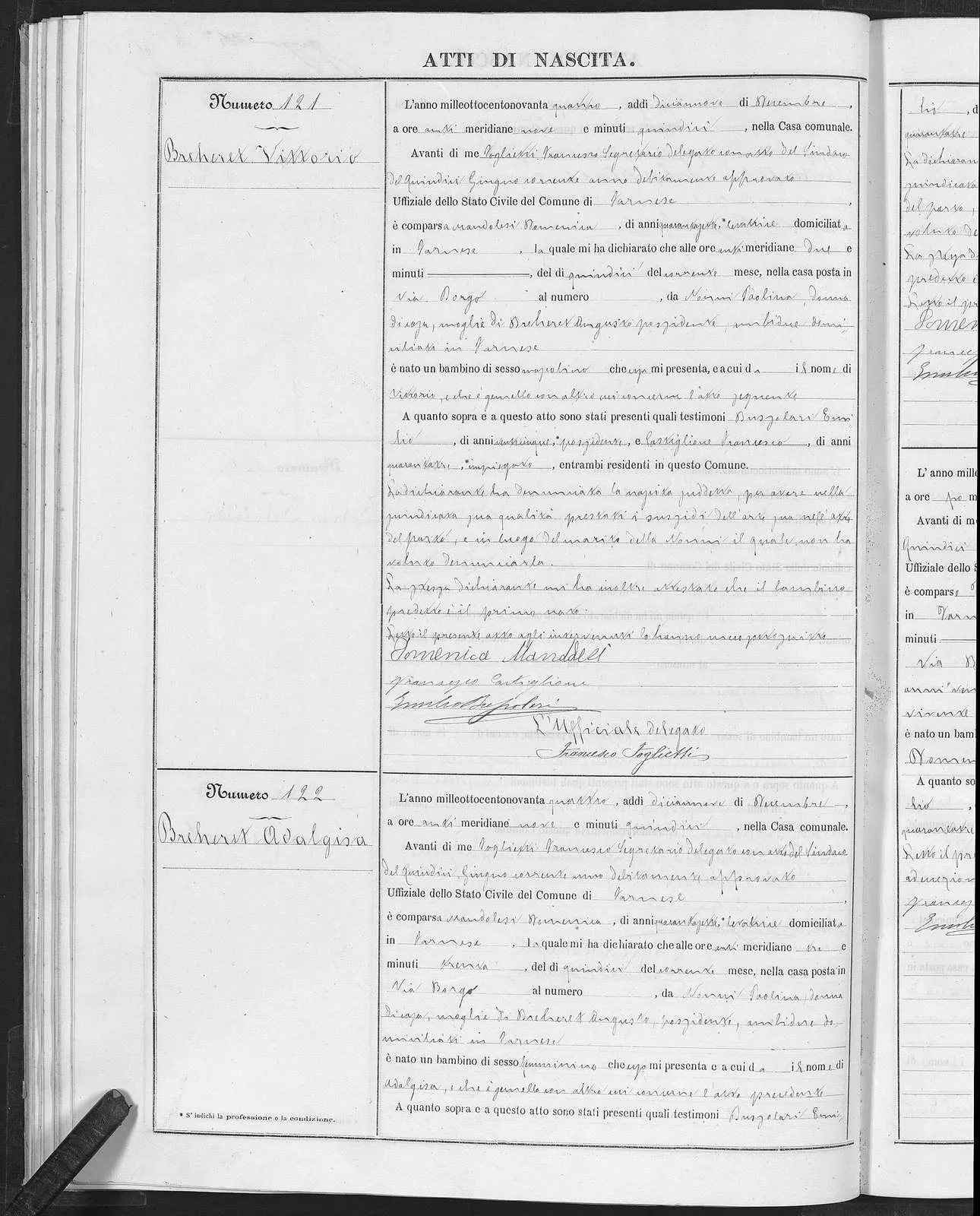
Birth act of Vittorio Breheret, Farnese (Viterbo), 15 December 1894. Civil register published through Portale Antenati. Public domain.
A full opening date is year, day, month, hour. Practice with the pieces rather than memorizing every ordinal.
Addì sette di marzo is “on the seventh of March.” Alle ore dieci antimeridiane is 10 in the morning. Alle ore quattro pomeridiane is 4 in the afternoon. Put the declaration date at the top of your note and the event date, oggi or ieri or a fully written day, underneath it.
The year mille ottocento ottanta plus a unit is the nineteenth-century pattern you will see most. Compare it with the margin, where the clerk may also have written numerals. If the words and the numerals disagree, record both. The estratto comparison matters when a later typed extract “corrects” a date. The register page remains the page you read here.
Atto n. 45 in an index should be opened. A decade index, indice decennale, still sends you back to a single act.
When the word is not in the table
Mark it and move to the next slot. One unread occupation should not stop you from copying the parents. After the session, compare the word with the same formula on the previous act in the register. Clerks repeat themselves. The unclear word is often clear two pages earlier.
Spelling varies by clerk and by region. Double consonants appear and disappear. Sarto and a slightly different ending still point at a tailor if the rest of the word supports it. Say so in brackets. The hometown guide is for place-names that look like vocabulary and are actually towns. A frazione can resemble a last name. Check it before you add a person.
If the book is not on the portal, the list still helps you read whatever the office sends. The not-online guide is the path: confirm the gap, try FamilySearch, then the comune letter or the parish letter. Ask for the atto when you want the full narrative this list is built to unlock.
The record overviews show what a finished act looks like in context: births, marriages, deaths. The free records guide is the map of sites. This page is the glossary you keep open on the second screen. The kit includes it with the worksheet so you are not copying the table by hand. The reading still happens on the image, one word at a time.
Sources
Questions readers actually ask
Are civil acts in Latin or Italian?
Civil birth, marriage, and death acts are in Italian. Latin shows up in parish baptisms, marriages, and burials. Use this list for the town hall and the Latin list for the parish book.
What does nipote mean on a record?
Nipote can mean grandchild or nephew or niece. The rest of the act has to show which. Do not pick one from the English family tree and force it onto the Italian line.
Why is the year not written as 1880?
Clerks wrote years in words. Mille ottocento ottanta is 1880. They also abbreviated the phrase. Compare the words with the year on the register's title page.