
Reading the records
How to read Italian death records
How to read an Italian death act: who reported the death, which date is which, and why a burial may be in a different book.
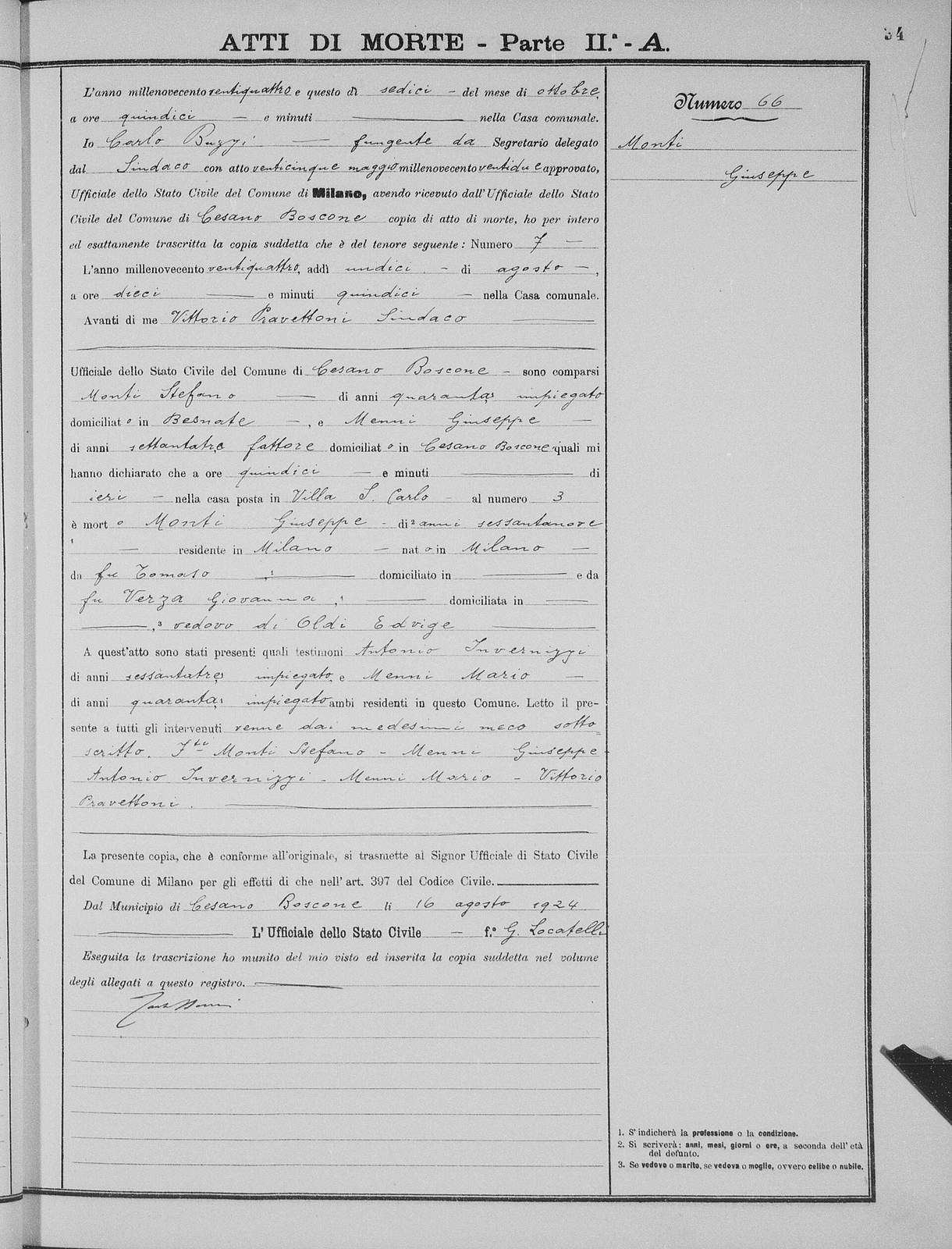
A civil death act is a report that someone died, made by a person who appeared before the official. It is good at the date of death, the place of death, the spouse, and the parents, when the declarant knew them. It is weak at the exact birth date, because the age is often a round number supplied from memory. Read it for what it is. Then go find the birth.
The death records overview is the map of the series. This page is the reading, for an image you found on Antenati or in the FamilySearch catalog. Words are on the Italian word list. If the book in front of you is a parish burial, stop and switch to the Latin word list and the church records page. Morto in a civil register and sepultus in a parish book are two entries. They can both exist for the same person. They are not two copies of one page.
What the folder is called
In the archive tree, deaths are morti or atti di morte. Indexes are indici. A decade index may gather ten years of last names and act numbers. Open the act the index points to. Index lines omit the parents often enough that two men of the same name stay tangled until the act is read.
Some towns bind deaths with other acts, or film several years in one item. Read the title page and write the real span on the worksheet. Check the archive’s current listing if the year you want is not a separate folder. It may be inside the neighbor.
General ranges help you pick a series and stay general: Napoleonic books roughly 1806–1815 in some areas; the Kingdom of Naples from January 1809; Bourbon reintroduction in 1816; Sicily in 1820 for that style; the unified series generally from 1866; Rome province from 1871. The FamilySearch civil-registration overview is the source of those ranges. Your town’s cover may differ. The civil records page keeps the series names.
The report: who came in, and who died
The opening is the declaration again. Year in words, day, month, hour, avanti a me, the ufficiale dello stato civile or the sindaco. È comparso introduces the dichiarante, the person who reported the death.
Read the dichiarante’s description and stop there for a moment. The act gives a name, an age, an occupation, a residence, and sometimes a relationship to the dead person. The relationship might be figlio, coniuge, vicino (neighbor), or nothing beyond “who declared.” A neighbor is a normal declarant. Do not attach him to the family. Do not drop his name either. In a hard-to-read act, his name is part of how you cite the page.
Then the formula turns to the person who died. È morto or è morta. Decesso is the death as an event. You want:
- The name, last name first or given name first, as written.
- The sex, which the verb ending already shows: morto masculine, morta feminine.
- The hour and the day of death, which may be oggi or ieri relative to the declaration, or a stated date. Label the declaration date and the death date separately, the same way you do on a birth act. The birth reading guide uses those same two words, oggi and ieri.
- The place of death. In questo comune, a street, a hospital, a frazione, or another town. The place of death can differ from the residence. Copy both if both appear. A person who died while visiting a relative is recorded where the death was reported, which may be far from the birthplace.
- Age, di anni, and occupation, professione.
- Parents, often with fu if a parent was already dead.
- Spouse, if any: coniuge, marito, moglie, or vedovo di / vedova di with the spouse’s name. A living spouse is a person to search. A deceased spouse is a second death act.
Invented example. A model sentence, not a real act:
È comparso Russo Luigi, di anni cinquanta, muratore, residente in questo comune, il quale ha dichiarato che oggi alle ore due antimeridiane è morto Bellini Giuseppe, di anni settanta, contadino, residente in questo comune, nato a [altro comune], figlio del fu Marco Bellini e di Serra Rosa, marito di Ferrara Anna.
Slots: declarant Luigi Russo, 50, mason, resident here. He did not claim kinship. Death: today at 2 in the morning, Giuseppe Bellini, about 70, farmer, resident here, born in another comune the real act would name, son of the late Marco Bellini and of Rosa Serra, husband of Anna Ferrara. The people are invented. The lesson is the declarant who is not a relative, and the cluster of parents plus spouse that a good death act gives you in one paragraph.
If your real declarant is a son, the act will say so. Use that. If it does not, leave the line as “declarant, relationship not stated.”
Cause, burial, and the sentences that may be missing
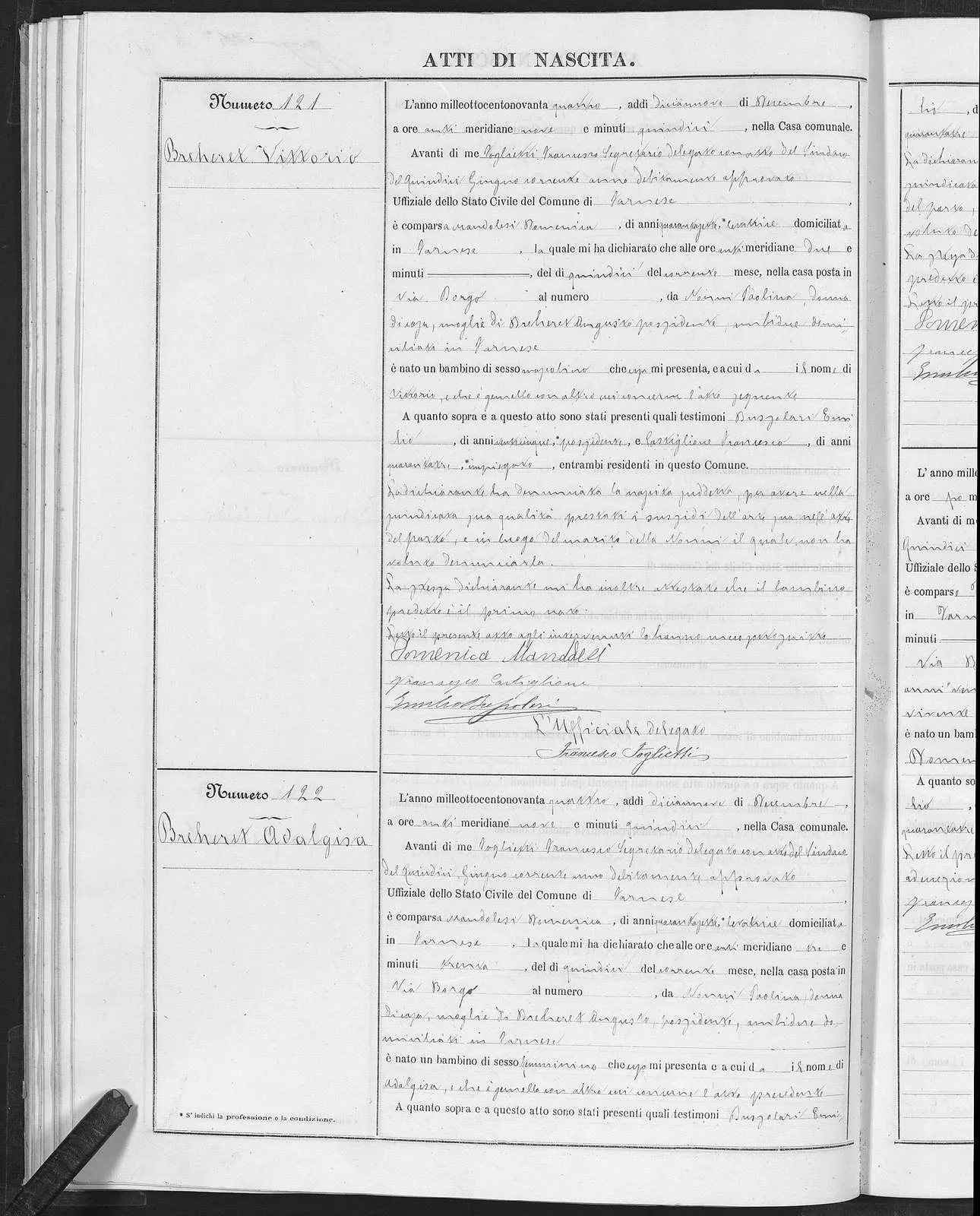
Birth act of Vittorio Breheret, Farnese (Viterbo), 15 December 1894. Civil register published through Portale Antenati. Public domain.
Some acts state a cause of death in a few words. Some give a vague phrase. Some omit it. If a cause is written, copy the Italian into the note and translate only the words you are sure of. A misread disease is a false medical story. If no cause is written, leave the field blank. Do not fill it from a family story about “the fever.”
Sepoltura means burial. It may appear in the civil act as a cemetery or a church, and it may not appear at all. Many civil death acts end at the death and the declarant. The burial is then a different entry, in the parish book, often in Latin: obiit, sepultus, sepulta. When you care about the burial, search the church records and be ready to read Latin. When you care about the parents and the spouse, the civil act is the better page if you have it. Finding one does not cancel the other.
A margin note is rare on deaths compared with births, and it still happens. Read it separately. Do not fold it into the hour of death.
Ages, birthplaces, and the next search
The age produces a birth-year window, not a birthday. Di anni settanta is a window you search with the parents’ names, not a command to open only one year. If you later find the birth act, keep the death act’s age in the note as “age given at death.” Conflicts belong on paper. They are part of the research, and they stop you from “correcting” a clerk who is no longer available to explain himself.
A birthplace named in the death act is a gift. Confirm it is a comune, or a frazione of a named comune, in the hometown guide. Then browse that town’s births for the window. The region pages matter when the birthplace is in a different province from the death. People moved. The death comune is not a substitute for the birth comune written on the same page.
Parents’ names on a death act are only as good as the declarant’s memory. Prefer the parents on the birth act and on the marriage act when you have them. Use the death act’s parents to find those earlier acts, and to tell two Giuseppe Bellinis apart in the index. The marriage reading guide shows you what to do when the marriage calls the same father fu.
A spouse’s name is the bridge to children. Births of children should name this person as a parent. Search the birth indexes for that last name in the years the marriage and the death make plausible. A widow’s later appearance as vedova di Giuseppe on her own death, or on a child’s marriage, is the check that you have the right man.
Infants, people who died away, and empty years
Infant deaths are short and easy to mix up, because the child may be “the son of Antonio” with a single given name and no occupation. Copy the parents in full. Two infant deaths in one family in one decade are a common pattern. Do not merge them because the names repeat. Act numbers exist so you can keep them apart.
A death in another comune is filed in that comune. The Ellis Island guide covers the voyage. Use Italian death registers for people who died in Italy: the ones who stayed, the parents, and the relatives who returned.
When the year is not in the listing, the not-online guide is the path. Confirm the gap, try FamilySearch, then the comune letter for the civil death. A burial request is the parish letter. Say which one you want. Asking a parish for a civil atto di morte sends the letter to the wrong shelf.
A note you can reuse
Finish a death transcription with labeled lines: declaration date, death date and hour, place of death, residence, name, age, occupation, birthplace, father, mother, spouse, declarant and stated relationship, act number, image identifier. Add “cause” only if the page has one. Add “burial” only if the page has one.
Invented example, continued. Giuseppe’s note would mark Luigi Russo as declarant with no kinship stated, Anna Ferrara as the surviving wife, Marco Bellini as a father already dead, and Rosa Serra as the mother. The birthplace line would send the next session to the other comune’s birth registers, inside the age window, using the birth overview to recognize the right series. Because this Giuseppe is invented, he ends here. A real note ends with the image link.
The beginners’ guide recommends this reading before you pick up the next generation, for a practical reason. The mother on a death act is sometimes the only surviving statement of her last name. Misread it, and every search upstream is the wrong family. The free records guide sits beside this page when you are still choosing a site. Once the image is open, the word list and the worksheet matter more than another website. The kit is those two, plus the letters, for the year the listing does not have.
Sources
Questions readers actually ask
Is the person who reported the death a relative?
Sometimes. The dichiarante can also be a neighbor, a doctor, or the person who found the body. Copy the name and only the relationship the act actually states.
Does the death act include the burial?
Sepoltura is often a separate church entry. Some civil acts mention a cemetery and many do not. A missing burial sentence is not a missing death. Look in the parish book if you need the burial.
The age on the death act disagrees with the birth act. Which do I keep?
Keep both, labeled. Use the birth act for the birth date once you have read it. Use the death act for the death date, the spouse, and the parents it names. Write the conflict in the note.