
Regions
Sicilian genealogy records
How to find Sicilian civil registers by province and state archive, and why Palermo on a list is not always the birthplace.
Affiliate disclosure.Some links on this page go to genealogy companies. If you buy through them, we may earn a commission, at no extra cost to you. We recommend a site only where it helps this kind of research. Read the full affiliate disclosure.
Sicilian genealogy is a province problem wearing an island’s name. The civil act was written in a comune. The copy you can browse online was usually filmed from a state archive, and the archive follows the province. “Sicily” is the right word for the region and the wrong word for a search box. If that is all a family story gives you, you are not ready to browse. You are ready to find a town in a record created after the family left, using the hometown guide and, for New York arrivals, the passenger-list guide.
The provinces you will see in catalogs are Agrigento, Caltanissetta, Catania, Enna, Messina, Palermo, Ragusa, Siracusa and Trapani. The state archives to name in your log are the Archivio di Stato di Palermo, Catania, Messina, Siracusa, Trapani, Agrigento, Caltanissetta, Ragusa and Enna. Open them from Esplora gli Archivi on the Portale Antenati and from the Ministry’s archives portal at archivi.cultura.gov.it. Do not invent a web address for an individual archive. If a search engine offers you one, check that it belongs to the Ministry before you trust it.
The range of years, stated carefully
FamilySearch’s article on important Italian research resources is the source for the ranges used here. It says Sicily did not get Napoleonic-style civil registration until 1820. On the southern mainland, the same article dates that style of registration to the Kingdom of Naples in 1809, with a Bourbon continuation from 1816. Sicily is the exception in that sentence, which is why an island birth in the years just after 1809 cannot be assumed to sit in a civil book. The same article says the civil records of unified Italy begin generally in 1866.
Those sentences are general. They are not a claim that every Sicilian town has a readable volume for 1820, or that a book from 1866 was filmed. Antenati’s listing for the comune is the authority. If the year is missing, write that down. Missing from the portal is not the same sentence as “the records burned.” Sometimes the duplicate never reached the archive that was filmed. Sometimes the images were never indexed. Sometimes the book is at the comune and was not part of the project. The FamilySearch wiki for Sicily is the place to see which collection titles exist for a province. Read the access line on each image set. Some films open at home with a free account. Some are marked for a FamilySearch Center or an affiliate library. A home login does not remove that mark. The FamilySearch Italy guide explains how to browse when name search fails.
Palermo is three different searches
Palermo is a city, a province and a port. American forms collapse the three into one word. A manifest can show Palermo as the place of departure while the last residence is a town elsewhere in the province, or elsewhere on the island. The city of Palermo has its own civil registers, in the Archivio di Stato di Palermo. A town in the province of Palermo has its own registers in that same archive, filed under the town, not under the city. A person from the province of Agrigento who sailed from Palermo does not belong in either of those books.
The same split applies to Catania and Messina. Each is a city, a province and, often, a place a ship left from. Siracusa is the Italian form; English text often says Syracuse. Agrigento appears in older writing as Girgenti. Search both if one form returns an empty catalog, and do not treat the older word as a different island. Enna appears in older writing as Castrogiovanni. Caltanissetta is easy to misspell with a single s. Write the form each document uses, then the form the gazetteer uses, and search the catalog with the gazetteer’s form.
Trapani is a good reminder that the province is larger than the port city. Smaller comunes in that province, including island towns off the western coast, are still Trapani-province searches. The Italy Gazetteers wiki is how you confirm that a string is a comune in Trapani rather than a neighborhood of the city. A frazione, a hamlet, may be where the family lived. The civil act was usually written in the comune that administered the hamlet. The parish may have been in the hamlet itself. Keep those three ideas in separate lines of the worksheet.
How to browse without a name index
The Antenati research guide matches the tool to the fact you have. If you have a name and the register has been indexed, a name search can find the act. If you have a town and a year, browse. Most of the time you should browse even after a name search fails, because failure often means “not indexed,” not “not born.”
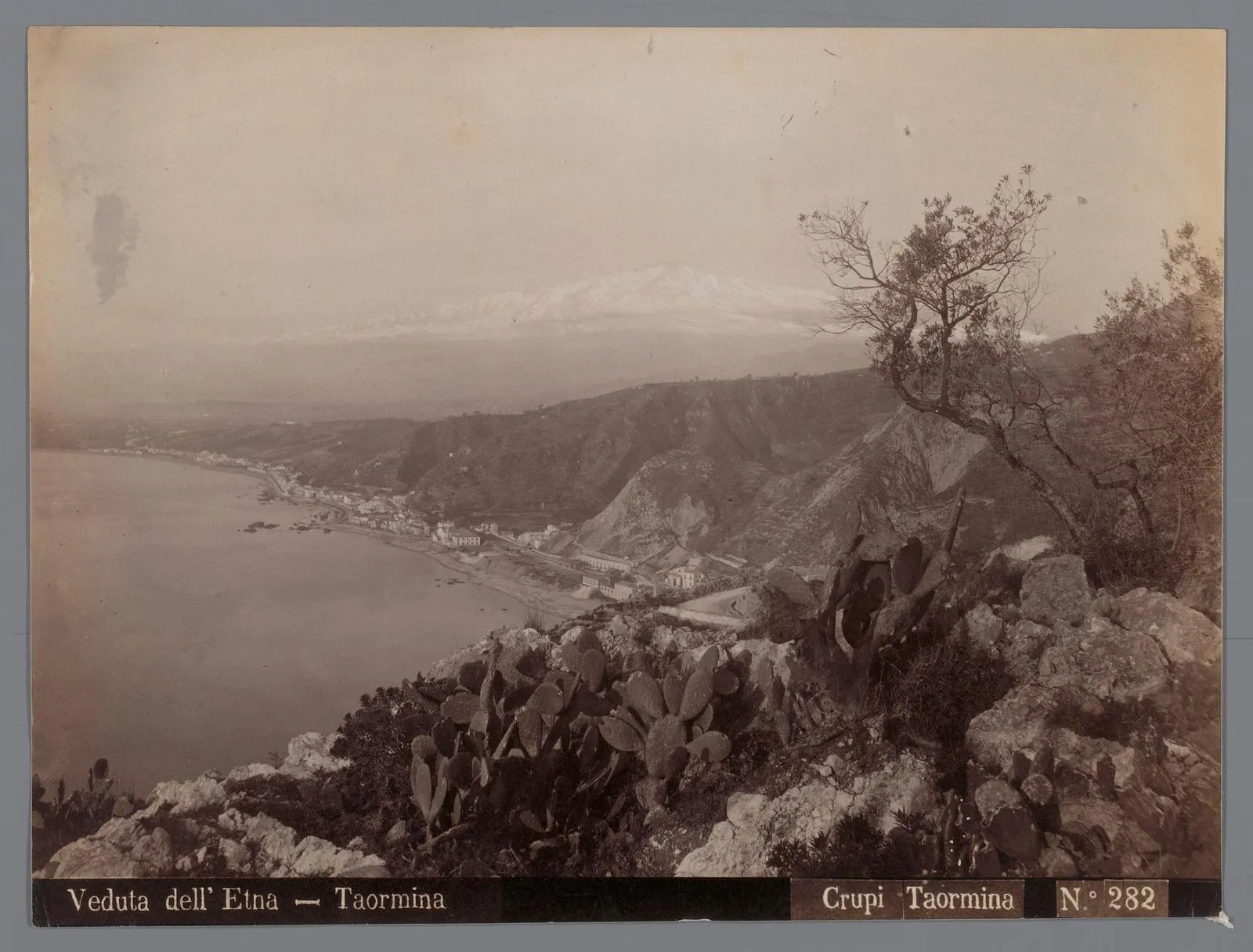
View of Mount Etna from Taormina, catalogue number 0282, by Giovanni Crupi.
Choose the archive for the province. Choose the comune. Choose births, marriages or deaths. Open the year, or the ten-year finding aid if the volume has one, the indice decennale. The finding aid gives you an act number. The act is in the annual register. Read the act. Indexes mis-hear names, and they often shorten the mother’s last name, which is the bridge to the next family. The word list is enough to follow the formula: child, parents, ages or occupations, residence, witnesses, and the date of the declaration. The date of the declaration is not always the date of birth.
Then repeat the path on FamilySearch. The same volumes often appear in both places. The indexes and the locks do not. Ancestry also hosts Italian civil images for many provinces, often from the same filming, inside a subscription. A subscription is optional. It does not create a year Antenati lacks if the film was never made. Use it when an index or a cousin’s tree gives you a lead you can check against the images. The website comparison keeps that optional status clear.
Parish books and the years before the civil series
For a birth before Sicily’s civil series, or in a gap the listing will not fill, the parish is the institution that may have written a baptism, a marriage or a burial. There is no single online shelf for every Sicilian parish. Some diocesan or parish films are in the FamilySearch catalog. Many are not. When you write, write for one event and one person, and ask what the office charges rather than sending money first. Say the request is for family history. The kit holds letter templates and a log if you would rather not assemble them. The research decision stays here: which comune, which archive, which year.
Do not begin with a letter to “the church in Sicily.” There is no such office. There is a parish in a town, and you need the town.
Last names will not choose the province
Sicily’s history includes Greek, Arabic, Norman and Spanish periods. Some surname dictionaries discuss those layers, which is a statement about dictionaries. It is not a method for assigning your spelling to one of those periods. This site does not publish a list of “Arabic” or “Norman” last names, because a modern spelling does not prove an origin. The Sicilian surnames page is the longer version of that refusal. A commercial coat of arms sold for the spelling is not evidence of nobility. Arms belonged to particular grants.
A distribution map can still be a clue when you have no town at all and you are deciding which records, in the country of arrival, are worth ordering next. It cannot replace those records. The distribution guide explains why a telephone listing is not a census from the years people left.
Invented example
Invented example. A death certificate in New Jersey says the man was born in “Palermo, Italy.” His passenger list, matched by age and by his wife’s last name, says last residence “Corleone” and port of departure Palermo. Corleone is a comune in the province of Palermo. The port explains the ship. The residence is the search. You open the Archivio di Stato di Palermo from Esplora gli Archivi, then the comune of Corleone, then the birth year you took from the list, not from the family story. You do not read the city of Palermo’s birth book for that year unless Corleone’s listing sends you there, which it should not. If the images stop before the year, you write to the comune of Corleone and ask, for family history, whether they hold the act. You do not write to every parish in the province.
A second invented detail is worth keeping beside that one. Suppose the list had said “Castrogiovanni” and a sibling’s obituary said “Enna.” Those are the older and newer names of the same comune, in the province of Enna, and the archive to open is the Archivio di Stato di Enna. The port can still be Palermo. The port never becomes the birthplace.
What to record so you do not repeat the island
Write the province, the archive, the comune, the series and the years you opened. Write the spellings you rejected and why. “Not Siracusa, because the second document says Caltanissetta” is a result. “Searched Sicily” is not. When the act appears, copy the parents before you hunt the next generation. The mother’s last name is how you leave the paternal line. The beginner guide is the full order. The regions hub is the map of which other launch guides exist, including Calabria, which is across the strait and is not a district of this island. People confuse the two because ships and stories say “the south.” The archives do not.
Sources
Questions readers actually ask
When did civil registration start in Sicily?
FamilySearch's overview of Italian research resources says Sicily did not get Napoleonic-style civil registration until 1820, later than the Kingdom of Naples on the mainland, where the same overview dates that style of registration from 1809 and a Bourbon continuation from 1816. The same overview says unified Italian civil registration begins generally in 1866. Those are general ranges. They tell you which series you are entering. They do not promise that every comune has a surviving volume for every year. Open the listing for the town on Antenati or in the FamilySearch catalog and read the years that are actually there. For a birth before the civil series, the parish register is the other place to look, and filming of parish books is uneven.
Which archive holds Sicilian civil records?
Use the state archive that matches the province: the Archivio di Stato di Palermo, Catania, Messina, Siracusa, Trapani, Agrigento, Caltanissetta, Ragusa or Enna. You open those archives from Antenati's Esplora gli Archivi and from the Ministry of Culture's archives portal at archivi.cultura.gov.it. This site does not publish separate hostnames for each archive, because those addresses are easy to invent and easy to get wrong. Inside the archive, choose the comune, then the type of act, then the year. The city of Palermo is not the archive for the whole island. A town in the province of Trapani stays in the Trapani archive even if the family later sailed from Palermo.
Does a Sicilian surname tell me the province?
No. A distribution map built from telephone listings can show where a spelling clustered in the late twentieth century, and that cluster is a place to look, not proof of one ancestor's town. Sicily's history includes Greek, Arabic, Norman and Spanish periods, and some dictionaries discuss those layers. A spelling does not prove which layer, if any, produced a particular family, and this site does not sort last names into ethnic lists. Identify the comune from a record created after emigration, then search that comune. The Sicilian surnames article explains the limits. A crest sold for the spelling is not a substitute for the register.