Five regions have launch guides. The dot is a link, not a claim about where a family lived.
Italian genealogy is filed by place. The place that matters first is the comune, the municipality that wrote the civil act. The place that matters next is the province, because the state archive that holds the filmed duplicates is usually the archive of that province. The region is the map you use to choose a guide. It is not a volume you can open.
This page is the hub for that second step. It explains why the province and the archive decide the search, then points to the launch guides. Those guides cover Sicily, Calabria, Campania, Abruzzo and Basilicata. Other regions are not published until each page can be specific. A thin page that only says “look in the state archive” is not worth a URL.
Why the archive follows the province
Civil registration, stato civile, is a local series. The official wrote the birth, marriage or death in the comune. In the arrangement genealogists actually use, a duplicate series was gathered for the courts and later deposited in a state archive, an Archivio di Stato. Antenati, the Ministry of Culture’s ancestors portal, publishes images from those state archives. Its catalog, Esplora gli Archivi, is a list of archives, not a list of last names and not a list of regions.
That is why “my family was from Calabria” does not open a book. Calabria is a region. Cosenza is a province and also a city. A town in the province of Cosenza is cataloged under the Archivio di Stato di Cosenza. A town in the province of Reggio Calabria is cataloged under a different archive. The Calabria guide adds a further warning: Crotone and Vibo Valentia are newer provinces formed from territory that had been part of Catanzaro, so a missing town should also be sought under Catanzaro.
FamilySearch’s Italy collections follow the same geography. You search the catalog for the comune, and you often have to pick a province or a court along the way. The FamilySearch Italy guide explains the catalog and the lock that sometimes limits images to a FamilySearch Center or an affiliate library. A lock is a condition of that image set. It is not evidence that the town is wrong.
The portal’s own research guide tells you to match the tool to what you know. A name search works when someone has indexed that register. A place search is the ordinary path: archive, comune, year, type of act. If you do not yet know the comune, you are not ready for either tool. You are ready for the hometown guide, which turns a garbled string from a passenger list or a petition into a municipality.
Dates are ranges, and the listing wins
FamilySearch’s overview of important Italian research resources gives general ranges, not a promise about your town. It says Napoleonic-style civil registration was introduced in the Kingdom of Naples in 1809 and reintroduced by the Bourbons in 1816, and that Sicily did not get that style of registration until 1820. It says the civil records of unified Italy begin generally in 1866. Use those ranges to know which kind of register you are entering. Then read the years Antenati actually lists for the comune. A year that is absent from the listing is a gap in that digital shelf. It is not a reason to invent a different town.
Before those civil series, and in the gaps, the parish is the other institution. Baptism, marriage and burial books were kept locally. Survival is local too. This hub does not pretend that every parish in a region has been filmed. When the civil year is missing, the next step is the parish or the comune’s own copy, not a second region.
What the launch guides add
The pages linked below are previews of problems, not substitutes for the articles. Read the one that matches the province you are testing. If you do not yet have a province, do not pick a guide because a last-name map looked darkest there. A map is a place to look, and the surname hub explains why a telephone-directory cluster is not an ancestor’s town.
Sicily
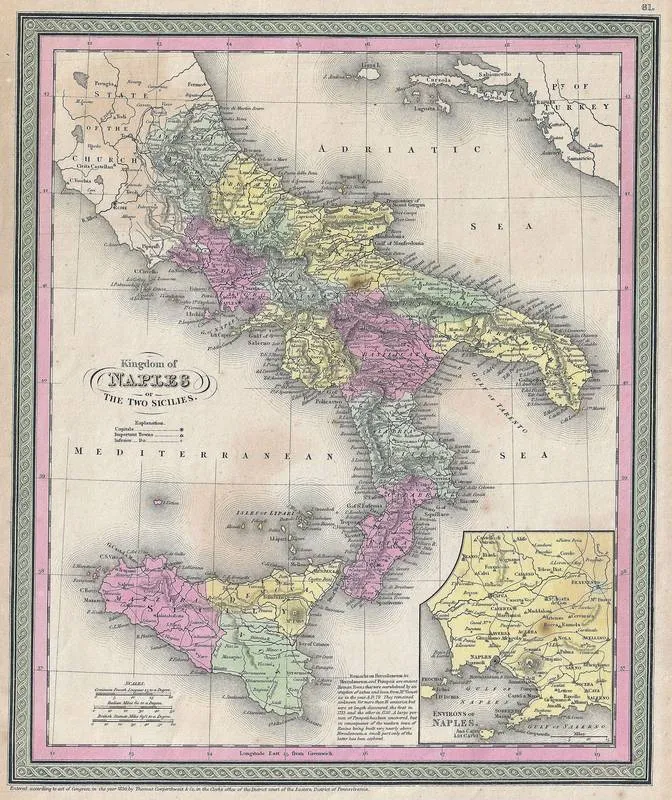
Map of southern Italy and Sicily by S. A. Mitchell, plate 61 in the 1853 New Universal Atlas. Public domain.
Sicily is an island with its own start date for civil registration. The FamilySearch overview cited above puts Napoleonic-style registration on the island in 1820, later than on the southern mainland. The provinces you will meet in catalogs are Agrigento, Caltanissetta, Catania, Enna, Messina, Palermo, Ragusa, Siracusa and Trapani. Each has a state archive of the same name: Palermo, Catania, Messina, Siracusa, Trapani, Agrigento, Caltanissetta, Ragusa and Enna. Open those archives from Esplora gli Archivi or from the Ministry’s archives portal at archivi.cultura.gov.it. Do not guess a website hostname for an individual archive.
The Sicilian page also separates the port from the town. A list that says Palermo may mean the city, the province or the ship. The Sicily guide is the place for that distinction, for older spellings, and for why a surname dictionary’s historical layers are not a birthplace.
Calabria
Calabria is the toe of the mainland, not a district of Sicily. Its current provinces are Catanzaro, Cosenza, Crotone, Reggio Calabria and Vibo Valentia. The state archives to name in a log are Catanzaro, Cosenza, Reggio Calabria, Crotone and Vibo Valentia. The trap the Calabria guide spends time on is administrative: if a town in Crotone or Vibo Valentia is missing, search Catanzaro in the catalog, because those newer provinces were formed from territory that had been part of Catanzaro. The other trap is linguistic. Reggio alone can mean Reggio Calabria or Reggio Emilia, which is a northern city. A second document has to decide.
Campania
Campania’s provinces are Avellino, Benevento, Caserta, Napoli and Salerno. The archives are Napoli, Salerno, Caserta, Avellino and Benevento. The Campania guide is built around one sentence that saves months: Naples the port is not a birthplace. People from the inland provinces sailed from Napoli and were recorded as if the port were home. The city of Napoli has its own civil registers. Those registers are the right books only when the person was born in that city.
Abruzzo
Abruzzo’s provinces are L’Aquila, Chieti, Pescara and Teramo. The archives are L’Aquila, Chieti, Teramo and Pescara. Older English books say Abruzzi. Pescara is a newer province, so a town that sits in Pescara today may be filed under an older provincial heading. The Abruzzo guide points to the Ministry’s general guide to the state archives for that problem and tells you what to do when the Pescara listing is silent. It does not ask you to browse the whole Adriatic coast.
Basilicata
Basilicata has two provinces, Matera and Potenza, and two state archives of those names. Older records and older English text call the region Lucania. The Basilicata guide tells you to search both words, and it warns that Lucania inside a town’s name is not the region. The choice of archive is narrower here than in Sicily. The choice of comune is not.
Regions that do not have a page yet
Lazio, Puglia, Campania’s neighbors, the north, Sardinia: if your gazetteer lands there, you do not need a regional essay to continue. You need the comune, the province and the archive. Use the Italy Gazetteers wiki to confirm the place, then Esplora gli Archivi, then the FamilySearch catalog. The Italy Genealogy wiki is the general map of record types. This site will add a region when the page can name the archives, the old labels, and the particular way American documents mis-hear that place. Until that page exists, do not trust a short blog that treats the region as one last-name list.
A search order that works in every region
Write the place string exactly as each document spells it, on the ancestor worksheet. Compare two records before you pick a winner. Separate the port of departure from the town of birth. If the string is a frazione, a hamlet, find the comune that kept the civil register. Confirm the province in a gazetteer. Only then open Antenati.
Log the archive name you opened, not only the region. “Looked in Sicily” is not a search. “Opened the Archivio di Stato di Agrigento, births for the comune, and did not find the year” is a search. The Antenati walkthrough shows the clicks. The beginner guide is the longer sequence, from the American record to the letter you send when the film stops.
When the repetitive part is the Italian wording, the log and the glossary, the Italian Records Kit is the download that holds them together. The region decision stays the one on this page: province, then archive, then comune, then year. A last name, a DNA label or a region story does not replace that order.
Why is a region not enough to find a birth record?
A region is a grouping of provinces. Civil registration was kept by the comune, the municipality, and the copies that were filmed for the state archives are cataloged under an Archivio di Stato, which usually follows the province. If you search only the region, you are asking a catalog to open every town at once. Antenati's Esplora gli Archivi is organized so you choose an archive, then a place, then a register and a year. FamilySearch collections are arranged the same way. The region tells you which guide on this site to read. The province tells you which archive to open. The comune tells you which book.
What if the province on an American document is wrong?
Treat it as a spelling to test, not as a filing decision. Clerks in the United States often wrote the port, the province, or the region in the birthplace blank. Naples on a passenger list is frequently the port of departure, which the Campania guide explains. Palermo can be a city, a province, or a port. Compare that string with a second record for the same person, such as a sibling's list or a later petition, and then check a gazetteer. The hometown guide walks through that comparison. If two records name two different comunes, keep both candidates until a third record agrees with one of them. Do not average them into a province and start browsing at random.
When will other Italian regions be added?
When a page can say something specific: which state archives to open, which older name a catalog still uses, and which mistake that region produces on American documents. A page that only repeats "search the state archive" does not help, so it will not be published to fill a map. Until then, the method is the same everywhere. Identify the comune, confirm the province, open that archive from Antenati's Esplora gli Archivi and from the Ministry's archives portal at archivi.cultura.gov.it, and check the same place in the FamilySearch catalog. The Italy Genealogy wiki is the overview for regions that do not yet have a page here.