
Reading the records
How to read Italian marriage records
How to read an Italian marriage act and its attached papers: the spouses, the banns, the parents, and the words clerks actually wrote.
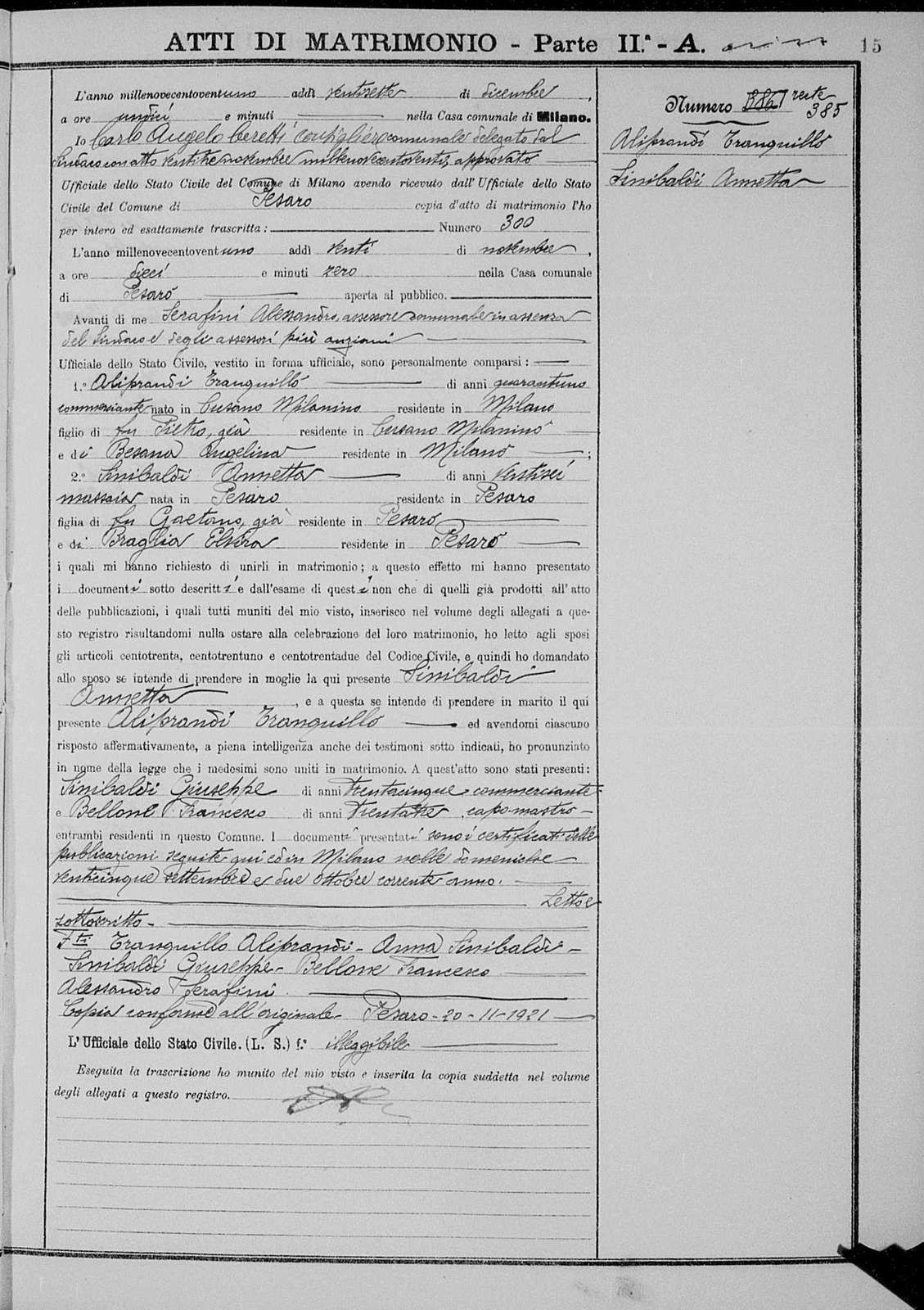
A civil marriage act is the richest ordinary page in Italian family history, and it is three different things bound near each other. The act itself names the spouses and their parents. The pubblicazioni are the banns posted beforehand. The allegati or processetti are the packet of supporting papers, when that packet was kept and filmed. Reading only the signature page leaves the births of the spouses sitting in the next item, unread.
The marriage records overview describes where these series sit. This page is how to read a page once you have it, on Antenati or in the FamilySearch catalog. The vocabulary lives on the Italian word list. A church marriage in Latin is a separate entry; use the Latin word list and the church records page for that book.
Find which piece of the marriage you opened
Look at the title before you translate a name. In the archive tree the pieces are often separate items:
- Matrimoni or atti di matrimonio: the marriage acts for the year.
- Pubblicazioni: the banns. Two dates here can show when the intention was posted. The wedding is the later act.
- Allegati or processetti: supporting documents. Births of the spouses are the usual prize. Deaths of parents appear when a parent had died and the packet needed to show that. The packet you meet may hold more, less, or a different mix. Read the cover.
- Indici: indexes. They point to an act number. They are not the act.
Check the archive’s current listing for which of these were filmed for that comune and year. A town can show marriages and no packets, or packets and no separate banns. Log the title you actually opened on the worksheet.
The FamilySearch overview gives general era labels that show up on these folders: Napoleonic civil books roughly 1806–1815 in some areas; the Kingdom of Naples from January 1809; Bourbon reintroduction in 1816; Sicily in 1820 for that style; the unified series generally from 1866; Rome province from 1871. They are general. The cover of the volume is the label you trust. The civil records page gathers the series names.
The act: two spouses, four parents
The opening matches a birth act’s clock. L’anno, the day and month, alle ore, then avanti a me, the ufficiale dello stato civile or the sindaco. Sono comparsi means they appeared: the two sposi.
Each spouse is named with a last name, given names, age (di anni), occupation (professione), and residence (residente). Then the parents. A typical formula says the spouse is figlio di or figlia di a father and a mother. Fu before a parent’s name means that parent was dead. Fu is a research lead. It points you at a death act, and it explains why a consent line may name a different relative.
Marito is husband. Moglie is wife. Coniuge is spouse. Vedovo and vedova mean widower and widow. If a spouse was widowed, the act often names the deceased partner. That earlier marriage is another act to find. Celibe is an unmarried man. Nubile is an unmarried woman. Copy the word. It tells you whether to look for a previous marriage in this town.
The bride’s last name is her own family name, the one she received from her father in the usual formula, or from her mother if that is how the act puts it. Do not file her under the groom’s surname. Later birth acts of her children will still call her by this last name.
Invented example. A shortened act, typed as a model, not taken from a register:
Sono comparsi Bellini Antonio, di anni ventotto, contadino, figlio del fu Giuseppe Bellini e di Ferrara Anna, e Greco Caterina, di anni ventisei, nubile, figlia di Greco Marco e di Conte Lucia, i quali mi hanno richiesto di unirli in matrimonio.
Slots: groom Antonio Bellini, 28, farmer, son of the late Giuseppe Bellini and of Anna Ferrara. Bride Caterina Greco, 26, unmarried, daughter of Marco Greco and Lucia Conte. They asked to be united in marriage. This family is invented. On a real page you would also copy the town, the date, the hour, and the witnesses before you closed the image.
Consento or consenso is consent. You see it when the formula records that a parent, a guardian, or another person the law of that year required had agreed to the marriage. The act names the person. Copy the name and the relationship stated. Do not assume a missing consent line means a quarrel. Many marriages of adults have no consent paragraph at all.
Banns, witnesses, and the end of the act
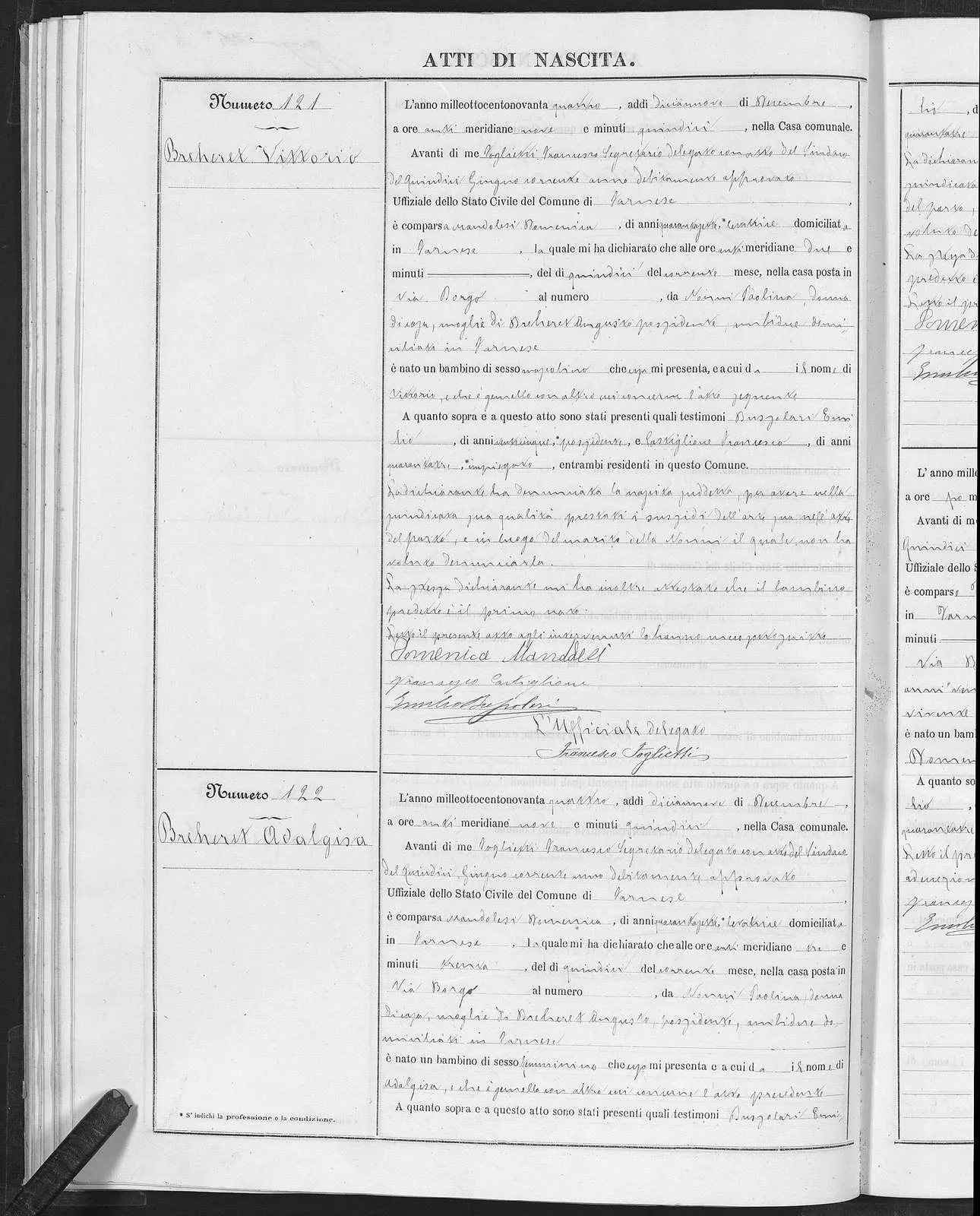
Birth act of Vittorio Breheret, Farnese (Viterbo), 15 December 1894. Civil register published through Portale Antenati. Public domain.
Pubblicazioni are the public notices. The act may say they were posted on two dates and that no opposition arrived. Those dates are earlier than the wedding. If you only have the banns and not the marriage, you have an intention. Look for the marriage act itself before you treat the couple as married on the banns date. Sometimes the marriage was elsewhere. Sometimes the banns are all the archive filmed. Check the archive’s current listing, and say in your note which document you hold.
Testimoni are witnesses, named with ages and occupations, just as on a birth act. They are not the godparents. Godparents belong to a baptism. A witness at the town hall is often a neighbor. Relationship is only what the sentence states.
Signatures sit at the foot. A spouse who non sa scrivere did not sign, and the clerk says so. That is a common sentence. The marriage is still the marriage.
Allegati and processetti
When the viewer or the archive tree offers the packet, open it the same day. The habit of “I’ll come back for the attachments” is how the attachments get lost. Inside, look for:
- A copy of each spouse’s birth act. The town of birth may differ from the town of the wedding. That town is the next catalog search.
- A copy of a parent’s death, especially where the marriage act said fu.
- The banns, sometimes repeated in the packet.
- Other papers the official required that year. Read the cover sheet. If a paper is a birth, the birth reading guide applies even though you found it inside a marriage file.
The packet is still a set of copies made for the marriage. If a date in the packet disagrees with a date you later read in the original birth register, keep both and prefer the original register for the birth, once you have opened it. Until then, the packet is the best version you have. Write “from the marriage allegati” on the note so you remember the distinction.
Dote means dowry. It appears in some marriage files and in some notarial papers. It is absent from many civil marriage acts. If you do not see the word, the file is ordinary. Do not add a dowry, a figure, or a list of goods. Do not treat a missing dote as a damaged page. Transcribe the spouses and the parents and move on. If the word is present, copy the sentence as written and leave interpretation of the goods until you can read every noun. Inventing a value is worse than leaving the line in Italian.
Ages and towns that do not match the family story
A spouse’s age on the marriage act produces a birth year only as a range. Di anni ventotto in 1882 points around 1854, and the real birth may sit a year or two away. Search a small window. The not-online guide is for a window the portals do not cover.
Residence can be a frazione of the wedding comune, or another comune entirely. The bride’s residence is a clue to where her birth was recorded. Confirm that place in the hometown guide before you browse a similarly spelled town in another province. The region pages help when the province name on the act is an older one.
Two marriages of the same person show up when the act says vedovo or vedova. Follow the name of the deceased spouse into the death registers, and then look for the earlier marriage. The death reading guide covers the death act you are about to open. A widow’s children from the first marriage will not appear on this page. This page only tells you she had a previous spouse.
A transcription that is finished enough
A marriage note is done when it has the date of the wedding, both spouses with last names and ages, both pairs of parents, any fu, the residences, the witnesses’ names, and a line that says whether you also opened the allegati. Image numbers for both the act and the packet belong on the worksheet.
Invented example, continued. Antonio and Caterina’s note would say: wedding date as in the act; groom’s father Giuseppe Bellini marked fu; groom’s mother Anna Ferrara; bride’s parents Marco Greco and Lucia Conte; allegati not in the listing for that year, or allegati opened and the birth copies saved under those image numbers. Because the example is invented, there is no image number to pretend. On a real file, the image number is the part you must not skip.
From there, the next searches are chosen, not drifted into. Birth of Antonio, birth of Caterina, death of Giuseppe, and the births of the children, starting with the birth overview. If a child’s birth is already in hand, compare the mother’s name letter for letter with the bride on this act. Greco and Grieco are a reading decision you make on purpose and write down.
The beginners’ guide places marriage reading after you know the town, because a perfect reading of the wrong province is still the wrong family. When the repetitive part is the two-column transcription, the kit is the worksheet and the word list in one folder. The order on the image stays: title, spouses, parents, banns, packet, then the next town those pages name.
Sources
Questions readers actually ask
What are processetti and allegati?
They are the supporting papers filed with a marriage, when they survive and when the archive filmed them. They often include copies of the spouses' births. Check the archive's current listing for that series.
Does every marriage act mention a dowry?
No. Dote appears in some files and is absent from many ordinary civil acts. If the word is not on the page, do not add it. Copy the spouses, the parents, and the date.
Which last name does the bride use on the act?
Her own. The act names her father and mother and her spouse. It does not replace her surname with her husband's. Later acts still call her by the last name she was born with.