
Letters and document types
Letter to an Italian parish priest
A formal Italian letter and English translation asking a parish priest for one baptism or marriage entry for family history.
Updated · Matteo Micheletti · 7 min read
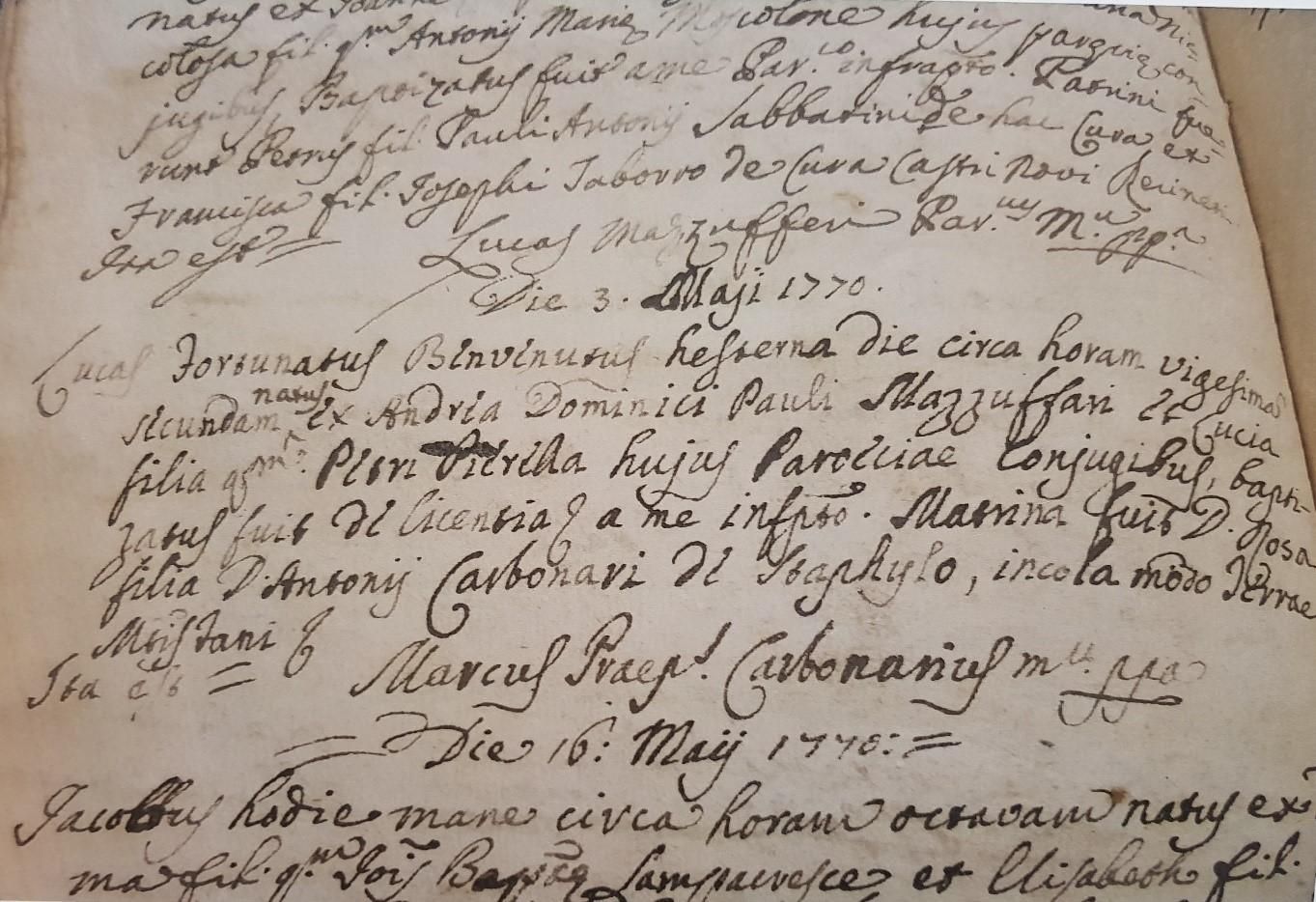
A parish letter is for a baptism or a marriage written in a church book. It is not a substitute for a civil act, and it is not a letter to the Ufficio di Stato Civile. Use it when the year falls before civil registration in that town, when the civil act is missing or damaged, or when you specifically want the godparents and the parish that baptized the child. The church records page explains how those books differ from stato civile. The comune letter is the template for a civil birth, marriage, or death.
Write only after you have looked for a digitized copy. Some parish books were filmed and appear on FamilySearch. The FamilySearch Italy guide shows how to search the catalog by place. The Portale Antenati is mainly civil registers and conscription lists, so a missing baptism there is not news. If the images exist, read them. If they do not, one specific letter is appropriate. The not-online guide helps you decide which office still has the book.
The Italian letter
Fill the brackets. One event only. The priest is not a clerk of a vital-records bureau, so the tone is personal and short. You are asking for a copy or a transcription of an entry, or of a marginal note, for family history.
Al Reverendo Parroco
Parrocchia di [titolo della parrocchia]
[Via e numero]
[CAP] [Comune] ([Provincia])
Italia

[Città del richiedente], [data]

Oggetto: richiesta di copia o trascrizione di un atto di battesimo o di matrimonio per storia familiare

Reverendo Parroco,

mi chiamo [Nome e cognome del richiedente] e sto ricostruendo la storia della mia famiglia. Chiedo cortesemente, se il registro è ancora presso la parrocchia, una copia oppure una trascrizione della seguente annotazione, per ricerca genealogica e per storia familiare.

Tipo: [battesimo, oppure matrimonio]
Nome e cognome della persona: [Nome e cognome]
Nome del padre: [Nome del padre]
Nome e cognome della madre: [Nome e cognome della madre]
Data, anche approssimativa: [giorno, mese e anno, oppure un intervallo di anni]
Luogo indicato dalla famiglia: [frazione, parrocchia o comune]

Se nel registro compare una nota a margine, per esempio un matrimonio annotato accanto al battesimo, vi sarei riconoscente se la copia potesse includerla. Non chiedo una forma particolare. Vi prego di dirmi se il libro è presso di voi, se una copia è possibile, quale offerta o rimborso delle spese chiedete, e in che modo preferite ricevere il pagamento. Attendo le vostre indicazioni prima di inviare denaro.

Se i registri più antichi sono stati depositati presso l'archivio diocesano o presso un'altra parrocchia, vi sarei riconoscente se poteste indicarmi un indirizzo che quell'ente pubblica. Non dispongo di un recapito diverso da quello indicato dalla parrocchia.

Con rispetto e gratitudine,

[Nome e cognome del richiedente]
[Indirizzo postale completo, con lo Stato]
[Indirizzo di posta elettronica]
English translation
Do not mail the English text as the request. It is the key to the Italian letter.
To the Reverend Parish Priest
Parish of [title of the parish]
[street and number]
[postal code] [comune] ([province])
Italy
[your city], [date]
Subject: request for a copy or transcription of a baptism or marriage entry for family history
Reverend Father,

<p class="figcap">Church of San Martino, interior, Naples. Photochrom Print Collection, Library of Congress, between 1890 and 1900. Public domain.</p>
my name is [your full name], and I am reconstructing my family's history. If the register is still at the parish, I respectfully ask for a copy or a transcription of the following entry, for genealogical research and for family history.
Type: [baptism, or marriage]
Person's given name and last name: [name]
Father's name: [father's name]
Mother's given name and surname: [mother's name]
Date, even if approximate: [day, month, and year, or a range of years]
Place named by the family: [frazione, parish, or comune]
If the register contains a marginal note, for example a marriage written beside a baptism, I would be grateful if the copy could include it. I am not asking for a particular form. Please tell me whether the book is with you, whether a copy is possible, what offering or reimbursement of costs you ask, and how you prefer to receive payment. I will wait for your instructions before I send money.
If the older registers have been deposited at the diocesan archive or at another parish, I would be grateful if you would give me an address that institution publishes. I do not have a contact other than the one the parish itself lists.
With respect and thanks,
[your full name]
[full postal address, including country]
[email address]The parish may not be the church in the frazione
Families remember a hamlet. Priests kept books for a parish, and the parish boundary was not always the hamlet boundary. The chapel in the frazione may have been a chiesa succursale, a dependent church, whose baptisms were written at the mother parish in the comune. The hamlet may have become a parish only in a later century, so older books are somewhere else. Two saints’ names in one town can be two parishes. Writing to “the church in the village” without a title is how the letter goes to the wrong sacristy.
Start with the place you can document from a civil act, a manifest, or a family paper. Identify the comune with the hometown guide. Then identify the parish. A modern parish website, a diocesan page that lists parishes, or a note in a filmed register can supply the title: San Nicola, Santa Maria, and so on. Use the postal address and the email that those pages publish. This guide does not invent a diocesan email, because there is no address that fits every diocese and because invented inboxes waste the request. If a priest replies that the books were deposited, use the address he gives you, or the address that archive prints on its own site. Do not upgrade a guess into a recipient.
The church records page is the longer explanation of parish, diocese, and duplicate books that sometimes ended up in a state archive. Read it before you mail a stack of letters to every church in the province. One parish, one event.
What you are asking them to find
A baptism entry was written near the time of the baptism, which may be a day or two after the birth or, less often, longer. The date in the book is the date the priest recorded, and the entry may also state a birth date. Do not assume the two dates are the same. The parents’ names and the child’s names are the match. Godparents are additional people. They are often relatives or neighbors, and they are not a second set of parents. Copy them under their own label when you transcribe.
A marriage entry names the spouses and often their parents, plus witnesses. In some books a later clerk added a marginal note. The letter asks for that note if it is present, because a note can mention a later event without being a full second record. You are not demanding a form. You are asking for the entry and any note beside it, in whatever shape the priest can provide: a photograph, a photocopy, or a transcription in his own hand.
Older books are often in Latin. When the reply arrives, read it with the Latin genealogy word list. A priest’s cover note is more often Italian. Use the Italian genealogy word list for that. Months, relationships, and occupations are the words that change a guess into a transcription. If the scan is dark, ask once whether a clearer image is possible. Do not ask, in the same sentence, for three more relatives.
Money, tone, and silence
The letter asks the priest to name an offering or a reimbursement and a way to pay. That is deliberate. Do not enclose banknotes. Do not quote a fee from another town. If you receive a reply with instructions, follow those instructions and file the receipt with the correspondence row on the worksheet. The free log has a date, a place, a person and year, what you opened, and a result. “Reply received, transcription promised, offering described by the parish” belongs in the result. The kit includes editable copies of letters like this one and a longer tracker, if you would rather keep the files than copy from the screen.
Silence is common. Priests have a parish to run. A missing answer is not a refusal and not proof the book burned. Wait, confirm you used an address the parish actually publishes, and send one reminder that repeats the same event. If you still hear nothing, look again at whether a neighboring parish was the mother church, and look at the diocesan archive only through an address you can verify. The beginner guide suggests one letter about one event for a reason. Five letters to five guessed parishes on the same afternoon produce five confusing replies, or none.
Civil copy and baptism are both worth keeping
If you already have a civil birth from the comune, a baptism can still add godparents and a church. If you already have a baptism, a civil act can still add the witnesses and the wording of the stato civile. They are two records. Dates can differ by a day. A mother’s last name can be fuller on one than on the other. Keep both transcriptions. Do not “correct” the civil act to match the Latin entry, or the reverse. Note the difference.
When the parish says the books are gone, follow the pointer the priest gives you. Some church extracts also survive inside civil marriage packets, the allegati or processetti. That is a search in the marriage series, described on the church-records page, not a second parish letter. The birth records page stays the civil side of the same family. A baptism does not replace a civil birth you have already read.
Log the dead ends in the same sheet as the successes, including which parish you tried and what the priest answered. A blank log is how the same frazione gets mailed twice.
Sources
Questions readers actually ask
The family came from a frazione. Do I write to the church in the frazione?
Not automatically. A frazione may have a chapel whose baptisms were written in the mother parish, the parrocchia matrice, in the main town. It may have a parish of its own. It may have had a parish that was later suppressed, with the books moved to a neighboring parish or to the diocesan archive. Start from the place name you can document, then find which parish served that place. The church-records page explains the difference between a parish, a diocese, and a state archive. Use the address on the parish's own page or on the diocese's page for that parish. Do not invent an email. If you cannot find a current address, say so in the log and ask the comune's site only for a pointer to the parish name, not for the baptism itself. Civil and church books are different desks.
Should I offer money in the first letter?
State that you will follow the priest's instructions about an offering or a reimbursement of costs, and do not enclose cash. The sample letter asks what amount, if any, the parish wants, and how they prefer to receive it. Parishes are not a single fee schedule. One priest photocopies a page. Another transcribes a line by hand and asks for a contribution to the church. Another cannot help because the old books have been deposited elsewhere. Sending a sum you chose from a forum post creates an awkward gift if the books are not there, and it does not oblige anyone to answer. Wait for a reply. If the reply names an amount and a method, follow it and log it. If the reply names no amount, thank them and do not invent one.
The reply is in Latin. How do I read it?
Use the Latin genealogy word list for the formula of a baptism or a marriage, and the Italian word list for any modern note the priest added in the margin or in the cover message. Priests often reply in Italian even when the register is in Latin. Transcribe the entry before you translate it, including given names in the order written. Godparents are not parents. A marriage entry's witnesses are not the couple. If a marginal note records a later marriage, copy it separately from the baptism. If you cannot read a word, leave a blank in the transcription rather than guessing a last name. A second look on another day, or a scan sent with the worksheet, is safer than a confident misreading. The church-records page tells you what a typical entry is trying to say. The word lists tell you what the printed abbreviations usually expand to.