
U.S. and emigration records
Castle Garden immigration records
Castle Garden was New York's immigration station from 1855 to 1890. How to find the lists and what an early line may omit.
Affiliate disclosure.Some links on this page go to genealogy companies. If you buy through them, we may earn a commission, at no extra cost to you. We recommend a site only where it helps this kind of research. Read the full affiliate disclosure.
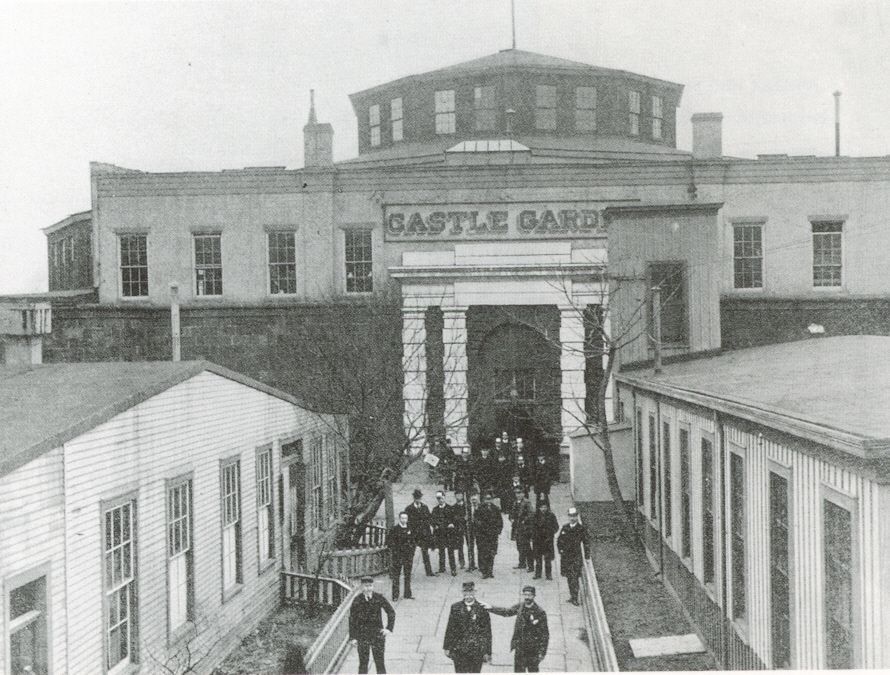
Castle Garden was New York’s immigration station from 1855 to 1890. The building is Castle Clinton, on the battery at the tip of Manhattan, and the National Park Service documents the site at nps.gov/cacl. If your ancestor arrived at New York in those years, the place to look is a passenger list for the port, not an Ellis Island manifest. Ellis Island’s years as an immigration station are 1892 to 1954. The two stations are neighbors in the family story and different buildings in the records.
This page does not estimate how many people passed through the Garden. Counts are easy to garble and unnecessary for finding one person. What you need is the year, the kind of list that existed then, and a way to reach the image.
The station, the gap, and the island
Use the dates as a filter on the story you were told. An arrival in 1870 cannot be an Ellis Island arrival. An arrival in 1910 cannot be a Castle Garden arrival. An arrival “around 1890” sits on a seam. Historians describe the Barge Office as the interim station between Castle Garden’s close and Ellis Island’s opening, around 1890 and 1891. This page will not invent a precise number of days for that interim. Search the passenger lists for the year. Name the station only when a source supports it.
Relatives often say “Ellis Island” for any New York landing. That is a memory of the famous station, not a date. Test it. The Ellis Island passenger-list guide explains the later manifests, which are usually richer. The free-search guide explains the Foundation, FamilySearch, and the National Archives as doors. Those same doors often cover earlier New York arrivals, which is why a Castle Garden search does not require a separate forgotten website.
Customs lists are older than the station
Passenger lists for the port of New York exist before Castle Garden opened as an immigration station. The National Archives discusses arrival records on its immigration research page. A data file associated with the Castle Garden Immigration Center collection documents years that begin in 1820, which is before the station. Do not describe an 1840 arrival as a Castle Garden processing just because a database with that name returned a row. Say that you found a customs passenger list entry. Say Castle Garden when the year falls between 1855 and 1890 and you are talking about the station.
The distinction matters for Italian research because the early customs list and the later immigration manifest do different jobs. The early list can prove that a person of a certain name and age sailed to New York. It often cannot prove a comune. The later list, especially in the Ellis Island decades, is more likely to include a last residence that you can test. If you are choosing where to spend an evening, a vague 1870s arrival with a common last name is a weak path to a town. A petition or a child’s record may name the town faster. Still search the list. An age and a date are worth having. Just do not expect the column that later manifests use for a village.
Where to search
The Foundation’s Arrival Records Collection is a free search the Foundation describes as covering passenger manifests for Ellis Island and the Port of New York, plus a wider set of arrival records. Earlier New York arrivals are part of what that wider net is for. Search there with the Italian name and a year before 1892. If the result is a list of customs passengers rather than a two-page twentieth-century manifest, you are in the right era. Open the image anyway.
The National Archives Access to Archival Databases series “Ship Passenger Records” documents 1820 through 1912. The series description ties it to the Castle Garden Immigration Center collection and says the data were extracted from customs passenger lists. Treat every hit as an index, not as the record. The file can give you a name and some typed fields. It will not show you whether the town was a ditto, whether the age was smudged, or whether the person above was a relative. When a row matches, go find the image.
Ancestry’s collection 7488, titled New York arriving passenger and crew lists, including Castle Garden and Ellis Island, 1820 through 1957, is a subscription index of the long New York series. It includes the Castle Garden years. It is not the only copy. If you already subscribe, it is a reasonable place to search those years, especially when you want one site to cover 1820 through the Ellis Island period. If you do not subscribe, the Foundation search and the AAD series are real alternatives for finding a candidate. Either way, read the image before you copy a place name into your tree. Ancestry’s homepage is the way in if you decide to use a subscription. This page carries an affiliate relationship with Ancestry. The relationship does not make the subscription the only place the lists exist.
FamilySearch’s catalog is the other free place to look for a digitized film of New York passenger lists. The method is the same as on the free Ellis Island page: search the catalog by port, do not trust a collection number from a blog, and obey any note that sends you to a FamilySearch Center. The wiki page on Italy emigration and immigration is the orientation, not a substitute for the list.
How to read a short line
A Castle Garden-era line often has fewer questions than a manifest from 1912. You may see a name, age, sex, occupation, the country to which the person belonged, and a destination country or place. You may not see a last residence in an Italian village, a relative in the old town, or a travel document number. Those columns became more common as the forms were revised. Do not scold an 1874 list for failing a 1910 checklist, and do not invent the missing town from the ship’s port of departure.
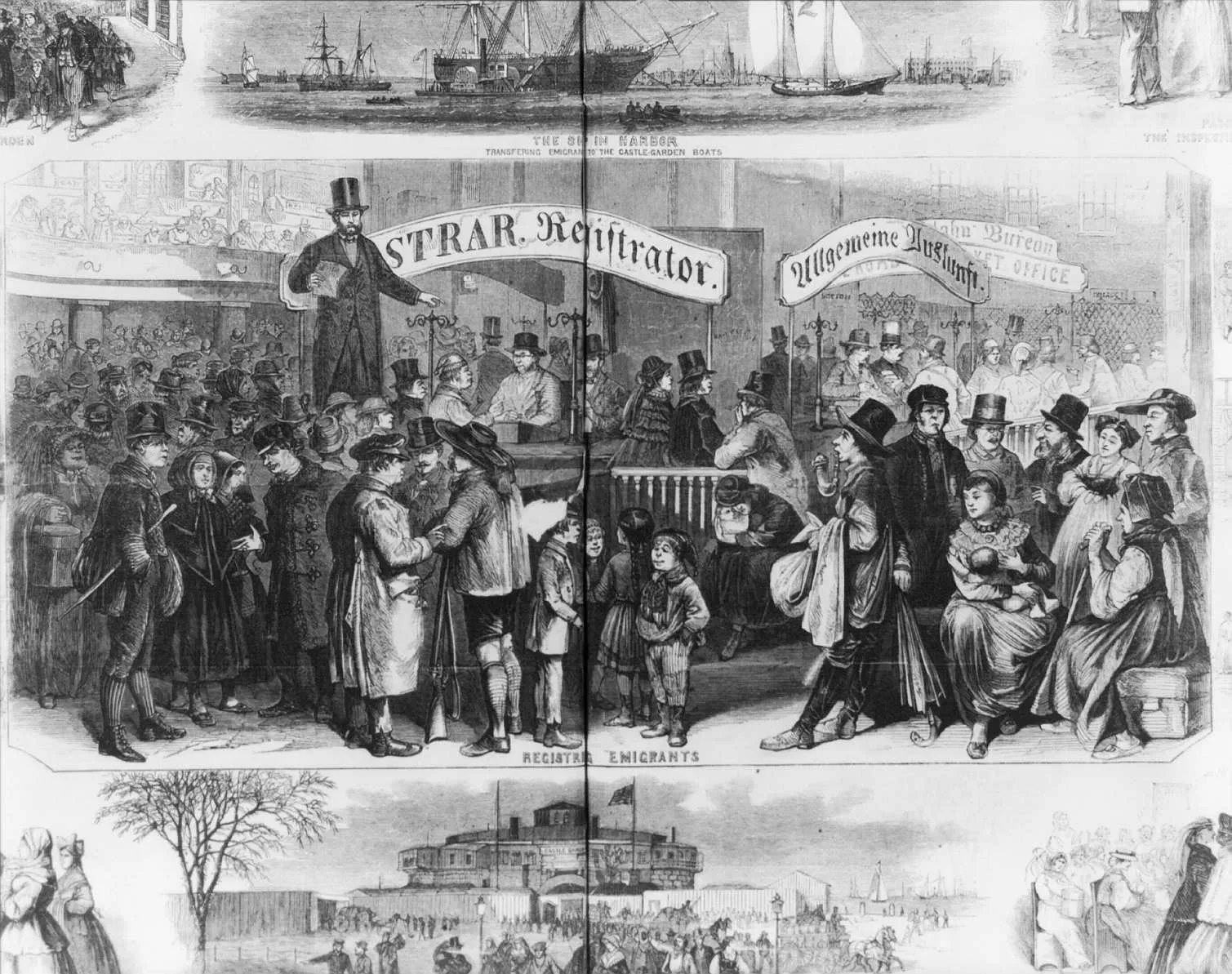
Immigrants at Castle Garden, New York. Wood engraving in Frank Leslie's Illustrated Newspaper, 20 January 1866. Artist not named. Library of Congress. Public domain.
Transcribe what is there. Note the ship and the date. Note the occupation and the age. If several people of the same last name sit on consecutive lines, copy all of them. A household can be visible even when no column says “family.” Invented example: a line for “Lucia Greco, 28, female, Italy” followed by two children with the same last name is a household hypothesis. It is not proof they are hers until the image shows a relationship or a later record ties them together. Keep the hypothesis in your notes with the words “same list, consecutive lines.”
Ditto marks matter on these lists too. If the country column shows a mark under “Italy,” write Italy. If an index spelled the mark out as a town from ten lines higher, the index is wrong. This is the same rule as on the Ellis Island page, and it is stricter here because the index-like AAD file is one more step removed from the page.
What to do with a list that says only Italy
A country without a town is a normal outcome for this period, not a failed search. Record it. Then use the age and the arrival year as tests on other records.
A naturalization petition from after 1906 may name a town of birth and an arrival date you can compare with the Castle Garden list. If the dates disagree by a year, keep both and see which one the rest of the file supports. People misremembered arrival years. Clerks misheard them. The list is usually better for the voyage. The petition is usually better for the birthplace, and not every petition has one.
A death record or an obituary may name a town the 1870 list never asked for. The immigration records guide puts those sources in order. A child’s birth record in the United States sometimes names the parents’ birthplaces more clearly than the parents’ own arrival list. Search the child if the parents’ list is mute.
When you do get a place string, even a province, take it to the hometown guide before you open Italian registers. Castle Garden passengers who later settled in a known American city can also be followed in a census. The census will not usually name the comune. It will tell you whether the age and the arrival year you took from the list are even roughly stable.
A small search plan
Pick one person. Write the Italian name, an approximate birth year, and the arrival year if you have one.
Search the Foundation arrival records for New York in that year. Open any image that matches the age within a few years. If the name is common, require a second fact before you keep the hit: a child of the right age, an occupation you already know, or a destination that matches the city where the person later appears.
If the Foundation search fails, try the AAD Ship Passenger Records series as an index, then hunt the image. If you have Ancestry, search collection 7488 for the same year. Do not stop at the transcript screen.
If the year might be 1890 or 1891, search the lists and note the Barge Office only as the interim station historians describe. If the year might actually be 1893 or later, switch to the Ellis Island reading guide. Families compress decades.
Log the search on the worksheet, including “no town on the list” when that is the result. That sentence will stop you from searching the same customs film next month under a slightly different spelling and hoping a village appears. Villages, when they exist for this generation, are more often in a later American document or in an Italian register you reach after the town is known. The beginner sequence still applies: American record first, place second, Italian register third.
Sources
Questions readers actually ask
My ancestor arrived in 1886. Should I search Ellis Island?
Search New York arrival lists for 1886, and do not describe the landing as Ellis Island. Ellis Island opened as an immigration station in 1892. In 1886 the New York station was Castle Garden, also called Castle Clinton. The passenger list is still a customs or immigration list for the port, and it may be digitized in the same websites that hold later New York lists. What changes is the form. Early lists are often short. You may get a name, an age, a sex, an occupation, and a country, without an Italian town. Use the National Park Service page for the site history, and use the Foundation's arrival search or the National Archives as the way in. If the family only guessed the year, search a range, because a story of "the 1880s" sometimes turns out to be 1893.
What is the Barge Office gap?
Historians describe an interim period around 1890 and 1891, after Castle Garden closed and before Ellis Island opened, when arrivals were handled at the Barge Office. This page does not turn that interval into a count of days. If your person's arrival falls in that seam, search New York passenger lists for the year you have, and do not force the story onto one building. The list, if it was filed, is what you can cite. The building explains why a relative's speech about "the island" may be a later simplification. Write the arrival date from the manifest and the station only if a source identifies it. A list from those months is still worth reading for name, age, and country.
The AAD database showed a name. Is that the manifest?
No. The National Archives Access to Archival Databases series called Ship Passenger Records documents 1820 through 1912. It comes from the Castle Garden Immigration Center collection and was extracted from customs passenger lists. It is an index-like data file. It can point you to a person and to some of the fields a typist entered. It does not show the handwriting, the ditto marks, or any column the typist skipped. When a row looks right, find the manifest image through the Foundation's arrival search, a National Archives copy, or Ancestry's New York passenger collection if you subscribe. Cite the image. Keep the AAD hit as the finding aid that led you there. If the image and the data file disagree, follow the image.