
Surnames
Italian surname origins
What Italian surname patterns can mean, and why a spelling, a crest, or a dictionary label is not a family's origin.
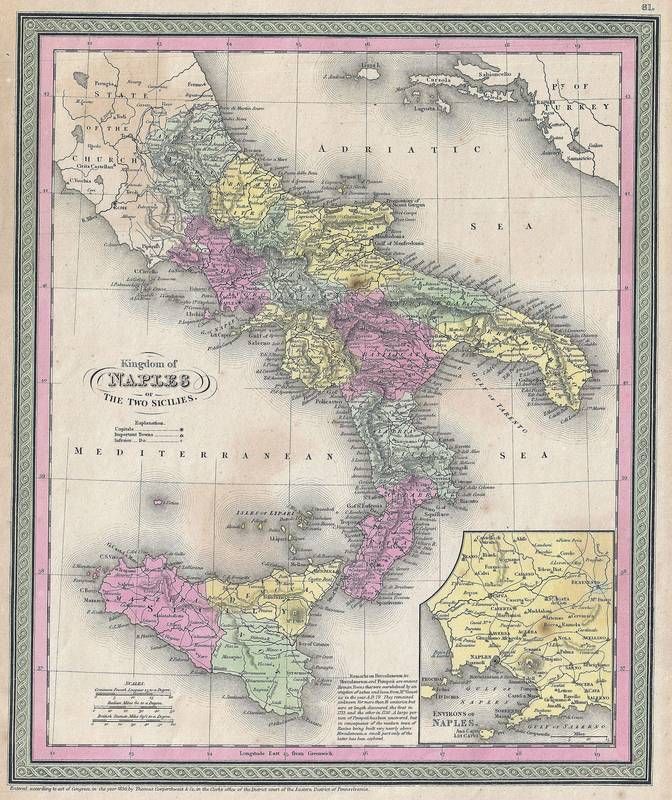
An Italian surname origin, in the only sense this page will use, is a remark about how a word is built. It is not a family tree, not a village, and not a title. The temptation to make it those things is the entire market in surname books and surname websites. The archives did not file births by etymology. They filed them by comune. If you remember that, the patterns below are useful. If you forget it, they are a way to spend a year on the wrong story.
The surname hub is the short version of the same caution. This page is the vocabulary. It explains four patterns you will see discussed in dictionaries, and it explains what none of them can prove about one household. It does not assign your spelling to a province. The distribution maps are the separate question of where a spelling showed up in telephone listings. The Sicilian and southern pages refuse a different over-reading, the one that turns a spelling into an ancient people.
Patronymic patterns
A patronymic surname is built from a father’s name or from a personal name treated as a father’s name. In Italian the relationship often shows in a particle: Di, De, or D’, roughly “of” or “from” in the grammatical sense, attached to a given name. Di Marco has the shape “of Marco.” De Luca has the shape “of Luca.” The particle is a clue to the pattern of the word. It is not a clue that a man named Marco was the father of your immigrant, and it is not a clue that the family is unrelated to people who spell the name without the particle.
American clerks dropped particles constantly. A petition may say Marco where the Italian act says Di Marco, or the reverse, a clerk may have added Di because the name sounded Italian. Search both. Write both on the worksheet. When you are inside an Italian index, search the form the index is likely to have used, which is the form with the particle if the clerk in the comune heard it that way. Do not “correct” the act to match the American spelling.
Other last names are patronymic in shape without a particle. A given name standing alone as a surname can have the same history of formation. That possibility does not identify a generation. Formation happened long before your immigrant, or it happened in more than one town to more than one family. The pattern does not date itself.
Toponymic patterns
A toponymic surname echoes a place or a landscape. The word may match a town, a region, a river, or a common geographic noun. Romano, as a word, can mean a person associated with Rome. That sentence is about the word. A person with the last name Romano is not thereby from Rome, and a person with the last name Napoli is not thereby from the city of Napoli. Place-names became surnames in many towns at once, including towns far from the place the word points at. If your ancestor was actually from Rome, a record will say so. The last name will not.
This is the pattern that most often tricks people into skipping the gazetteer. They see a town inside the surname and book a search of that town’s registers. Sometimes they are lucky. Often the town in the last name is a word the family carried from somewhere else, or a word that was never a migration at all. Use the hometown guide on the place written in a document. Use the Italy Gazetteers wiki to test it. Do not use the last name as the place.
The same warning applies when the surname matches a province you have been hoping for. Hope is not a catalog. The regions hub is where province and archive are explained. Open an archive because a record named a town in that province, not because the last name resembles the province.
Occupational words
Some surnames are identical to job titles. Ferraro is the word for a worker in iron, a smith. Pastore is the word for a shepherd. Those are meanings of the words. They are not proof that your ancestor, or any particular person of that last name, worked that job. By the time a name is hereditary, the household can be doing something else entirely, and the civil act will say what they were doing if the official bothered to write an occupation. Believe the act. The act is about those parents on that day. The last name is about a word that may have described someone, somewhere, at the time the name stuck, or that may have been a nickname comparing someone to the trade.
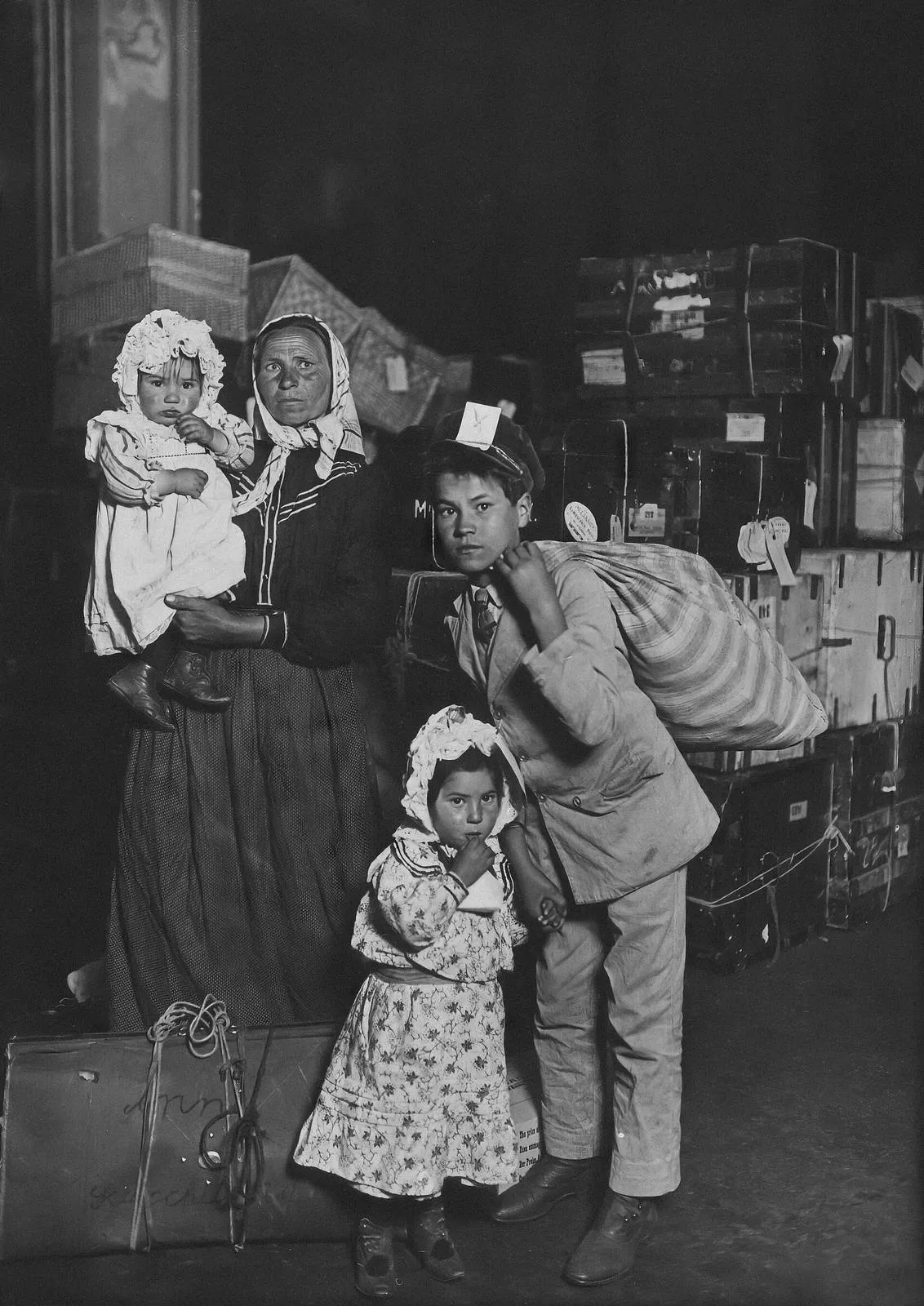
Italian family in the baggage room at Ellis Island, 1905. Photograph by Lewis Hine. The Commons author field spells the surname Hines. Public domain.
You will see occupational words inside the acts as well, in the occupation line, in Italian. Those lines are evidence. The word list is for reading them. Do not mix the occupation line up with the last-name line and decide they confirm each other. A man with the last name Pastore whose act calls him a shoemaker is a shoemaker in that act. The surname has not been disproved. It has been shown to be a surname.
Nicknames
A further pattern is the nickname: a body, a temperament, a comparison. Rosso, as a word, is “red.” The last name can come from that kind of label. Again, the translation does not tell you that your ancestor had red hair, and it does not tell you which ancestor, if any, was first called that. Nickname last names are especially easy to over-translate into a personality. Dictionaries enjoy them. Registers ignore them. You should too, once you have understood the word well enough not to be impressed by a paragraph of folklore.
What dictionaries are for
A careful surname dictionary can teach the pattern, cite older written forms, and warn you that a spelling has several explanations. That is worth an evening. A careless one assigns a single province, a single noble house, and a crest. The assignment is the part you cannot use. Treat any sentence of the form “this name comes from the province of” as a hypothesis that still needs a household. If the book names a century and a village and does not show you a record, it has not finished the job. This site will not repeat those assignments, and it will not rank spellings by how many families use them. Rankings of that kind are statistics this page does not have.
Sicily adds a special version of the dictionary problem. The island’s history includes Greek, Arabic, Norman and Spanish periods, and some dictionaries discuss those layers. The Sicilian surnames page explains why a layer in a dictionary is not an origin you can stamp on a family. A spelling does not prove an origin. Do not accept a list that sorts names into those periods as if the sorting were genealogy.
Heraldry is a grant, not a spelling
Heraldry belonged to particular grants. A shield identified a grantee, or an institution, under the rules of the time and place that issued it. It did not identify every later person whose name was spelled the same way, and it did not survive unchanged as a family logo. A commercial coat of arms sold for a spelling is a picture attached to letters. It is not evidence of nobility. It is not evidence that your immigrant’s grandfather used that picture. If you want to know whether a specific, identified person was granted arms, you are in a different kind of research, with grants and contemporary descriptions, and this page will not pretend a last-name shop has done it.
The practical test is simple. If the crest disappears when you close the shopping cart, it was never a source. Spend the same money, if you spend any, on a record copy the office has priced itself, or on a book about records rather than about shields. The book guide names a few real research books and tells you to read the free Antenati guide and the FamilySearch Italy wiki first.
How the patterns change the search, slightly
Particles change the way you type a search. Occupational and nickname translations change nothing about which archive you open, except that they keep you from opening the wrong one out of romance. Toponymic lookalikes are the only pattern that can actively misfile you, by sending you to a town that matches the last name and not the household. When a document already names a town, and the surname also looks like a town, follow the document.
Invented example. A family in Connecticut spells the name Ferraro. A website says the name is a smith’s name from Naples and sells a crest. The passenger list for the immigrant, matched by age and by his wife’s last name, says last residence Bisignano and port of departure Napoli. Ferraro, as a word, can mean a worker in iron. That is the whole etymology you need. It does not make him a smith, and the crest does not make him noble. Bisignano is a comune in the province of Cosenza. Napoli on that list is the port. The search goes to the Archivio di Stato di Cosenza, which the Calabria guide explains how to open from Antenati, not to a crest and not to every Ferraro in the city of Napoli.
If the list had no town, the etymology would still not supply one. You would look for another record in Connecticut, and you might glance at a distribution map to see whether the spelling is too common to point anywhere. You would not write “smith, Naples” into a tree.
After the word, the act
When you do have a comune, the last name becomes a string you match in an index and then check in the act. Parents’ names decide the match. A surname match alone, in a town where the name is common, is not an identification. Read the act using the Antenati guide and the portal walkthrough. The FamilySearch Italy Genealogy wiki is the wider map of record types if you want a reference that is free and maintained. The beginner guide is the order of work.
Origins are interesting after that, as language. They are a poor substitute before it. If a paragraph about your last name cannot name the comune it is talking about, and show the act, it is not about your family. It is about a word that your family happens to use.
Sources
Questions readers actually ask
Does the meaning of an Italian last name identify my ancestor's town?
No. A meaning is a statement about a word. Patronymic particles, place-words, occupational words and nicknames are patterns you can learn so you stop over-reading the name. They do not place a household in a comune. Two families with the same spelling can have no shared paper trail, and one spelling can be common in more than one province. The town comes from a record made after emigration, or from a civil or parish act once you know where to look. Use the hometown guide for a garbled place string. Use Antenati after you have a municipality and a province. A dictionary that offers a single village for a spelling is offering a story, not a search.
Are Italian coats of arms evidence of nobility?
A commercial coat of arms sold for a spelling is not evidence of nobility. Heraldry belonged to particular grants, to particular people and institutions, not to every person who has ever used the spelling. A website that pairs your letters with a shield, a helmet and a paragraph about knights has matched a product to a string. It has not opened a register and it has not produced a grant. If a family really was armigerous, the evidence would be a grant or a contemporary use tied to identified people, not a last-name page with a checkout button. For family history, ignore the shield and copy the parents' names from the act.
What should I do with a surname and nothing else?
Keep the spelling variants, and go find a place. Write every form the documents use, including forms that dropped Di, De or a final vowel. Then search records in the country where the person settled: a passenger list, a petition, an obituary, a marriage record. You are hunting a town of birth or last residence. A distribution map can suggest provinces where the spelling clustered in telephone listings, and the map article explains why that cluster is not an ancestor. Do not write to an Italian comune with only a last name. Do not buy a crest while you wait. The beginner guide is the longer sequence, and it starts in the country of arrival on purpose.