
U.S. and emigration records
Ellis Island passenger lists
How to search an Ellis Island passenger list and read the image for a last residence that may name an Italian town.
Affiliate disclosure.Some links on this page go to genealogy companies. If you buy through them, we may earn a commission, at no extra cost to you. We recommend a site only where it helps this kind of research. Read the full affiliate disclosure.
An Ellis Island passenger search is useful when it produces a line you can read, not when it produces a name in a results list. The line is a row on a ship manifest. For Italian research the prize on that row is the last residence, because it may be the town where the civil register was kept. It may also be a port, a province, or a word the clerk only half heard. You will not know which until you see the image.
Ellis Island operated as an immigration station from 1892 to 1954. The Statue of Liberty—Ellis Island Foundation’s Arrival Records Collection is a free search of passenger manifests for Ellis Island and the Port of New York, and the Foundation describes a wider set of arrival records as well. A person who landed at New York in those decades may appear in that search. A person who landed earlier was not processed at Ellis Island. Use the Castle Garden guide for the station that preceded it. This page is about how to read a line. The free-search guide is about where to open the search without a subscription.
What you need before you type a name
Write a small brief on the ancestor worksheet before you open a search box. You want the last name as it was spelled in Italy and the surname as it was spelled after arrival. You want the given name in Italian and the English name the family used later. Giuseppe may be Joseph. Giovanni may be John. Vincenzo may be Vincent or James. Concetta may be Connie. Search the Italian form first.
Add an age or a birth year, even if it is a range. Add the year the person said they arrived, if a census or a court paper records one. Add anyone who might have traveled on the same ticket: a wife, a child, a brother. A companion with an unusual given name is often easier to find than the head of the household.
Leave unknown facts blank. A ship name you invented from a family story will hide the right manifest if you type it into a filter. The Foundation’s arrival search treats fields as optional. Use a ship name only when a document or a newspaper notice gives you one.
Search the arrival records, then open the image
Start at the Foundation’s Arrival Records Collection. Search by name. If the form offers a year, a port, or a ship, add those only when you have them. A wide search that returns many rows is more honest than a narrow search that returns the wrong person cleanly.
The Foundation’s search page has warned that passenger IDs saved before April 1, 2026 are no longer valid, and that the way back to a record is to search by name. If an old bookmark or a note in a tree stores only an ID, do not treat a failed ID lookup as a missing passenger. Search the name again and read the notice on the current page, because the form can change.
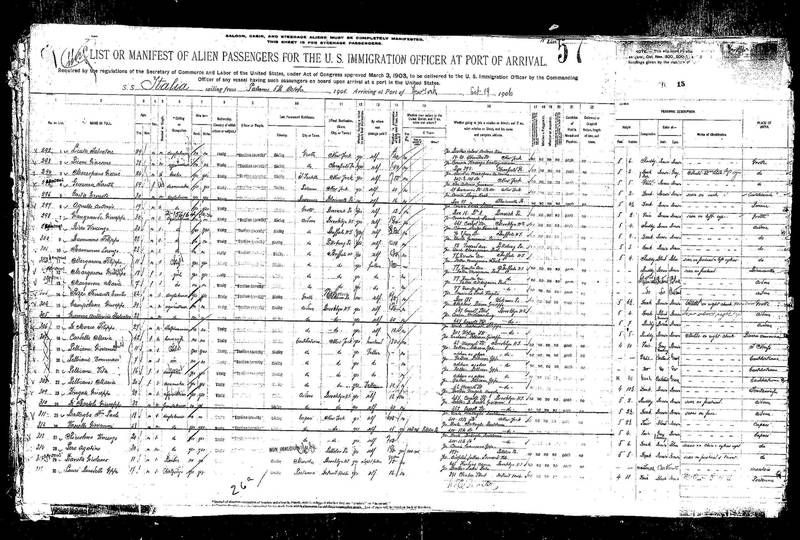
When a row looks possible, open the manifest image and read the headings on that page. Transcribe the line and anyone with the same last name nearby. Record the ship, the arrival date, and the list and line numbers so you can find the image again.
An index is a finding aid. It can drop a column, misread a letter, or expand a ditto mark into the wrong town. The National Archives describes passenger arrival records on its immigration research page. Whatever copy of the list you use, the handwritten or printed row is the source. The typed index is not.
A second search box, with a limit
Stephen P. Morse’s One-Step forms are a secondary way to query Ellis Island database entries. The gold form was built for the database years 1892 through 1924, and the introduction explains the forms. If the site those forms query has changed, a form may return no results. That empty result is not evidence the passenger never arrived. Repeat the search in the Foundation’s Arrival Records Collection, the primary free door. The free-search page compares the doors.
What a manifest line can include
Columns changed over time. Early lists are short. Lists from the early twentieth century often run across two pages and ask more questions. There is no single checklist that describes every year. The headings on the image in front of you are the checklist for that voyage.
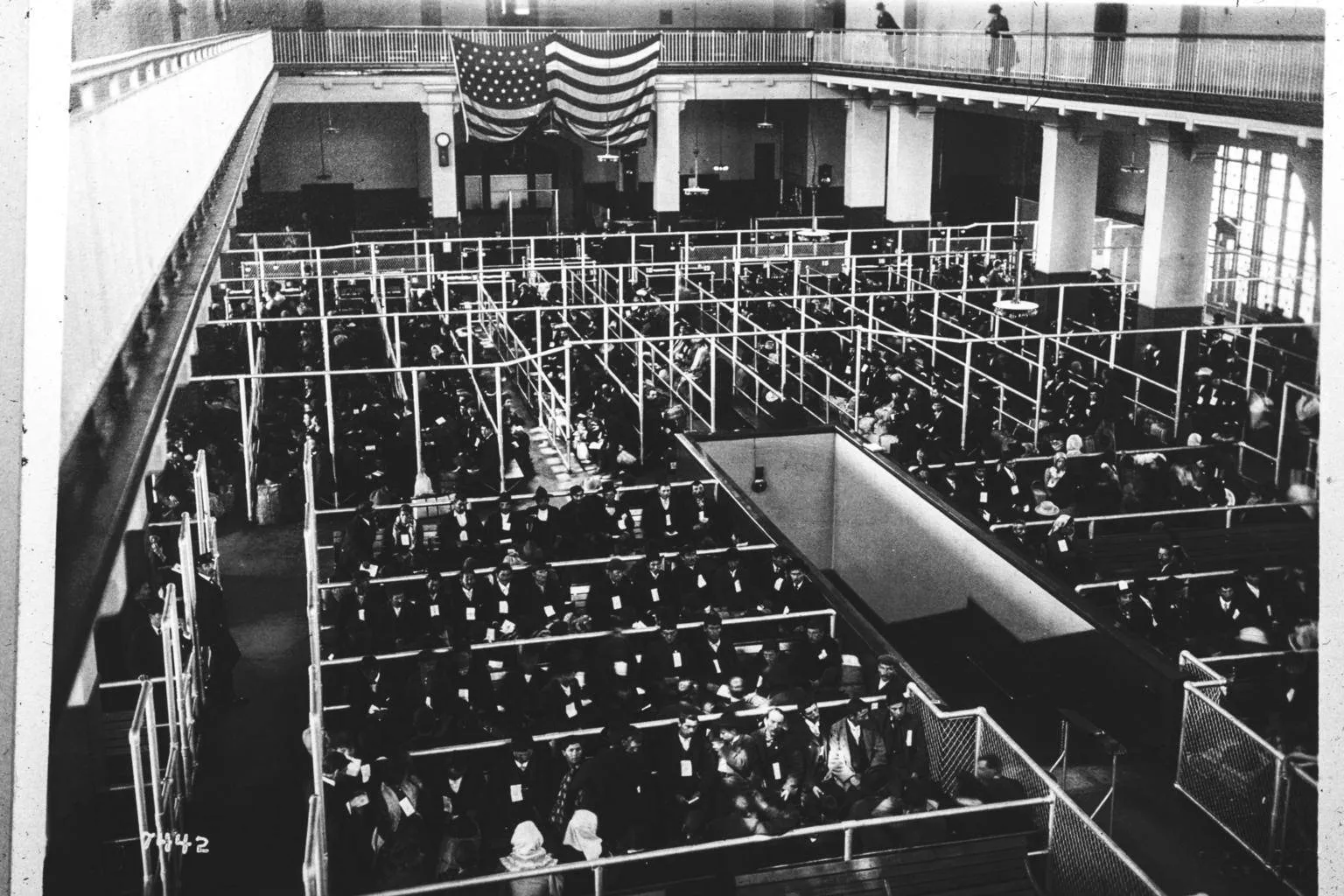
The registry room at Ellis Island, photographed by Edwin Levick between 1902 and 1913.
A line often includes the name, age, sex, marital status, and occupation. It often includes a last residence, a destination, the name of the ship, and the date of arrival. Depending on the year, it may also include who paid for the passage, the name of a relative left behind, the name and address of a person the passenger was joining, whether the passenger could read, a physical description, a birthplace distinct from the last residence, or a travel document number. Later lists are where those extra columns tend to appear. Do not copy a column from a list of one decade onto a list of another. If the heading is not on the page, the fact is not on the page.
Nationality, when the form has that column, is separate from last residence. Copy them into separate fields. “Italian” plus a town is more useful than a note that only says “from Italy.” Marital status and occupation are worth keeping beside the age, even when the occupation is only “laborer.”
Last residence is the prize, and it can disappoint
Last residence is the column Italian researchers came for. When it names a small place, you may finally have a string you can test against a gazetteer. Take that string to the hometown guide before you browse a register. A spelling on a manifest is a clerk’s spelling. It can be a frazione, a comune, or a province, and those three do not open the same book.
The same column fails in predictable ways. The clerk wrote the port: Napoli, Palermo, Genova. The clerk wrote the province and stopped. The clerk wrote a city that was the nearest place he recognized. The clerk repeated the town from the line above with a ditto, and an indexer expanded the ditto incorrectly. The passenger’s last home was a spouse’s town, not the town of birth. Any of these can be true on a clear, well-indexed line.
Invented example: a row reading “Rossi, Antonio, 24, male, single, laborer, last residence Cosenza” does not tell you whether Cosenza is the city or the province. It does not tell you he was born there. It tells you what that column says. If his petition later says he was born in a small town in that province, the manifest supports the region and the petition is the better pointer to the comune. If you only have the manifest, search the string as a candidate and keep a second candidate. The Campania and Sicily pages are for after you know which region the string belongs to, not before.
When a later list has both a birthplace and a last residence, copy both and do not merge them. A young man may show the same place in both columns. A married woman may show her husband’s town as the last residence and her parents’ town as the birthplace. The heading decides what you are allowed to conclude. Write “last residence” or “birthplace” next to the words. The beginner guide depends on that distinction when you move from American papers to an Italian register.
Names that hide the right row
Search more than one spelling. Drop or keep the final vowel. Try the last name with and without a particle: Di Marco and Dimarco, La Rosa and Larosa, D’Angelo and Dangelo. Double surnames may have been shortened to the second word. A married woman may be listed under her maiden name, which is what you want for the Italian birth act, or under her husband’s last name.
Given names were shortened or translated. Search the surname with an age if you only know the American given name, then read the given name on the image. If the last name is common, add a traveling companion. Children are sometimes listed by a diminutive, so read the whole group before you decide a child is missing. If the main list marks someone as held and the image set includes a later detained page, look there. If that page was not digitized, say so in the log. Do not assume the person was turned away.
What to copy, and what not to upgrade
Copy the line as a quotation, then add a short reading in your own words that stays inside what the columns say. A good note names the ship, the arrival date, the last residence as written, the person being joined, and the city of destination. Those last two facts tell you where to look for the census, the church, and the court.
Do not upgrade last residence into “born in,” and do not turn a brother’s address into a lifetime residence. Other ports kept lists too, including Boston, Philadelphia, Baltimore, and New Orleans. The National Archives research page is the overview. If New York fails, try the port the family actually names.
Ancestry publishes New York arriving passenger and crew lists, including Castle Garden and Ellis Island years, as another index of the same kind of record. It is not the only copy. Use it to find the image, then read the image. The free-search page compares the doors.
When the list will not name a town
Some manifests will never give you a comune. The column is empty, the word is only “Italy,” or the word is a port. That is still a useful document. You have an arrival date, a ship, an age, and a destination. Those facts test later stories. They also give you a year to carry into a naturalization file, where a birthplace was more often asked after 1906.
Put the result on the record log, including a result of “list found, no town.” Then follow the immigration records map to the next source that might name a place. When a place survives that test, the Antenati portal and the FamilySearch Italy guide are the next browse. If the year is missing online, the not-online guide is the path to a letter, not another hour of the same index.
Sources
Questions readers actually ask
The index names my person but the town field is blank. What do I do?
Open the manifest image and read the line yourself. Blank town fields in an index are often ditto marks on the page, meaning the clerk repeated the residence from the passenger above, or they are columns the indexer did not type. Look at the two lines above and the two lines below, especially when the last name matches. Copy the town only if the handwriting or a clear ditto supports it. If the image really has no place, write "no town on this list" in your log and move to a petition, an obituary, or a Social Security application. Do not fill the gap with the port of departure. Naples, Palermo, and Genoa on a ship line are often where the vessel sailed from, not where the family kept a house.
Last residence says Naples. Does that mean the city of Naples?
Not by itself. On an Italian passenger, Naples can be the port, the city, or a clerk's shorthand for a place in the province. Palermo and Genoa work the same way. Treat the string as a place to test, not as a finished identification. Write it down exactly, then compare it with any town named in a petition, a death record, or a child's birth record. The hometown guide shows how to separate a frazione, a comune, and a province. If a second document names a small town in Campania and the list says Naples, the small town is the better candidate for the civil register, and Naples may only explain the voyage. Search that comune on Antenati before you write to an office.
There are dozens of people with the same last name. How do I pick a line?
Do not pick the first hit because the year is close. Add one fact you already trust: an age within a few years, a given name in Italian rather than English, a wife or child on a neighboring line, or a ship name from a newspaper notice. If those still leave several candidates, keep two and mark both as possible. Invented example: three men named Giovanni Russo, ages 19, 24, and 41, arriving in a three-year window, are three leads, not one match. Read each image. A laborer joining a brother in Brooklyn is a different research path from a married man joining a wife in Philadelphia. When nothing separates them, stop and look for the arrival year on a census or in a court file. Guessing a line wastes the next month of browsing in the wrong province.