
Reading the records
How to read Italian birth records
How to read an Italian birth act: declaration date, parents, midwife, witnesses, and the dates clerks wrote as words.
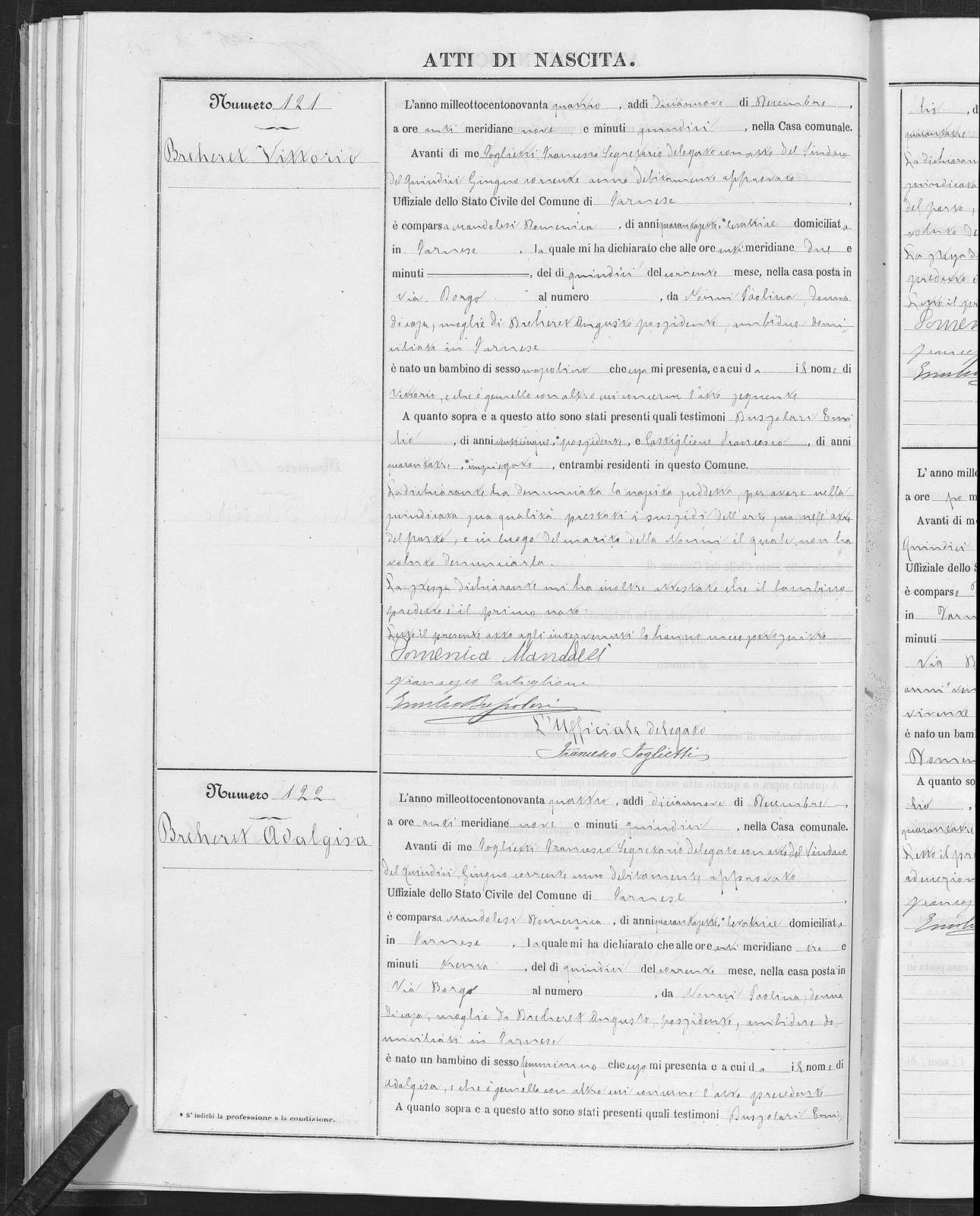
- 1Act number
- 2Office heading
- 3Declaration
- 4Signatures
- 5Margin
- 1 Act number, at the top of the page.
- 2 Heading that names the civil official and the office.
- 3 The declaration: who appeared, when the child was born, and who the parents were.
- 4 Signatures along the bottom.
- 5 A later note can sit in the margin. Read it apart from the original act.
An Italian birth act is a short legal narrative. Someone appeared before an official, presented a child, and named the parents. The clerk wrote that scene in a formula. Once you can see the formula, the handwriting gets much easier, because you already know which sentence comes next. You are not translating a diary. You are filling known slots: who appeared, when the child was born, what the child was named, who the parents were, and who witnessed the statement.
The image on Antenati or in the FamilySearch catalog is the register entry, the atto. A certificato or an estratto is a later copy. Those three words are separated on the estratto page. For reading, you want the atto, because the formula is still there. The birth records overview explains where these books sit in the archive. This page is the reading.
Civil birth acts are in Italian. A Latin baptism is a different book, covered by the church records page and the Latin word list. Keep them in different notes even when they name the same child.
The shape of the page
Look at the furniture of the page before the prose.
The margin often carries the last name, the given name, and the act number, atto n. That margin is how you scan a year. It is also where a later clerk sometimes added a marriage or a death note. Read a margin note as its own sentence, with its own date. It was not part of the original statement. Some acts have no later note. Absence of a note is not a fact about the child’s later life.
The heading names the comune and the year. Trust it enough to orient yourself, then let the first sentence of the act confirm the date. The word list has the months from gennaio through dicembre and the numbers from uno to mille.
Printed forms become common in the unified registers. The FamilySearch overview of Italian civil registration describes printed forms as prevalent around 1875, as a general observation. Earlier acts, and plenty of later ones, are solid handwriting. The slots are the same. On a printed form, read the printed label and then the handwritten blank. On a prose act, the label is the formula itself.
The opening: a declaration, with a clock
The act opens with the date the declaration was received. You will see l’anno, then the year in words, then the day and the month, then alle ore and an hour. Antimeridiane is the morning. Pomeridiane is the afternoon. Oggi means today, the day of the declaration. Ieri means yesterday.
That opening date is the date someone stood in front of the official. The child’s birth date is a later clause. When the clause says ieri, subtract a day from the declaration. When a child was born on 31 December and declared on 1 January, the register year can be the year after the birth. People miss whole births by filing the act under the wrong January.
Avanti a me means “before me.” The speaker is the ufficiale dello stato civile, the civil-registration official. In some towns the formula names the sindaco, the mayor, acting in that role, or a deputy. Copy the title. You do not need to identify the official in your tree. You need to see where his sentence ends and the family’s sentence begins.
È comparso (or è comparsa) means the declarant appeared. The verb comparso is your cue that the next name is the person who walked in, not the child.
The dichiarante, the child, and the names
The dichiarante is the person who reported the birth. Read the words that follow the name:
- A father is often padre of the child, and the act may say he appeared in that role without using the noun, by saying the child was born da lui e da the mother, “by him and by” her.
- The mother appears as madre. Her last name is her own. Do not replace it with the father’s surname.
- The levatrice is the midwife. She is a common declarant when the father was absent. Her name is a name in the act, not a relative, unless the act also says she was related.
- Another relative or a neighbor can declare. The act says who. If it does not say, write “relationship not stated” in your note. Do not promote a witness into a grandfather.
The child is nato if a boy and nata if a girl. Figlio and figlia are son and daughter. Un bambino or una bambina is the infant just presented. The names given to the child usually follow ha dato il nome di or i nomi di. Copy every given name, in order. A second or third name is easy to skip when you only wanted the name the family still uses.
Invented example. A prose act, written here in type so the slots are visible, not copied from a real register:
L’anno mille ottocento ottantaquattro, addì sette di marzo, alle ore dieci antimeridiane, avanti a me, ufficiale dello stato civile, è comparso Bellini Antonio, di anni trenta, contadino, residente in questo comune, il quale mi ha presentato una bambina, nata ieri alle ore quattro pomeridiane da lui e da Greco Caterina, sua moglie, di anni ventotto, e alla quale ha dato il nome di Rosa.
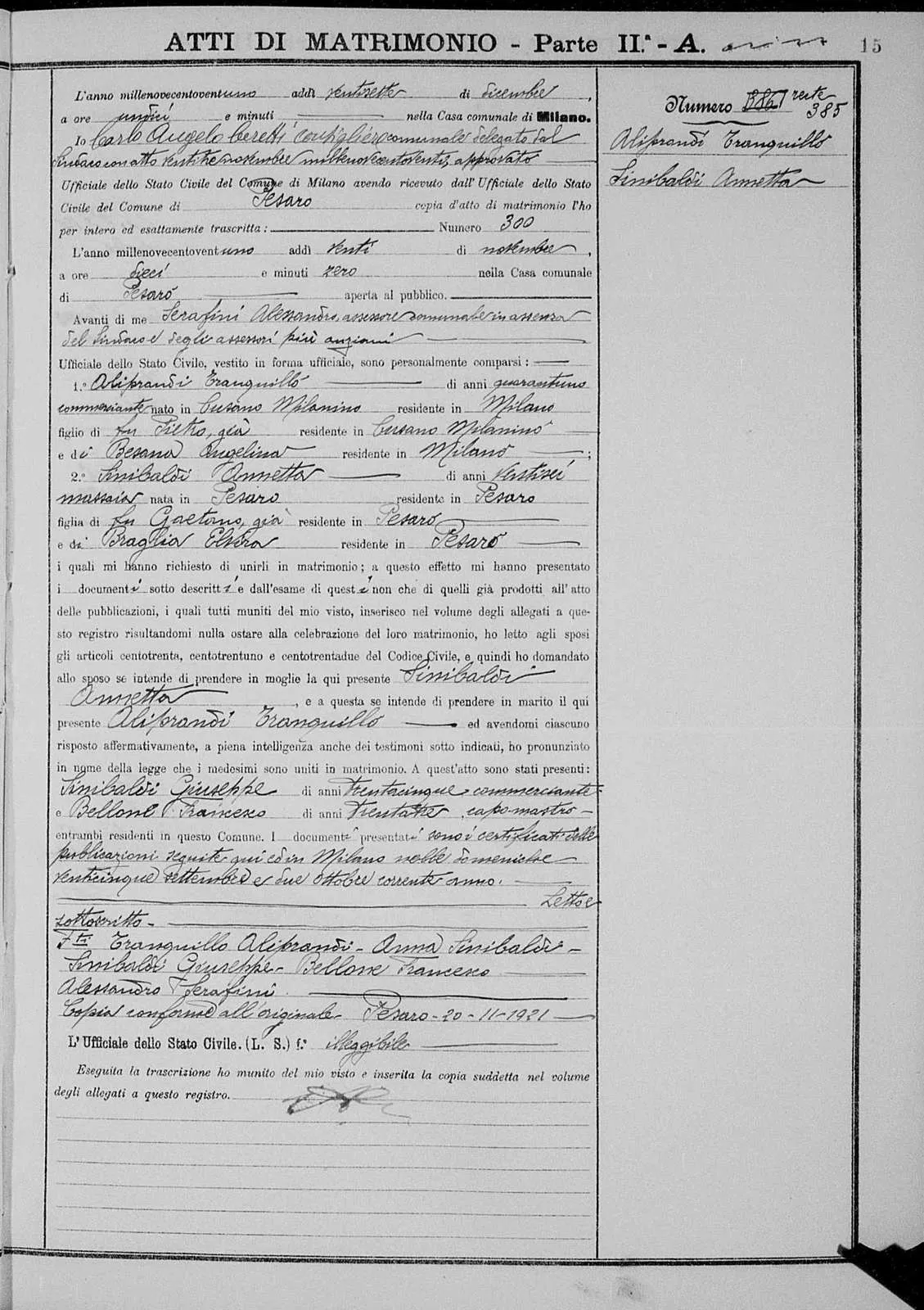
Marriage act of Tranquillo Aliprandi and Annetta Sinibaldi, Milan, 20 November 1921. Civil register of the Comune di Milano. Public domain.
Read it as slots. Declaration: 7 March 1884, at 10 in the morning. Declarant: Antonio Bellini, age 30, contadino (a peasant farmer), living in this comune. Child: a girl, born yesterday at 4 in the afternoon, so 6 March 1884. Mother: Caterina Greco, his wife, age 28. Name given: Rosa. This family is invented. The slots are what you mark on a real image.
Mille ottocento ottanta is 1880. Mille ottocento ottantaquattro adds four. Clerks abbreviated these words heavily. If the middle of the year-word is a scribble, take the year from the title page of the volume and from the act number sequence, and note that the word was unclear. Guessing “1884” because the family story says 1884, without saying the word was unclear, is how a neighboring year gets glued to the wrong child.
Parents, residence, occupation
Parents are named with ages and often with a professione. Di anni trenta is “of thirty years.” Ages are approximate more often than modern readers expect. Copy them. Use them as a check, not as a birthday.
Residente means residing. In questo comune means in this comune. A street, a frazione, or another town may follow. If the father is residente in one place and the mother in another, copy both. Domiciliato can appear beside residente. Keep both words. They are not always the same address, and the act is the authority for what it meant that day.
Occupations are clues to identity when two men share a name. They are also just words. Contadino on Antonio’s line does not describe every Bellini. The word list explains a handful of common occupations as vocabulary, not as a family story. Professione on a printed form is the label; the handwritten word under it is the fact.
A deceased father of the declarant is marked fu, “the late.” Antonio, fu Giuseppe means Antonio, son of the late Giuseppe. That is a lead to Giuseppe’s death, not a statement that Giuseppe died in this town. Search the death registers with that clue, and expect to look beyond a single year.
Witnesses and signatures
Testimoni are the witnesses. The formula names them, with ages, occupations, and residence. A witness can be a neighbor or a relative. Relationship is whatever the act states. Copy the names anyway.
Near the end, the act says who signed. A sentence that someone ha dichiarato di non sapere scrivere, or that he was illetterato, means he said he did not know how to write. That sentence is common. It does not change the child’s name. Note it only so you do not hunt for a signature that the clerk already said was missing.
If a word is illegible, mark the gap in the transcription with square brackets. Do not smooth the Italian into the name you hoped to find. The worksheet works well with two columns: Italian on the left, English on the right.
Numbers, months, and the title page
You can read most birth dates with a small set of words. Months run gennaio, febbraio, marzo, aprile, maggio, giugno, luglio, agosto, settembre, ottobre, novembre, dicembre. Days are ordinals or plain numbers: primo, due, tre, up through trentuno. Tens are venti, trenta. The year pattern mille ottocento plus a ten plus a unit covers the nineteenth century. Mille novecento moves you into the 1900s.
Compare three places when they disagree: the title page, the margin, and the first sentence. Disagreement is a reading problem to record, not a reason to pick the date that matches a family story. The family story may be the thing the act corrects.
From this act to the next one
A finished birth transcription tells you the next book to open. You want the parents’ marriage in the years before the birth, in this comune or in the mother’s. The marriage reading guide is the key for that act, including the allegati and processetti when they were filmed. You may also want the parents’ births, about the age given in this act, in the town the marriage or this birth says they came from.
If the year you need next is not in the listing, do not invent a substitute from a similar last name. Follow the not-online guide: confirm the gap, check FamilySearch, then the comune letter. A baptism, if you want the church entry as well, is the parish letter.
General ranges on the civil records page help you choose a series. Check the archive’s current listing for the town in front of you.
Log the act number, the image identifier, and the two dates. The beginners’ guide puts this reading step before any hunt for the grandparents, because a misread mother sends the next search into the wrong family. The kit collects the word list and the worksheet so the two columns, Italian and English, are already on the page when the image opens.
Sources
Questions readers actually ask
Is the date at the start of the act the baby's birthday?
It is the date the declaration was made before the official. The birth itself is often "oggi" or "ieri," sometimes with an hour. Copy both dates and keep them labeled.
Who is the dichiarante?
The person who appeared and reported the birth. Often that is the father. It can be the levatrice, the midwife, or another person the act names. Read the relationship the act states.
Why is the year a string of words?
Clerks wrote years in words, such as mille ottocento ottanta for 1880. They also abbreviated those words. Use the title page of the register to anchor the year, then read the words.