
Vital records
Italian civil records and stato civile
How Italian civil registration is organized, which date ranges are only general, and where the birth, marriage, and death volumes sit.
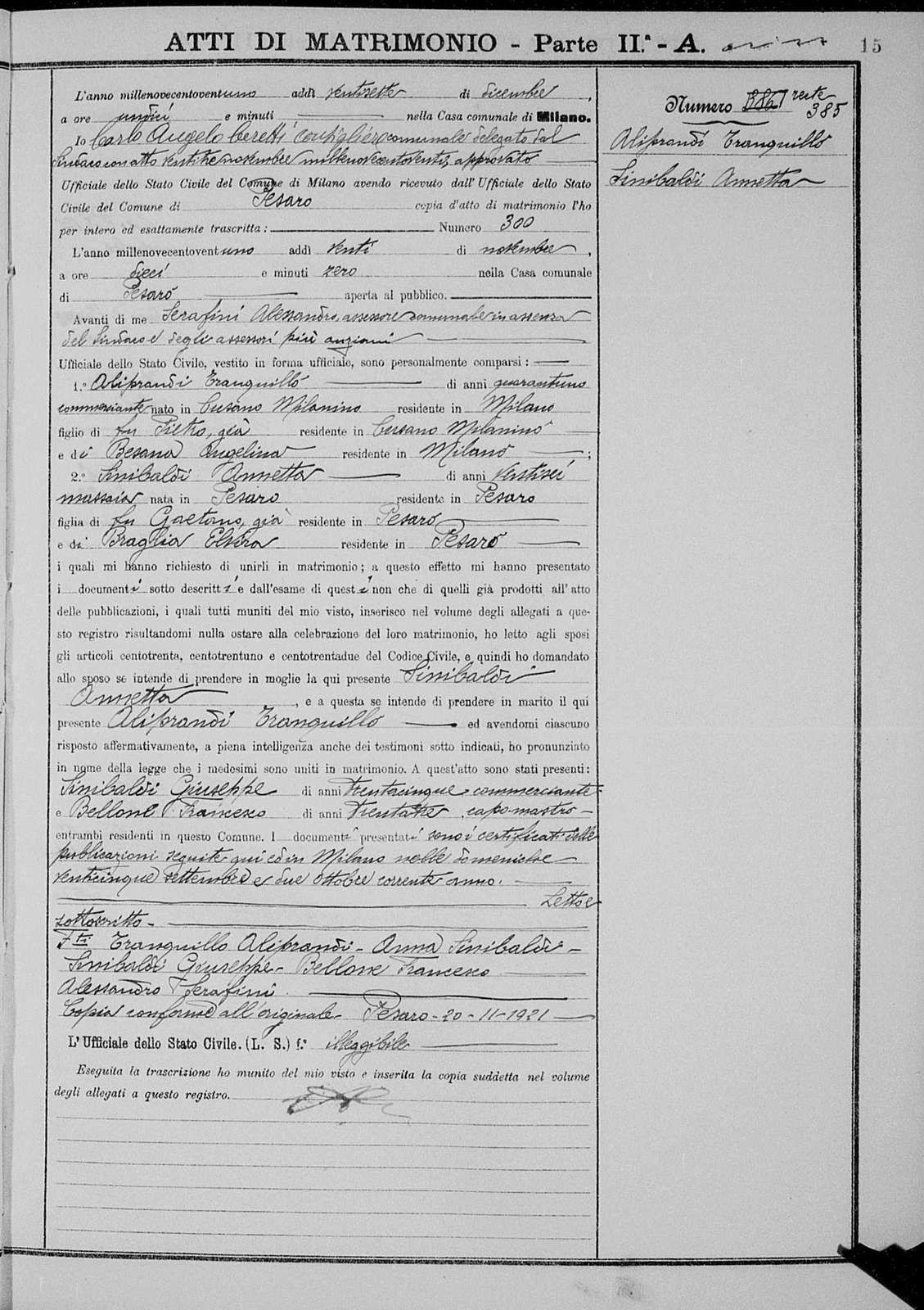
Stato civile is the civil register of births, marriages, and deaths. It is the backbone of Italian genealogy for the nineteenth century and after, town by town. The books were written by a civil official of the comune. Many of the older ones now sit in a state archive, the Archivio di Stato, which is why a national portal can show a village register without the village having a digitization project of its own.
This page is the map of that system. The entries themselves are described on the birth, marriage, and death pages. Church books, which begin earlier in many parishes and keep going alongside the civil series, are on the church records page.
Three event types, one office
Each year, a comune kept acts of birth (atti di nascita), marriage (atti di matrimonio), and death (atti di morte). The annual books are the atti. A ten-year index, an indice decennale, gathers a decade so you can find an act number. Some decades also have separate volumes of marriage banns (pubblicazioni) and of supporting papers (allegati or processetti). Those are still stato civile. They are not optional extras. A marriage search that ignores them misses the copies of birth acts the officials filed.
The act is the record. Words you will see when you ask for a copy are defined on the glossary page: an estratto is an extract, a certificato is a certificate, an atto is the register entry, and a copia integrale is a full copy of the act. For family history, ask for a full copy or an extract, per ricerca genealogica. The office decides which form it will issue and what it will charge. This page does not set either one.
Mothers appear under their own family names in all three kinds of act. That is the feature that makes the civil series more informative than a later household that has already translated the family into one last name.
Series you will see in a catalog
Catalogs and archive inventories often split the books into series. The labels vary by archive. Three that researchers meet constantly are the Napoleonic civil series, a Restoration series, and the unified Italian series. The dates attached to those labels are general. FamilySearch’s overview of important Italian research resources states them as a pattern, and the pattern has local exceptions.
Napoleonic civil registration, as a general rule, runs about 1806 to 1815 in some areas. In the Kingdom of Naples, Napoleonic-style registration was introduced in January 1809 under Joachim Murat and was reintroduced in 1816 by the Bourbons. That style was not introduced in Sicily until 1820. Unified Italian civil registration is generally from 1866. In the province of Rome it is generally from 1871, because Rome joined the kingdom later. Other pre-unification states had their own start dates. The sentence to remember is the one that keeps people out of the wrong series: the comune’s own volumes control.
A practical result: a birth in 1850 in a southern town that followed the Bourbon continuation is in the earlier series, not in the post-1866 books. A birth in 1866 may be the first year of the new series or the last year of the old one, depending on how that office bound the books. Open the inventory. If a year is absent, say that it is absent from the listing you checked, and check the archive’s current listing before you call the year destroyed.
You will see titles such as stato civile napoleonico and stato civile della Restaurazione on some shelves and not on others. Use the title the archive used. Do not rename a volume to match a guide.
Who holds the books
Antenati exists because state archives hold the historical copies. The Portale Antenati publishes stato civile, liste di leva, and ruoli matricolari from those archives. The Istituto Centrale per gli Archivi states that access is free and that no registration is required. The Direzione generale Archivi lists the portal among its thematic research sites. The portal’s history describes the digitization agreement of June 2011 between the Direzione generale Archivi and FamilySearch, which is why so many of the same books can be opened in both catalogs.
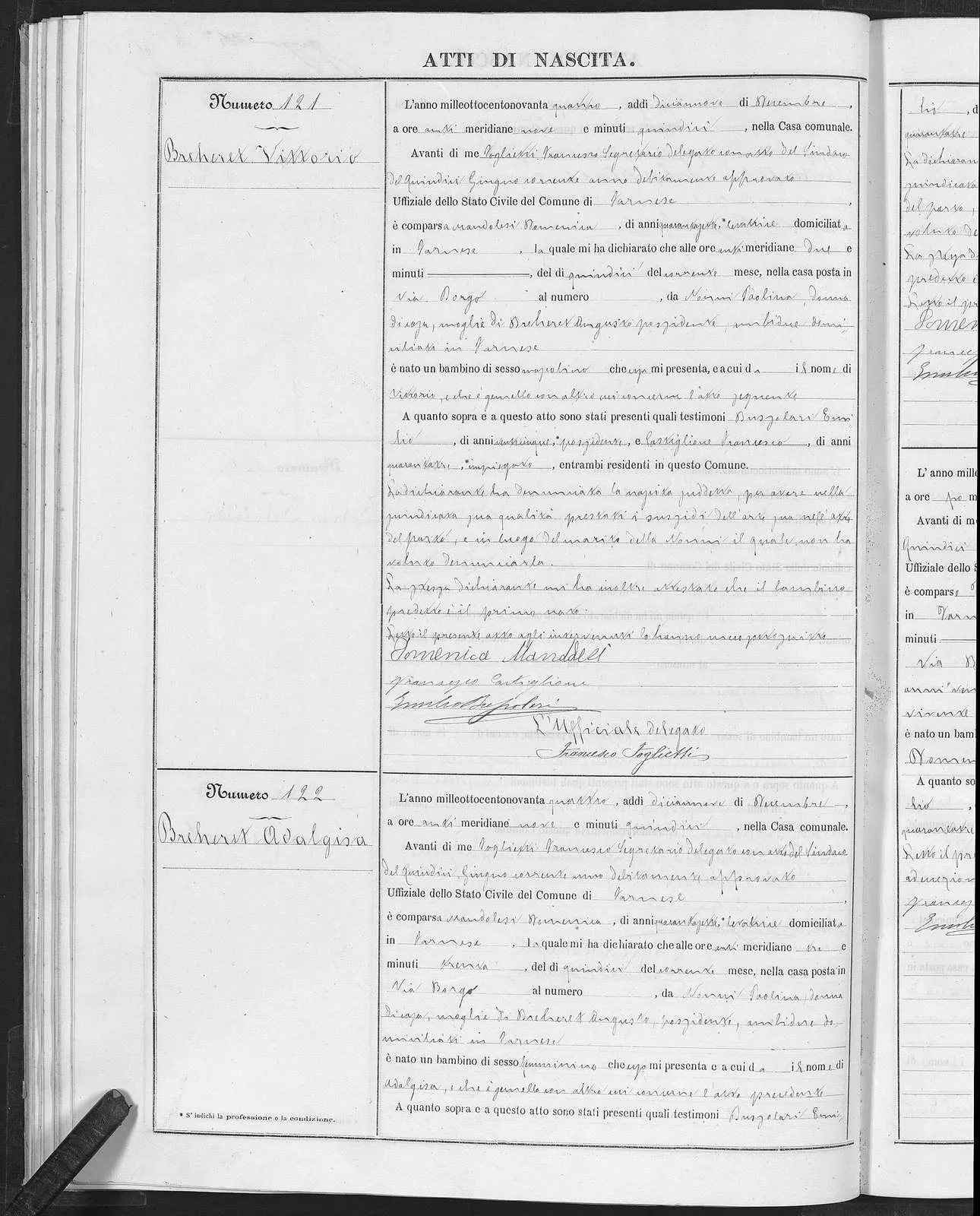
Birth act of Vittorio Breheret, Farnese (Viterbo), 15 December 1894. Civil register published through Portale Antenati. Public domain.
Older volumes are often at the Archivio di Stato. More recent volumes are often still at the Ufficio di Stato Civile. The split is local. Antenati shows what the portal has from the state archive, not everything the comune still holds. When the year is missing, use the not-online guide and write to the Ufficio di Stato Civile. If they say the volume is at the archive, follow that reply.
How to look, in the order the portal expects
The Antenati research guide distinguishes three tools, and the distinction saves hours:
- Cerca per nome searches indexed registers. If the handwriting has not been indexed, your ancestor can be on the site and absent from this box.
- Cerca nei registri searches by place, year, and type of register. This is the ordinary path once you know the comune.
- Esplora gli Archivi is the shelf list: archive, then town, then series, then year.
The Antenati walkthrough and the name-search guide expand those steps. FamilySearch’s catalog is a second door into many of the same films, including image groups that are browsed rather than searched. Use the FamilySearch Italy guide. Read the access note on each image group.
Work from a known comune. A last name plus a region is a hint, not a volume. Identify the municipality with the hometown guide and the beginner guide. The town string is usually in Ellis Island lists or naturalization files.
Indexes, acts, and the habit of stopping too early
An indice decennale lets you jump to an act number. Stopping there is the most common way to cite the wrong person. The index line was made to be short. The act has the parents, the ages, the residence, the witnesses, and the second date. Open it. If the number does not match the family, read around it. Try the mother’s last name. Try the spouse.
On a birth, the declaration date and the birth date can differ. On a marriage, the banns and the wedding can sit in different volumes. On a death, the declarant may not know the birthplace. Those three cautions are why the act pages exist separately. Read the one that matches the event in your hand.
Margin notes tie the series together. A birth that cites a marriage, or a marriage packet that cites two births, is the clerk telling you the next call number. Follow citations. Do not retype them from memory after you close the image. Put the archive, the series title, the year, and the act number on a worksheet.
A practical search order
- Choose one event: one birth, one marriage, or one death. Write the names, a year or a range, and the comune.
- Decide which series could contain that year, using the general ranges only as a hypothesis. Then ignore the hypothesis if the inventory disagrees.
- On Antenati, open Esplora gli Archivi and find the state archive for the province. Open the comune. Read the series titles and the years.
- If the year is listed and indexed, try a name search. If it is listed and not indexed, browse the indice decennale and the annual atti.
- Read the act and any allegati. Copy parents under the last names as written.
- If the year is not listed, search FamilySearch for the same comune and series. Image groups sometimes exist there when a portal browse is hard to find, and sometimes the reverse is true.
- If neither catalog has the year, write to the Ufficio di Stato Civile. Ask whether they hold that act or whether the volume is at the Archivio di Stato. Ask the cost of a genealogical copy. Pay only after they state the amount and the method.
- Use the new names and ages to pick the next event. Stay in one town until the acts in that town are exhausted.
Invented example
The family and the town in this section are invented.
You want the birth of Giuseppe Conte, who appears as a father, age 34, on an invented 1888 birth in Castelnovo del Colle. Subtracting the age suggests the early 1850s. You open Antenati and, out of habit, click the unified civil series. The unified books for this invented town start in 1866. There is no 1854 volume in that series. The birth is not “missing.” You looked in the later run.
The same comune listing shows an earlier series whose title includes the Restoration. Its births cover the 1850s. The ten-year index for 1851–1860 points at act 19 of 1854. The act is Giuseppe Conte, and the parents match the names you already hold from his son’s marriage packet. The series title, not the arithmetic, was the step that had been wrong.
Had that earlier list stopped before 1854, you would have asked the Ufficio di Stato Civile instead of browsing 1866 again. The kit holds the letter, the glossary, and the worksheets for that handoff. Check the current listing when you return to a town, because archives add volumes.
Sources
- Portale Antenati
- Istituto Centrale per gli Archivi, Antenati
- Antenati, guida alla ricerca
- Antenati, esplora gli archivi
- Antenati, il portale
- Direzione generale Archivi, Portale Antenati
- FamilySearch, Important Italian Research Resources
- FamilySearch Wiki, Italy Civil Registration
- FamilySearch Wiki, Italy Genealogy
Questions readers actually ask
What does stato civile mean?
It is the civil registration of births, marriages, and deaths, kept by the comune and, for older volumes, often preserved at the state archive. The atto is the register entry. A certificate or an extract is a copy an office makes later.
Did every town start civil registration in 1866?
No. Unified Italian civil registration is generally from 1866, and the province of Rome generally from 1871. Earlier Napoleonic and Restoration books exist in many places on other dates. The comune's own volumes are the authority, not the national pattern.
Should I write to the comune or the Archivio di Stato?
Look first at Antenati, which publishes material from the state archives. If the year is not listed, ask the Ufficio di Stato Civile whether that volume is still at the comune or was sent to the archive. The split is local.