
Vital records
Italian marriage records and the allegati
How to use Italian marriage acts, banns, and the allegati packet, including copies of the spouses' births when that file survives.
Affiliate disclosure.Some links on this page go to genealogy companies. If you buy through them, we may earn a commission, at no extra cost to you. We recommend a site only where it helps this kind of research. Read the full affiliate disclosure.
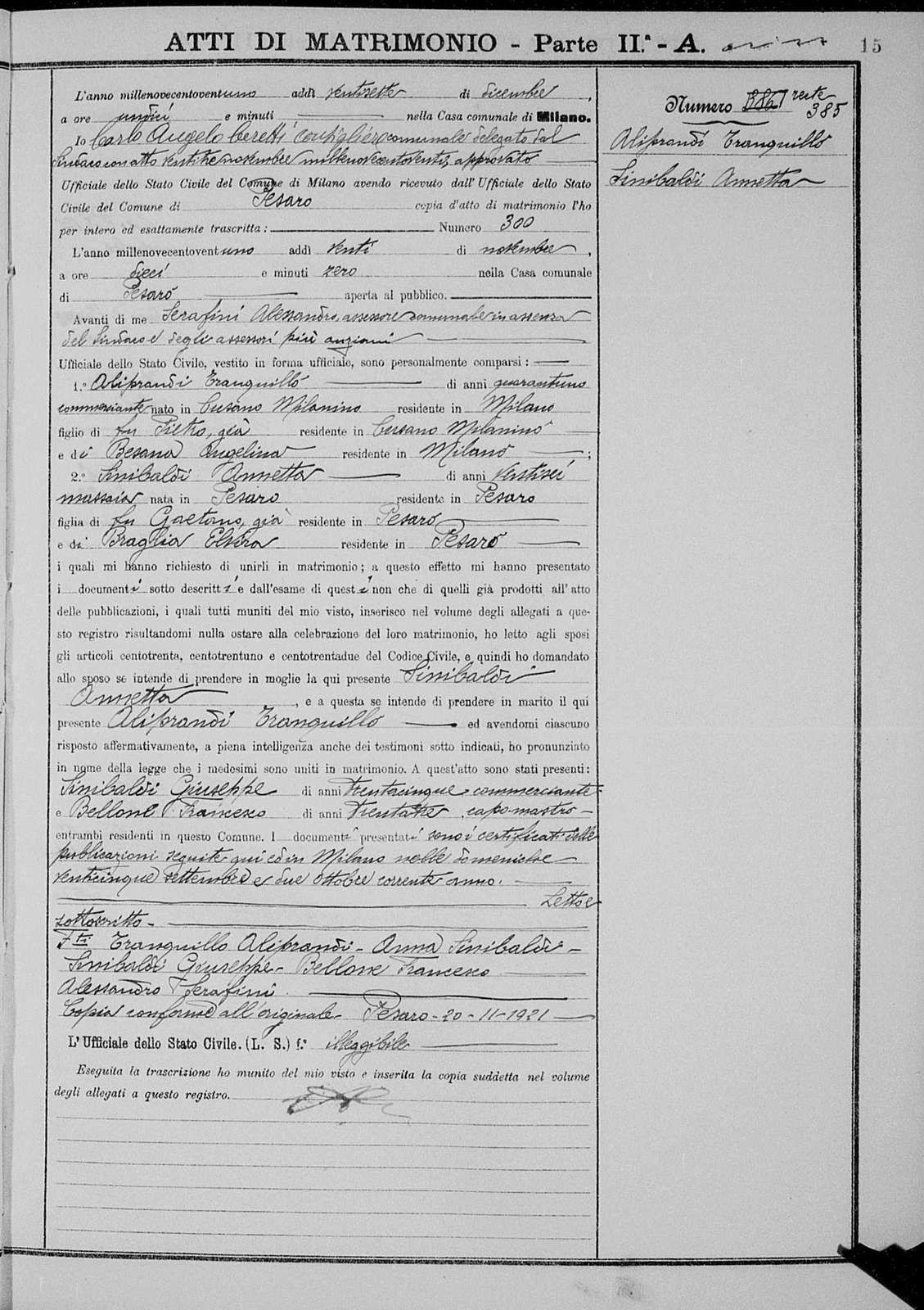
Italian marriage records do two jobs at once. The marriage act states that two people married, and the packet filed with it often copies the records that prove who they were. For a family historian, the packet is frequently the page that moves the tree back a generation. The act alone is still worth reading. It names parents, ages, and towns the packet may not repeat in the same words.
Civil marriages belong to stato civile. The civil overview covers how those series were created. Church marriages are a separate book, kept by the parish, and they are described on the church records page. After civil registration was in force in a town, a couple may appear in both. Keep the two dates distinct until you have read both entries.
What the marriage act says
A civil marriage act names the spouses, and it usually names their parents, including mothers under their own family names. Ages or birthplaces, occupations, and residence appear often enough that you should expect them and write them down when they are there. Witnesses sign or are named. As on a birth act, a witness is not automatically a relative.
There may be two dates in the surrounding paperwork: the dates the banns were posted, and the date of the marriage itself. The pubblicazioni are the banns. In many towns they are a separate register or a separate section, not a sentence buried in the marriage act. If the marriage act feels thin, look for the pubblicazioni volume for the same year. It can name parishes, occupations, and parents that the shorter act skipped.
The wedding was recorded in the comune where it was celebrated. That is often the bride’s residence, and it is not always the birthplace of either spouse. A man from one town and a woman from another produce a marriage in one register and births in two others. If you search only the groom’s birthplace, you will miss weddings that were never written there.
Widows and widowers are identified as such, sometimes with the name of the deceased spouse. That name is a death search and a prior marriage search. Do not attach the new spouse to the old household until you have read the earlier act.
The reading guide for marriage acts follows the clauses. The Italian word list covers sposo, sposa, nubile, vedova, and pubblicazioni. Compare the index spelling with the act before you split one person into two.
Allegati and processetti
Supporting papers are called allegati or processetti. The word in the archive’s inventory is the one to follow. Both labels point at the file assembled so the marriage could take place. That file may include copies of the birth acts of the spouses. It may include a death act for a previous spouse, a copy of a parent’s death, or a consent paper when the law of that year required a parent to agree. It may include a certificate that the banns had been posted in another town.
The copies in the packet were collected so officials could see that the spouses were free to marry. If the birth volume is missing or not online, the copy can be the usable text. Treat it as a copy. If the birth register survives, open it and compare the names and the date.
The packet is easy to overlook because it is not always bound in the same book as the marriages. On Antenati it may be a separate item under the same comune and year, with a title that says allegati, processetti, or pubblicazioni. Browse the list of registers instead of stopping at the first volume labeled matrimoni. The Antenati guide shows how those titles are grouped.
How the series affect a marriage search
The same general ranges used for births apply to marriages, because they are ranges for civil registration as a system. FamilySearch’s overview puts Napoleonic civil registration, as a general rule, at about 1806 to 1815 in some areas. In the Kingdom of Naples the style was introduced in January 1809 under Joachim Murat and reintroduced in 1816 by the Bourbons. Sicily did not receive that style until 1820. Unified Italian civil registration is generally from 1866, and the province of Rome from 1871.
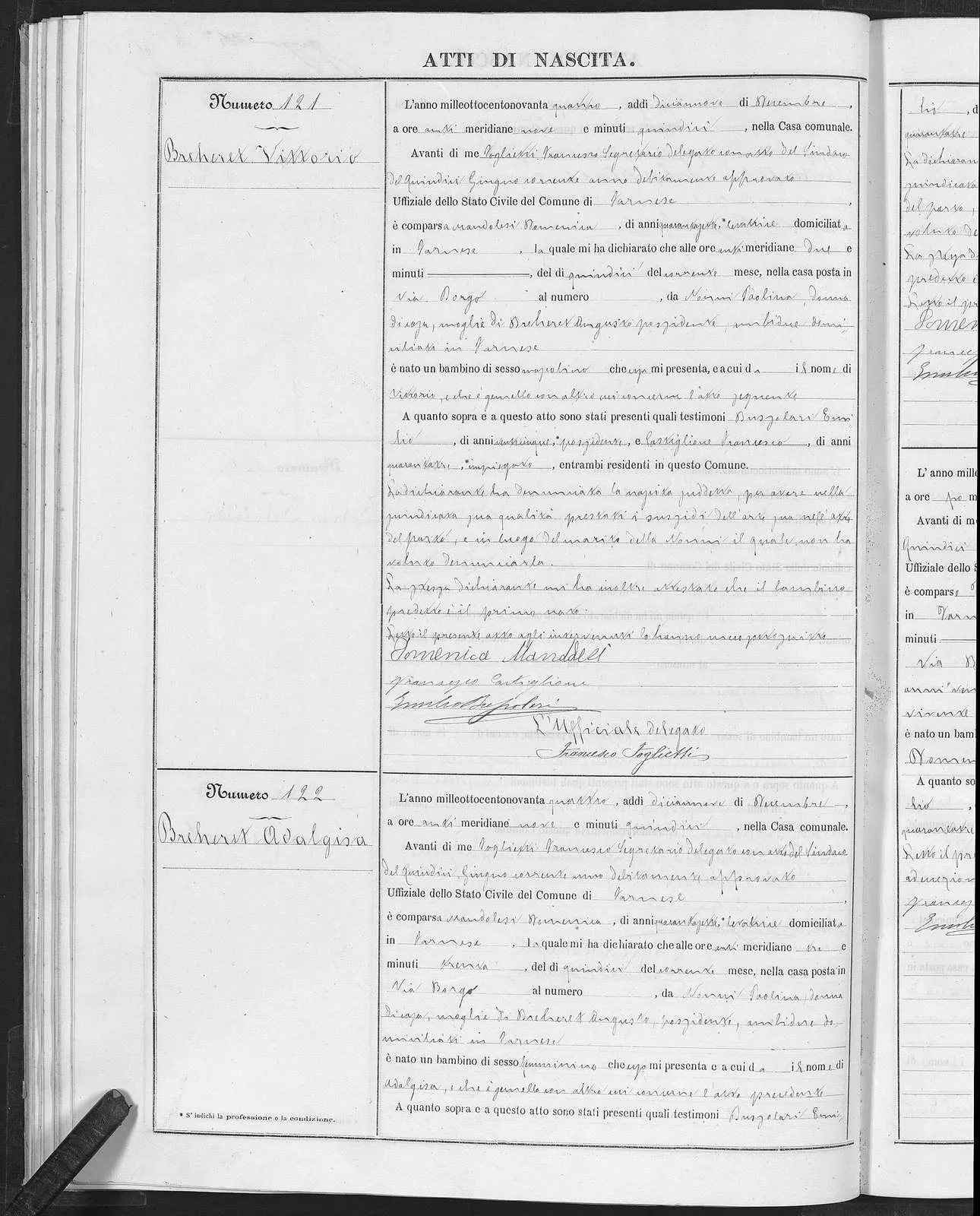
Birth act of Vittorio Breheret, Farnese (Viterbo), 15 December 1894. Civil register published through Portale Antenati. Public domain.
A marriage in 1850 will not be in the unified series. It belongs, if it was recorded by the state at all, to whatever series that comune kept in 1850. The listing of volumes is the authority. A church marriage can exist for years, and in places, where no civil marriage book exists. When the civil listing has a gap, the parish is the other place to look, not a second guess at the civil year.
Searching the portals
The Portale Antenati publishes marriage acts from the state archives along with births, deaths, and the military lists. The Istituto Centrale per gli Archivi states that use is free and that no registration is required. Indexed registers can be searched with Cerca per nome. Unindexed ones are browsed with Cerca nei registri or by walking the town inside Esplora gli Archivi. The portal’s own research guide describes those three tools. Empty name search means “not indexed,” or “different spelling,” or “wrong town.” It does not mean “no marriage.”
FamilySearch holds many of the same films. Use the FamilySearch Italy guide when a name search is silent. Some of the same images are on Ancestry. Check that catalog for the comune and the year. A subscription does not fill a year that was never filmed. See the free-records guide.
Ten-year indexes, the indici decennali, point at act numbers. Open the act. Search both last names. Women are entered under their own family names.
Search a range of years before the children’s births. A first child long after the wedding is ordinary. A marriage dated after a child’s birth should be read as written.
When you already know one spouse’s birth
A birth margin sometimes names the marriage and the act number. Start there if you have the birth act. If the margin is blank, estimate from the children’s births and search marriages in that window in each spouse’s town of residence. Occupations and fathers’ names separate cousins who married in the same decade.
Once the marriage is found, copy from the packet any birth extract that names grandparents. Those extracts are how a wedding in 1884 identifies a birth in 1858 without a blind search of thirty index pages. Then go to the birth register and confirm.
A practical search order
- Write both spouses’ names, the wife’s last name as born, approximate ages, and every town you have seen. Use a worksheet so the bride’s town and the groom’s town stay in separate fields.
- Confirm each town is a comune, using the hometown guide.
- On Antenati, list every marriage, pubblicazioni, and allegati or processetti volume for the likely years. Check the archive’s current listing if you are unsure the set is complete.
- Use the ten-year index for both last names. Note the act number. Open the annual marriages and read the act.
- Open the allegati for that marriage, not only the act. Copy any birth or death extracts, including the year and act number they cite.
- Read the extracts against the original registers when those registers exist. Differences in a parent’s age belong in your notes.
- If the civil year is not online, check FamilySearch, then write to the Ufficio di Stato Civile with the comune letter. Ask for the marriage act and whether the allegati for that number are held. Ask the fee. Send no money until they name the amount and the method.
- If there is no civil series for that year, write to the parish with the parish letter.
Invented example
The family and the town in this section are invented.
You know that Pietro Lanza and Caterina Russo had a son in 1896 in an invented comune, Marina di Sopra. The son’s birth act names both parents and gives Pietro’s age as 28 and Caterina’s as 24. You do not have their births. You search marriages in Marina di Sopra from 1888 through 1896, under both Lanza and Russo.
The 1894 index lists Pietro Lanza and Caterina Russo at marriage act 12. The act gives Pietro’s father as Salvatore Lanza and his mother as Rosa Vitale, and Caterina’s parents as Vincenzo Russo and Giulia Serra. Pietro’s residence is a different invented town, Pontecorvo Marina. The marriage celebrant is in Marina di Sopra because Caterina lived there.
The processetti for act 12 include a copy of Pietro’s birth act from Pontecorvo Marina, act 30 of 1866, and a copy of Caterina’s birth from Marina di Sopra, act 18 of 1870. You now have towns, years, and act numbers for both births. You open those birth registers and read the originals, because the copy in the packet names the grandparents in a shorter form than the birth act does. Rosa Vitale’s last name never appeared on the son’s birth. It appears here. That is the whole point of the packet.
You would not write to either comune until those images were saved and cited. The kit holds the letter, the word list, and the worksheets. The finding aid is still the town listing on Antenati.
Sources
Questions readers actually ask
Why is the marriage packet better than the marriage act alone?
The allegati or processetti are the supporting papers. They may include copies of the spouses' birth acts, and sometimes papers about a prior spouse. The marriage act names the wedding. The packet is where the earlier generations often appear.
Where was an Italian civil marriage recorded?
In the comune where the marriage was celebrated, which is often the bride's town and not always the town where either spouse was born. If you know only a birthplace, search marriages there and in the spouse's town before you decide the wedding is missing.
Are marriage records on Antenati free to view?
The Istituto Centrale per gli Archivi states that Antenati is free and does not require registration. You still have to browse when the marriage register for that year has not been indexed. Check the listing for the comune rather than assuming every year is present.