
Vital records
Italian church records and parish registers
How to find Italian parish baptism, marriage, and burial books, and when to write the parroco instead of the town hall.
Affiliate disclosure.Some links on this page go to genealogy companies. If you buy through them, we may earn a commission, at no extra cost to you. We recommend a site only where it helps this kind of research. Read the full affiliate disclosure.
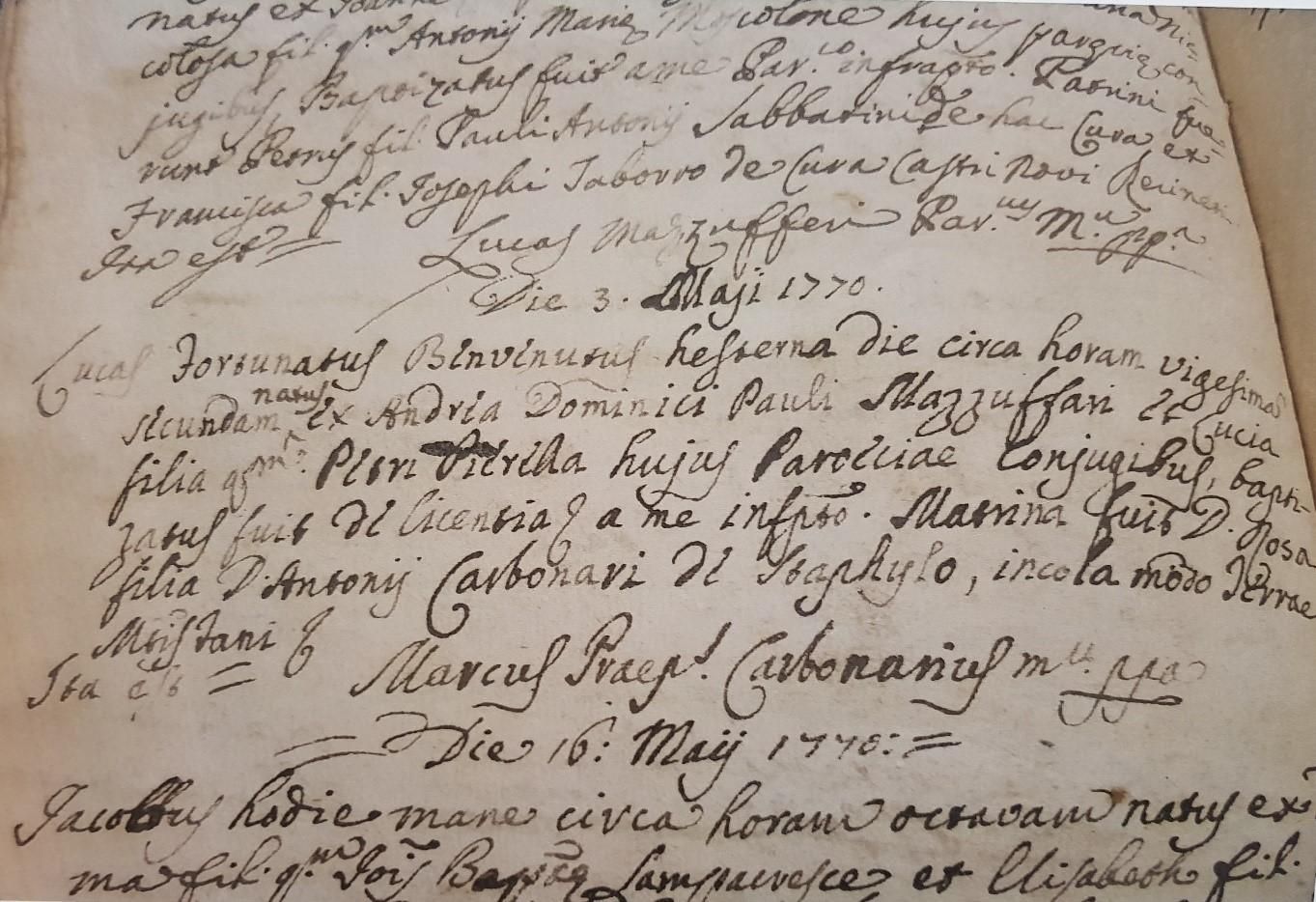
Italian church records are the parish books: baptisms, marriages, and burials, and sometimes confirmations or a census of souls. They are the path backward from civil registration, and they are a parallel path after civil registration begins. A baptism is not a civil birth act with different handwriting. A different institution wrote it, for a different purpose, and it names different people, starting with the godparents.
The FamilySearch Wiki’s page on Italy church records is the reference overview. This page is the working order: identify the parish, see whether a film exists, read the entry, and write to the priest only for what you still cannot see.
What the council required, and what survives
The Council of Trent closed in 1563. Many parishes then kept baptism, marriage, and burial books. That sentence is as far as a national date can be pushed. Compliance was uneven. Books were started late, kept badly, rewritten, moved, or lost. One parish in a diocese may have a sixteenth-century baptism book. The next parish may have nothing you can consult before the eighteenth century. Do not assign a start year to a parish because a guide, or a cousin’s tree, named a year for a different town.
When you cite a church record, cite the book you opened: parish, sacrament, year, and page or entry number. “The family was Catholic, so the baptism exists” is not a citation. Existence is a property of that archive’s shelf. Check the current listing, whether the listing is a FamilySearch catalog entry, a diocesan inventory, or a letter from the parish.
Baptism, marriage, burial
A baptism entry names the child, the parents, and usually the godparents. The mother’s last name is again the research prize. Godparents, the padrini, were sometimes relatives and sometimes neighbors or social patrons. Record them. Attach them to the family only when a second record says how they were related. A godfather with the mother’s last name is a lead toward her brothers, not a conclusion.
The baptism date is not always the birth date. If the entry states only the baptism, say so. Do not invent a birthday by subtracting a fixed number of days.
A parish marriage names the spouses and often their parents and their parishes of origin. It may sit years away from a civil marriage in the same town, or it may be the only marriage that exists, in years before the civil series. Compare the two when you have both. Do not average the dates.
A burial names the deceased and sometimes a spouse or parents. Like a civil death, it depends on what the priest was told. It is still the burial you have. For years with no atto di morte, it is the death.
Some parishes also kept a stato delle anime, a household list made for pastoral reasons. Ask the parish or the diocese. Do not plan as if every town had one for every decade.
Latin is the language of many of these books. Italian appears in others, and the switch is local. The Latin word list and the Italian word list cover the formulas. Olim, quondam, filia, and uxor change the name beside them.
Parish, diocese, state archive
The parish is the creator of the book. The parroco is the person you write to when the book is still there. Diocesan archives hold older books, duplicates, or transcripts for some parishes and not for others. A state archive may hold a deposit or a film. None of these arrangements is uniform enough to guess. The catalog entry in front of you is the evidence.
The Portale Antenati is a poor first stop for a baptism. The Istituto Centrale per gli Archivi describes its holdings from the state archives as civil birth, death, and marriage acts, liste di leva, and ruoli matricolari. A marriage processetto may quote a parish book, and the marriage records page explains that file. It is still stato civile. If a town listing on the portal includes something else, believe the listing.
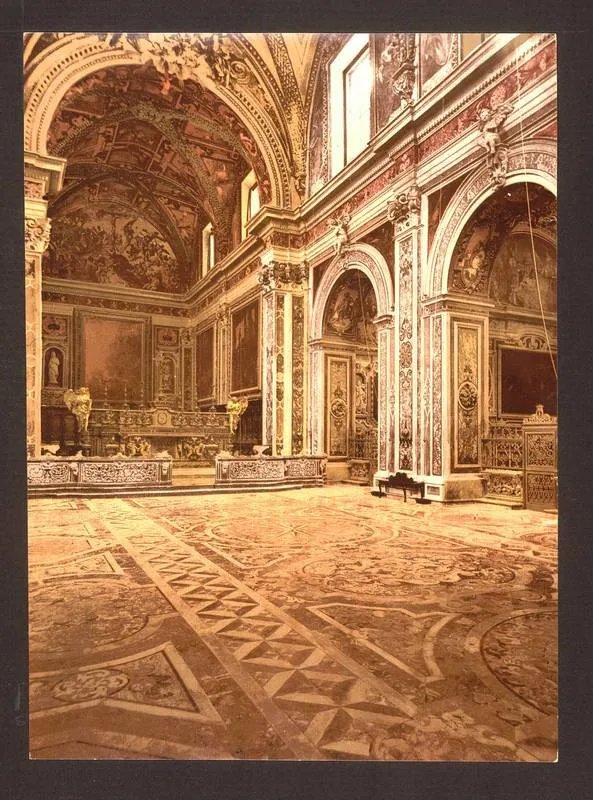
Church of San Martino, interior, Naples. Photochrom Print Collection, Library of Congress, between 1890 and 1900. Public domain.
FamilySearch is where many parish films are. The FamilySearch Italy guide shows the catalog search by place. Open church books as their own entries. The viewer states whether an image is at home or at a FamilySearch Center or affiliate library.
Ancestry licenses parish films for some dioceses. Search by parish or diocese. A missing collection sends you back to FamilySearch, the diocese, or the parroco. The website comparison and the free-records guide keep you from paying for a book that is already open.
Civil dates do not date the parish books
FamilySearch’s summary of civil registration is a help only as a boundary. Napoleonic-style books begin, as a general rule, about 1806 to 1815 in some areas, in the Kingdom of Naples in January 1809, again there in 1816, in Sicily in 1820, and as a unified series generally in 1866, or 1871 in the province of Rome. Before the first civil volume in your comune, the parish is the register. After that first volume, you want both, because godparents and a frazione chapel do not always make it into the town hall.
The civil overview is the page for those series. The hometown guide is the page for matching a hamlet to the parish that served it. A frazione may have had a chapel that baptized, while marriages were at the mother church. If a baptism search in the main parish fails, the hamlet church is the next question, addressed to the diocese or the parroco, not a reason to change the family’s town.
Writing to the parish
Write after the catalog search, not before. Identify the parish as closely as you can. Give the person’s name, the parents, and a year or a short range. Say that you are asking for family history. Ask whether they hold the baptism, marriage, or burial, what a copy costs, and how they want to be paid. Do not send money until they state the amount and the method. Do not send a list of twenty cousins.
The parish letter is the wording. The civil letter is the wrong form. The Ufficio di Stato Civile does not keep the baptism book. For a civil act that is not online, use the comune letter and the request guide.
If the priest replies that the books are at the diocesan archive, write to that archive next, and say who told you the books had moved. Keep the reply. It is the finding aid you did not have.
A practical search order
- Start from a civil act if you have one. Copy the residence, including the frazione, and the parents. The birth record page shows which lines those are.
- Name the parish that likely served that residence. If you are unsure, write down the mother church and the hamlet as two candidates.
- Search the FamilySearch catalog for the place. Open any church books and read the year range on the film. Do not import a start year from another town.
- Read the entry with the Latin or Italian word list. Copy godparents separately from parents.
- If the film stops before your year, or there is no film, look for a diocesan inventory or a research guide the diocese itself publishes. Prefer that page over a forum memory.
- Write to the parroco for one sacrament and one person. Ask the fee. Track the letter on a worksheet.
- When a marriage processetto already contains a baptism extract, read it and still seek the parish book if the extract is only a summary.
- File the church entry and the civil act as two events, even when they describe the same birth.
Invented example
The family and the town in this section are invented.
You have an invented civil birth for Rosa Vitale in 1818 in Pontecorvo Marina. The civil listing for that invented town begins in 1816, so her parents’ births are before the books. Rosa’s birth act says her father, Matteo Vitale, was 36 and a native of the frazione of San Lio. You need Matteo’s baptism, around the early 1780s, with a wide range because 36 is a declared age.
The FamilySearch catalog for this invented place shows baptisms for the parish of San Lio only from 1790. You do not announce that the family “starts in 1790.” You note that the filmed book starts in 1790. Matteo may be in an earlier book that was never filmed, or he may have been baptized at the mother church. You read 1790 through 1795 in case the age was high. He is not there.
You write to the parroco of San Lio, name Matteo and his parents, and ask for a baptism in the 1770s or 1780s, per ricerca genealogica. You ask the cost and enclose no money. The reply says the older baptisms are at the diocesan archive. You write there next, quoting that reply, and you leave the baptism date blank while you wait.
The kit holds the parish letter and the Latin list. The year the film begins is a fact about the film. The region guides do not change it.
Sources
Questions readers actually ask
When did Italian parishes start keeping baptism books?
After the Council of Trent closed in 1563, many parishes kept baptism, marriage, and burial books. Survival varies. There is no single start year you can assign to a parish without looking at that parish's own volumes.
Are Italian church records the same as stato civile?
No. Parish books are church records, kept by the parish. Stato civile is the civil register of the comune. A person can appear in both after civil registration began, and the dates and sponsors will not always match word for word.
Who do I write to for a baptism?
Write to the parroco of the parish, after you have checked whether the book is already filmed. Ask for a copy for family history, and ask the fee. Send money only when the reply states the amount and the method.