
Getting started
Italian genealogy websites
What Antenati, FamilySearch, Ancestry, MyHeritage, Findmypast, and newspaper sites each do for Italian research.

Affiliate disclosure.Some links on this page go to genealogy companies. If you buy through them, we may earn a commission, at no extra cost to you. We recommend a site only where it helps this kind of research. Read the full affiliate disclosure.
Italian genealogy websites overlap, and the overlap is the reason people pay for a record they could have seen free, or skip a free image because a paid search box returned nothing. This page says what each major site is for. It does not score them. A score would hide the only fact that matters: the right site is the one that holds the record you need this week, and the record you need this week is usually a town you identified somewhere else.
The beginner guide is the order. The hometown guide is how you get the town. The free-records guide is the subset you can use without a subscription. Stay here for the comparison, including the paid sites and the newspapers.
Antenati, the free archive door
The Portale Antenati is the Ministry of Culture’s site for civil registers, conscription lists and related material kept in the state archives. The research guide tells you to choose a tool that matches what you know. A name search succeeds when the register has been indexed. A browse by archive, comune and year is the ordinary path. Esplora gli Archivi is the list of archives. The walkthrough on this site follows those tools.
Antenati is free. It is not complete. A missing year is a gap in that portal’s listing, not a proof that the birth was never written. You still note the archive, the comune and the years you opened. You do not invent a private hostname for an individual Archivio di Stato. You open the archive from Esplora or from archivi.cultura.gov.it.
Use Antenati when you know the place. Do not use it as a last-name search of the whole country. The catalog will not do that job well, and the job is the wrong job. The regions hub explains why the province decides the archive.
FamilySearch, free with a lock to read
FamilySearch is not a company this site earns from. There is no affiliate program to disclose. The Italy Genealogy wiki is the overview, and the FamilySearch Italy guide is the catalog method. Account creation is free. Some Italian civil images are viewable at home. Some carry a notice that they are viewable at a FamilySearch Center or an affiliate library. The notice is the rule for that set. A home login does not override it.
FamilySearch and Antenati often show the same volumes and different indexes. Search both before you conclude a name is absent. Use the catalog, not only the global search box, and search the comune. Collection titles follow the province or the court. A lock is a reason to visit a center or to look at the same year on Antenati. It is not a reason to change the town.
Ancestry, a subscription and a test
Ancestry sells a record subscription and, separately, AncestryDNA, an autosomal test with cousin matches and trees. Italian civil images for many provinces sit inside the subscription, often from the same filming as the free portals. Passenger lists, censuses and user trees are the American reasons the site earns its place in an Italian search. A tree that cites a town is a lead. The lead is not an act until you see the act.
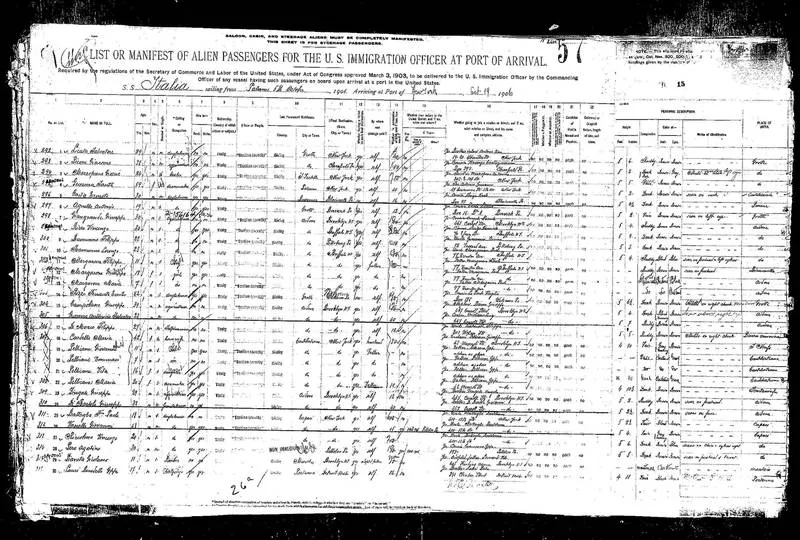
Ellis Island passenger manifest for a group recorded as Italy (South), including towns in Sicily. The file title says 1903; the Commons date field says 19 October 1906. Public domain.
A subscription does not contain a year nobody filmed. It does not identify a comune from a last name. The comparison with MyHeritage refuses to call either company the winner and reminds you that both are subscriptions. Use Ancestry when an index or a cousin’s tree cites a source you can verify, or when the American records you need are indexed there and not on a free site you have already tried. The Ellis Island guide names the free Foundation search as well as the subscription copies, so you can try the free door first.
MyHeritage, records and a European match list
MyHeritage also combines a record subscription with an autosomal DNA test. The test is often used by European testers, which is a research reason to care when relatives who did not settle in the United States are the people who may know the town. The record side, like Ancestry’s, is optional next to Antenati. Use it for a collection or a tree you have a reason to see. Do not browse it as if it were a different Italy.
The two companies’ ethnicity-style labels are models they revise. The labels do not name a comune and do not prove a province. The label page is the explanation. If you are choosing a test rather than a record site, use the test comparison, which includes FamilyTreeDNA and Living DNA and mentions 23andMe only editorially. 23andMe’s affiliate program is paused, and this site does not earn a commission from it. It is not a record portal for Italian civil registers, so it is not a candidate for the town itself.
Findmypast, for a British or Irish detour
Findmypast is stronger for United Kingdom and Irish records than for Italian civil registers. That sentence is the whole evaluation this page will give it. There is no star rating beside it. If the Italian-born person married in England, or a child was born in Ireland, or a ship list you need is a British outbound list, Findmypast can be the site that holds the detour. The detour sometimes names the Italian town more clearly than the American death certificate does. Then you leave Findmypast and open Antenati for that town.
If nobody in the family touched Britain or Ireland, Findmypast is not the first subscription to buy for a Calabrian birth. Buying it because the name says “genealogy” will not put the Archivio di Stato di Cosenza on your screen. The Calabria guide and Antenati will.
Newspapers
An obituary, a wedding notice or an arrival note can name the town, the ship or a surviving brother. Chronicling America, at the Library of Congress, is a free collection of historic American newspapers. It does not contain every paper. Subscription newspaper sites exist for papers and years the free collection does not have. This page does not rank those paid sites and does not claim any of them is complete. Search the free collection for the name and the American city you already know. If you find an obituary, copy the place string into the hometown procedure and test it. A newspaper can be wrong. It is still a second source, which is what the hometown guide asks you to compare.
A paid newspaper search is justified when you know the city and the approximate year and Chronicling America has a gap there. It is not justified as a substitute for the civil register once the town is known. The town’s birth act will not be in a Pennsylvania weekly, even if the obituary that points you to the town is.
How to move between them
Identify the place from a destination-country record, using a free newspaper or a free passenger search when that is where the string is. Confirm the comune in a gazetteer. Browse Antenati. Browse FamilySearch, and obey any library lock. Open Ancestry or MyHeritage if an index, a tree or a match list is the specific thing you lack. Open Findmypast if the detour is British or Irish. At no point do you need all of them. At no point does one of them replace the act.
Invented example. A researcher pays for three subscriptions because a blog ranked them, and still has only the word Naples. The subscriptions return dozens of men with the last name in the city of Napoli and a newspaper hit in Hartford that says the man was born in “San Fele, Italy.” San Fele is a comune in the province of Potenza. The rank was irrelevant. Chronicling America or a paid paper could have supplied the string. Antenati’s Archivio di Stato di Potenza is where the birth is browsed, free. Findmypast never entered the problem, because nobody in the invented file lived in Britain. Ancestry’s passenger index might have shown the same town earlier, which would have been a fair use of a subscription, and the Foundation’s free arrival search might have shown it too. The websites did not fail. The order did. Place first, then the free portal, then a paid site for a hole you can name.
The kit does not replace any of these sites. It is a folder of letter templates for the year the websites do not show. Use it after the comparison, not instead of it. A website that is “best” in a headline is a website that matched someone else’s hole. Name your hole, then open the door that fits it.
Sources
Questions readers actually ask
Which Italian genealogy website should I use first?
Start with the Portale Antenati if you already know the comune, and start with records in the country of arrival if you do not. Antenati is the Ministry of Culture's free portal for civil registers from the state archives. Its research guide explains name search and browsing by place. FamilySearch is the next free door, with a free account and a catalog that sometimes locks images to a FamilySearch Center or an affiliate library. Ancestry and MyHeritage are subscriptions that add indexes, trees and DNA matches. Findmypast is a subscription that is stronger for United Kingdom and Irish records than for Italian civil registers. Newspapers, free or paid, are a different job: an obituary may name the town. No site on this page earns a rating, because a rating would pretend that one login contains every archive.
Do Ancestry and FamilySearch have the same Italian records?
They often have images from the same filming projects, and they do not have the same indexes, the same trees, or the same access rules. FamilySearch is not a subscription. Some of its images are viewable at home and some are not. Ancestry is a subscription, and it also sells an autosomal DNA test that FamilySearch does not sell. Antenati may show a year that a paid index has not transcribed, or a paid index may find a name in a volume Antenati expects you to browse. When two sites disagree, open the image. The act outranks the transcription. A website that does not show your year has not proved the year is lost. It has proved that this website does not display it. Check the other free door before you pay, and check the comune's own copy before you decide the book burned.
Is Findmypast useful for an Italian town?
It is rarely the first place to browse an Italian civil register. Findmypast is stronger for United Kingdom and Irish records than for Italian civil registers. Use it when the family passed through Britain or Ireland, when a British birth or marriage might name an Italian father, or when a voyage touched a British port. Do not use it as a substitute for Antenati once you know the comune. A subscription there will not invent a Catanzaro birth book that the state archive has not put online. If your entire problem is a town in Calabria or Sicily, spend the session on Antenati and FamilySearch. If your problem is a child born in London to an Italian parent, Findmypast belongs in the comparison for that child, and the Italian town is still settled in the Italian registers.