
Letters and document types
Estratto, certificato, and atto
What an atto, an estratto, a certificato, and a copia integrale are, in genealogical language, when you ask for a family-history copy.
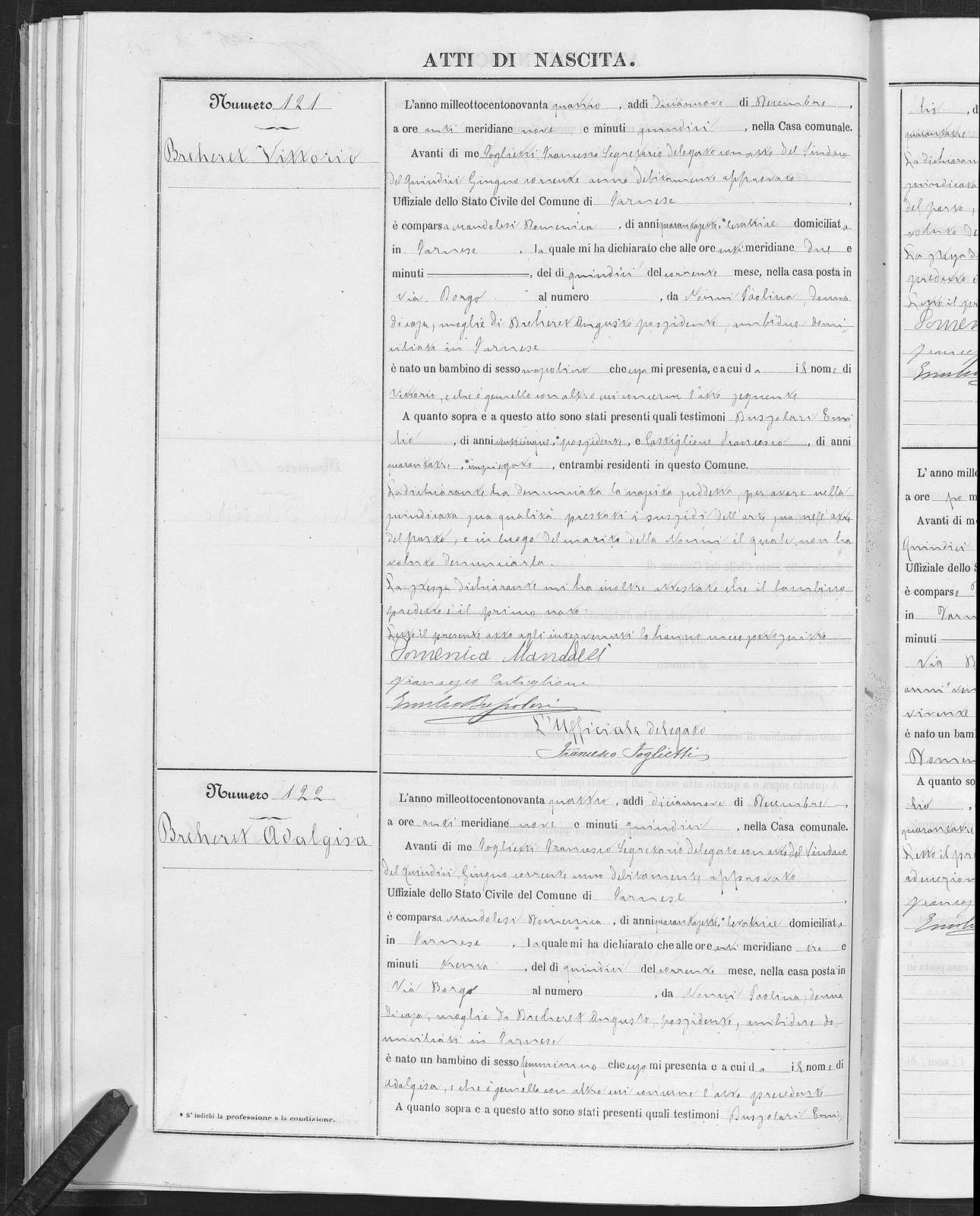
Italian offices use four words for what English flattens into “birth certificate.” The four words are not synonyms. If you learn them as a genealogist, you will know what you are holding and what you still do not know. This page defines them for family history. It does not say which paper anyone must file for a purpose outside family history. Fees, forms, and whether an office will issue a copy at all are decided by that office. The letter to the comune asks them to say which copy they issue and what it costs. Ask before you send money.
Atto di nascita
The atto di nascita is the birth act: the entry written in the civil register when the birth was declared. It is the record itself, not a summary typed a century later. In the nineteenth century and well into the twentieth, the act is usually a narrative. Someone, often the father or a midwife, appeared before an official and stated that a child had been born. The official wrote the date of the declaration, the parents, and the child’s names. Witnesses signed or were named. The child’s birth date is often in the text and is not always the same day as the declaration.
When a genealogist says “I found the atto,” they usually mean they found that entry as an image, on the Portale Antenati or on FamilySearch, or they received a copy that repeats it. The birth records page describes how these acts are organized and how to read one. The Italian word list is the vocabulary. Read the act number. Registers are cited by that number, not by a guess about the page.
Marginal notes, annotazioni marginali, were added later in the margin or at the foot. A marriage, a death, or a correction of a name may be there. Those notes are part of the atto as it stands today. A photograph that crops the margin has lost them even though the main paragraph looks complete. When you copy an image, check the edge of the frame.
Copia integrale
A copia integrale is a full copy of the atto. “Integrale” means complete. In genealogical use, it is the paper or the scan that carries the original wording, the witnesses, and the marginal notes, not a modern form that keeps only the names and the date. Offices produce that completeness in more than one physical way. Some issue a photocopy or a digital image of the register page. Some issue a transcription that repeats the full text and is signed by the office. Both can be called a full copy in ordinary speech. The heading on the document tells you which one you received.
This is the copy family historians hope for when the online image is missing or unreadable. It shows the mother’s last name as the clerk wrote it, the ages or occupations if the formula included them, the residence, and the witnesses. It shows a marginal marriage note that reveals a spouse. It does not, by existing, prove the office will send it. Some offices send it readily for a family-history request. Some send a shorter form and will say so if you ask. The letter template asks them to name the form. You may say you would prefer the text and the marginal notes. You should also say you will accept what they issue. That sentence is in the sample letter for a reason.
A full copy can still be a disappointing scan. If the words are illegible, ask for a clearer image of the same act, not for a different person. Cite the act number they already used.
Estratto di nascita
An estratto di nascita, an extract of the birth act, moves selected facts onto the office’s current form. Genealogists meet it often as an estratto per riassunto, a summary extract. A typical summary names the person, the date and place of birth, the parents, and annotations about later events such as marriage or death. That is already more useful than a one-line certificate. It is not the original paragraph.
Use an estratto for what it states. If it names the father and the mother, you may record those parents as coming from the extract, and you should say you have not seen the witnesses. If it includes a marriage annotation, you have a spouse’s name and a year to search. If a line is blank, do not fill it from a tree. The blank means this form did not report that fact. It does not always mean the atto lacks it.
The layout is the office’s. Two comuni can both send an “estratto” that does not print the same fields. Read the labels. A father’s name on the form is a father’s name. A blank box is a blank box. Comparing the extract with an Antenati image, when you have both, is the best check. Where they disagree, look at the handwriting again before you decide the clerk mistyped. Indexes and extracts both compress. The Antenati guide is about reading the register, which is the longer text the extract came from.
Certificato di nascita
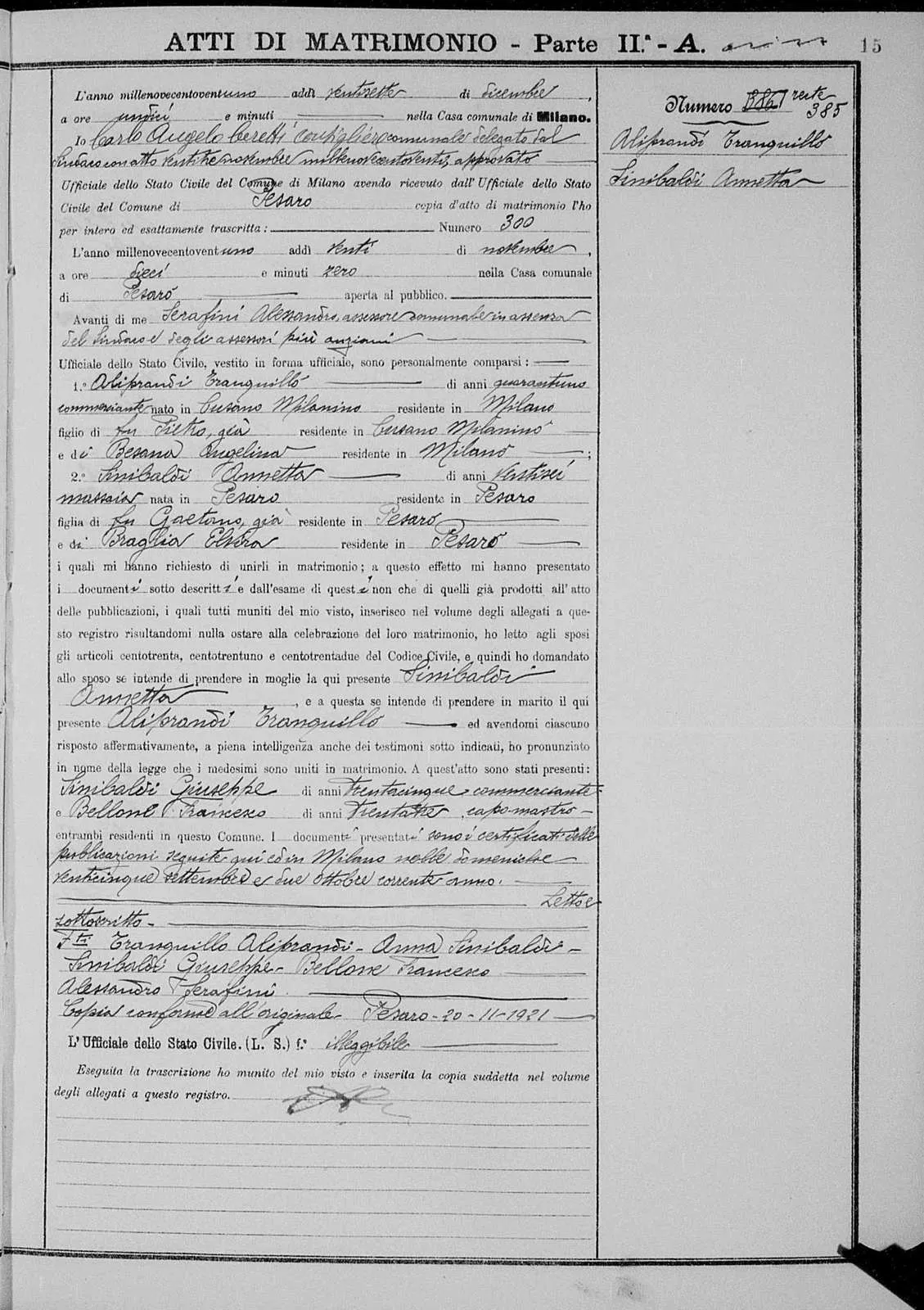
Marriage act of Tranquillo Aliprandi and Annetta Sinibaldi, Milan, 20 November 1921. Civil register of the Comune di Milano. Public domain.
A certificato di nascita is a certificate. In family-history work it is often the short modern abstract: a few lines that confirm a birth, sometimes without the parents, almost never with the witnesses, the street, or the original sentences. It can be the right everyday paper for a living person dealing with an office in the present. It is a thin paper for reconstructing a nineteenth-century household.
People use “birth certificate” in English for all four documents on this page. That habit is why orders go wrong. If you write to a comune and ask only for a “certificate,” you may receive the short form, and the clerk will have done what you asked. The Italian letter on this site avoids that trap by asking for a copy for family history and by asking the office which form it issues. When a reply says certificato, read the page before you file it as if it were the atto. Count the facts. If you see a date and a name and nothing else, you are holding the short form.
A certificate drawn from the current population register, the anagrafe, is not the same as a copy of the historical civil register. Someone who died in the nineteenth century is not a current resident. The historical atto is the target. If the office says the volume has moved to the state archive, follow that. The not-online guide is the next step when the comune no longer holds the book.
The same four ideas for marriage and death
The vocabulary repeats for the other two civil events.
An atto di matrimonio is the marriage act in the register. A copia integrale of it repeats the full wording. An estratto di matrimonio is the extract. A certificato di matrimonio is the certificate, often short. Marriage acts are rich when they are full: the spouses, their parents, their ages, and sometimes a packet of supporting papers. A short certificate may confirm only that a marriage happened on a date. If you are trying to learn a mother’s maiden name, the full act is the one that usually states it, and the short certificate may not.
An atto di morte is the death act. The estratto di morte, the certificato di morte, and the copia integrale stand in the same relationship. Death acts name a spouse or parents when the formula asked and the informant knew. They are full of people who died far from the town of birth. A full copy lets you see who reported the death and what they claimed. A summary may keep the date and drop the informant. Copy the heading so your notes show which level you saw.
Invented example: an 1896 birth image shows a marginal note of a marriage in 1920 to a named spouse. An estratto per riassunto might reduce that note to one line with the spouse and the year. A short certificato might state only that the person was born on a given day. All three can be “right” about the birth and still not be the same document. The invented page is an illustration, not a register you can order. Your own act is the one in the volume.
What to say when you write, and how to read what comes back
Use the comune letter. It asks for one birth, one marriage, or one death, for ricerca genealogica and storia familiare. It asks the office to state the cost and the payment method. It says you do not demand a particular form, and that you would prefer a copy that includes the text and the marginal notes if that is possible. That preference is genealogical. It is not a claim that one form is required for any other filing. This page will not tell you which paper to use outside family history.
When the envelope or the file arrives, do three things. Read the title printed on it and write that title in your log: atto, copia integrale, estratto, estratto per riassunto, or certificato. Transcribe every name, date, and place it actually contains, with the word list beside you. Note what it does not contain. “No witnesses on this estratto” is a useful sentence. It reminds you not to say you know the witnesses.
If the paper is a full copy, compare it with any image you already had. If the paper is an extract, and the year is on Antenati, open the image and finish the transcription from the image. If the year is not online and the extract lacks a fact you need, one follow-up question is appropriate: whether a fuller copy exists and what it costs. Then stop, unless they invite more. The worksheet log is where the reply belongs. The kit holds the letter files and a glossary you can keep next to a scan, which is convenient and not required. The definitions you need for the next hour are the ones on this page.
In your own notes, use the Italian heading printed on the paper. Relatives will keep saying “birth certificate” for whatever arrived. The heading is what tells a later reader that a short certificato is not the act that named the midwife.
Sources
Questions readers actually ask
Which of these should I ask the comune to send?
Ask which form the office issues for a family-history request, and ask what it costs. Do not open the letter by demanding a single legal form. For your own transcription, the useful paper is the one that shows the original wording, the witnesses, and the marginal notes. That is what genealogists mean when they hope for a copia integrale, a full copy of the atto. An estratto can still be enough when it names the person, the date, the parents, and a later marriage or death note. A short certificato is the one most likely to disappoint, because it often reduces the event to a few modern lines. The sample letter on the comune page asks the office to name the copy and the payment method. If they send a short form and you still need the witnesses, write once more and ask whether a fuller copy of the same act exists and what it costs. Accept the answer.
I found the birth on Antenati. Do I already have the atto?
You have an image of the register, which is the atto as the archive filmed it, including whatever margin the camera caught. That image is not an estratto and it is not a certificato. It is better than both for reading the original sentences, as long as the page is legible and the margin was not cut off. Transcribe it with the Italian word list and cite the archive, the volume, and the act number. You do not need to order a paper copy of a page you can already read, unless you want the office's current extract for your own file. If the image is torn, skipped, or missing the year, then a letter is reasonable. Say that you already searched the portal and the year is not there. The not-online guide explains that situation. A clerk who hears that you looked is easier to help than a clerk who is asked for a last name.
The paper says estratto per riassunto. Is that the full act?
No. An estratto per riassunto is a summary extract. The office pulled facts out of the atto and placed them on its form. It often includes the name, the date and place, the parents, and annotations such as a marriage or a death. It does not reproduce every line, and it usually does not list witnesses or the occupations and ages in the original sentences. Treat it as a reliable abstract of the facts it actually prints, and as silent about the facts it does not print. If a blank on that form matters to you, ask whether a copia integrale is available. If the office says the summary is what they issue for this request, stop. You can still browse Antenati for the underlying register if that year was filmed. The summary and the image can be used together. Where they disagree, look again at the image before you decide the summary is wrong. Clerks and cameras both make mistakes.