
Vital records
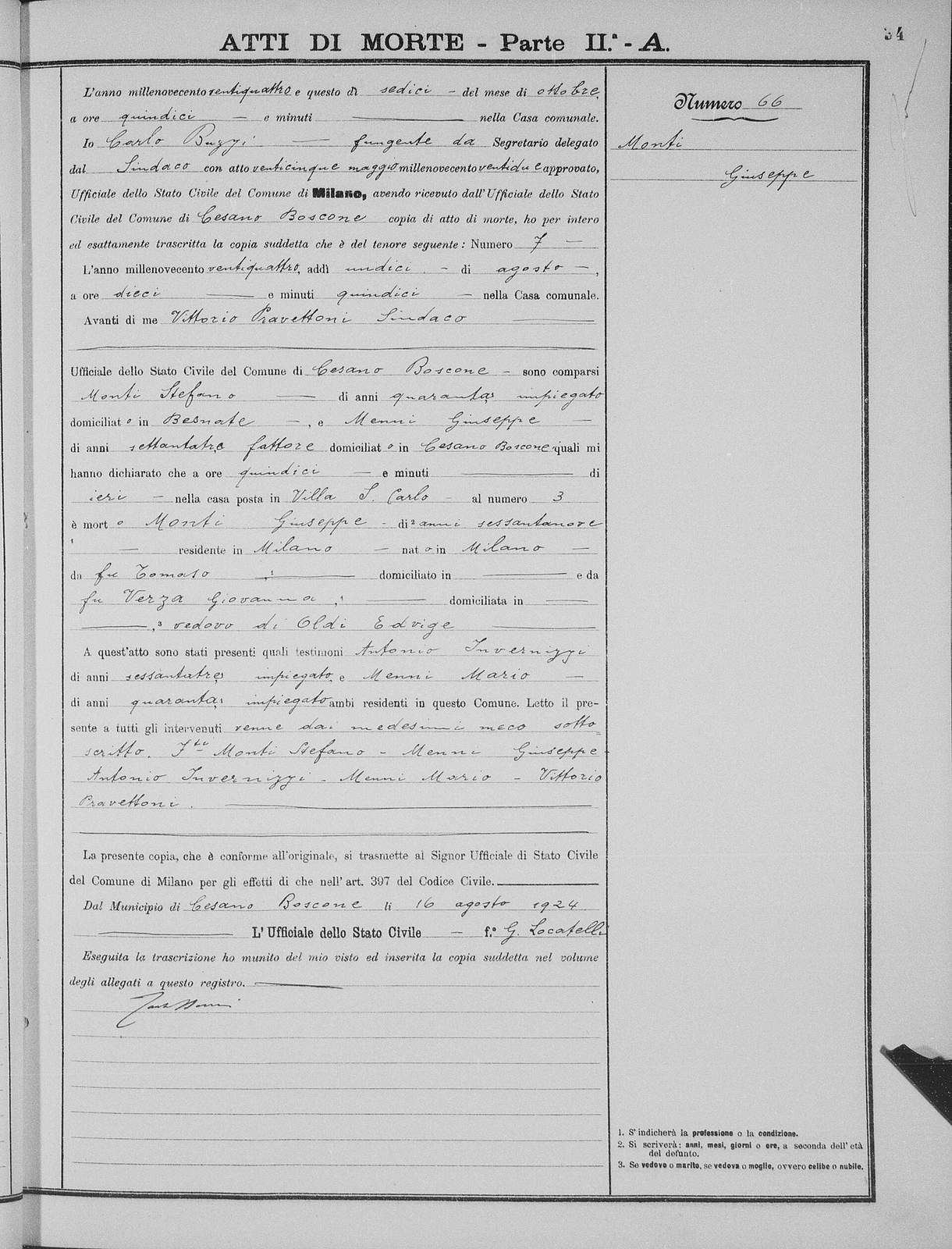
Italian death records: reading the atto di morte
What an Italian death act can tell you, why the declarant matters, and how to search the register by town and year.
Affiliate disclosure.Some links on this page go to genealogy companies. If you buy through them, we may earn a commission, at no extra cost to you. We recommend a site only where it helps this kind of research. Read the full affiliate disclosure.
An Italian death record is an atto di morte in the civil register of the comune where the death was declared. It is useful, and it is easy to over-read. The page was written so the state would have a record that a person had died. It was not written as a biography. The people who stood in front of the official sometimes knew the parents and the birthplace. Sometimes they knew a last name, an age, and the street where the person died.
Use a death act to place a death, to learn a spouse’s name, and to pick up parents when they are stated. Then test those statements against a birth act or a marriage packet. The civil overview explains the series those books belong to.
What the act usually names
The core of the entry is the dead person’s name, an age or a birth date, and the date and place of death. A spouse is often named, including a deceased spouse, and parents are often named, mothers under their own family names. Occupation and residence show up in many forms. A cause of death may be written in the medical language of that decade. Copy it if you want it. Do not use it to decide you have the right person. Cousins die of the same illnesses.
The declarant reported the death, and that person’s knowledge limits the other facts. A son in the house may know his grandparents. A neighbor or a hospital clerk may not. A blank birthplace is not a puzzle the death act has to solve.
Ages are often round. Use one to open a band of birth years. A marriage act closer to the wedding is the better estimate when the band is wide. The death reading guide and the word list cover dichiarante, coniuge, vedovo, and genitori.
Where the death was written
The ordinary place to look is the comune where the person died, not automatically the comune where they were born. A worker who died in a hospital in the provincial capital is in that city’s death register. A woman who married and moved is in the town where she was living. If the family later had the death noted on the birth act, the margin of the birth is a second doorway, and it usually cites the place and the act number. Search both towns when you have both names. Do not assume every birth town created a copy of every emigrant’s death. Many never heard of it.
Children who died young are in the death register of the town where they died, and they also have birth acts if they were born after registration began. An infant death does not replace the birth act. The birth act names the parents at the time of the birth. The death act may shorten those names.
People who emigrated often died in the new country. Do not assume that death was reported back to the Italian register. The Italian records that still help are the birth, the marriage, or a parent’s death in the town they left. Ellis Island lists and naturalization files connect that town to the later death.
How far back the books go
Deaths were part of civil registration, so the general ranges are the same ones FamilySearch summarizes for the system as a whole. Napoleonic registration, as a general rule, is about 1806 to 1815 in some areas. The Kingdom of Naples introduced that style in January 1809 under Joachim Murat and brought it back in 1816 under the Bourbons. Sicily’s introduction was in 1820. The unified series is generally from 1866, and the province of Rome from 1871. These are general ranges. The volumes for the comune control. A missing year in the listing is a missing year for you, even if the next town is complete. Check the archive’s current listing before you describe a book as lost.
Before those books, burials are parish entries. The church records page is the route, and the survival of a given parish series is local. Do not borrow a start year from a neighboring parish.
Finding the image
On the Portale Antenati, deaths sit with the other stato civile from the state archives. The Istituto Centrale per gli Archivi states that the portal is free and that registration is not required. Cerca per nome works when the register is indexed. Otherwise browse with Cerca nei registri or Esplora gli Archivi. The portal research guide and the name-search page cover the spelling traps.
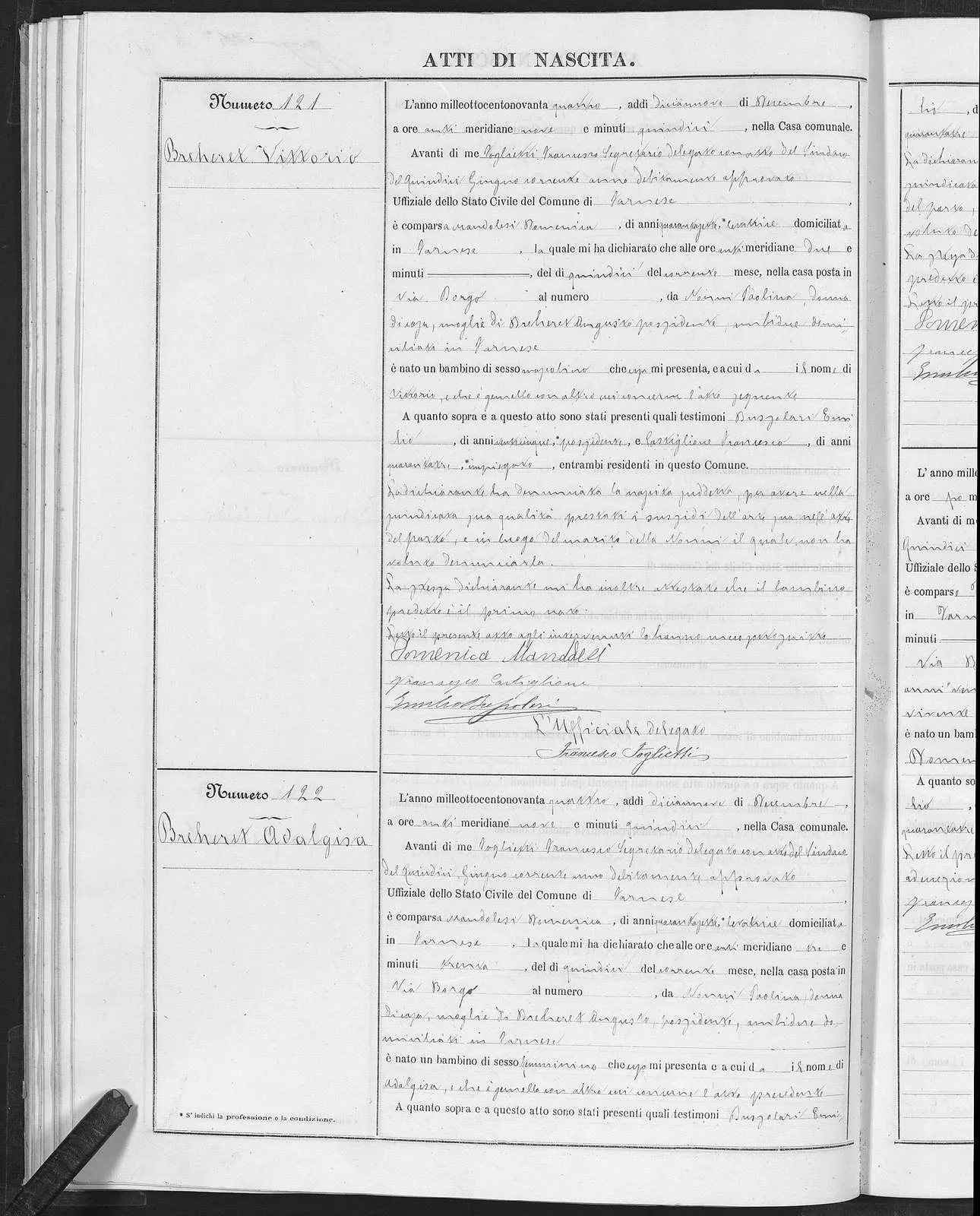
Birth act of Vittorio Breheret, Farnese (Viterbo), 15 December 1894. Civil register published through Portale Antenati. Public domain.
The ten-year index, the indice decennale, is the finding aid. Take the act number into the annual atti. Read the act. Indexes abbreviate, and they sometimes attach a widow to her husband’s last name even though the act uses her own. Search both.
FamilySearch is the other copy of many films. The FamilySearch Italy guide is the way through the catalog. Subscription sites, including Ancestry, hold some of the same images. Use them when the catalog shows your comune and year. They are not a second archive with a secret set of years. The website guide keeps that distinction sharp.
Using a death to get to a birth
A solid path runs like this. The death names a spouse and a rough age. You search marriages in a window around the age the person would have married, using the marriage records guide. The marriage packet copies the birth. You open the birth. The death has done its work.
Subtracting the age from the year of death is only a first look. Widen the search. If several people share the name, the spouse and the parents separate them, and only when the declarant knew those names. Otherwise use the marriage or a child’s birth.
Margin notes on a birth act that cite a death are better than a guessed year. Follow the citation exactly: town, year, act number.
If the register is not online
The not-online guide applies to deaths as much as to births. Write to the Ufficio di Stato Civile of the comune where the person died. Use the comune letter. Identify one person, with a spouse or parents if you know them, and a year or a short range. Ask for a full copy or an extract for family history. The glossary defines atto, estratto, certificato, and copia integrale. The office sets the fee and the form. Do not send payment until they tell you the amount and the method.
A request that says “all deaths for this last name” is how a letter gets set aside. One decedent, one town, one range.
A practical search order
- Separate what you know from what you hope. Write the name, a death year if you have one, a spouse, parents, and the town where you think the death happened. Keep the birth town in a different field on the worksheet.
- Confirm the comune. A hospital city and a village can both be true: one for the death, one for the birth. The hometown guide is the check.
- Open the death listing for the town of death on Antenati. Note which years are actually digitized. Check the current listing if a blog told you a year was complete.
- Search by name only if the register is indexed. Otherwise use the indice decennale, then the act.
- Copy the declarant’s name and relationship, the spouse, the parents, the age, the residence, and any birthplace exactly as written.
- Judge the birthplace by who declared it. If the declarant was unlikely to know, mark the town as unconfirmed.
- Use the spouse to find the marriage, and the marriage packet to find the birth. Then read those acts.
- If the year is missing online, write one letter to the stato civile office of the town of death. Track the reply on the worksheet.
Invented example
The family and the town in this section are invented.
You are looking for the death of Salvatore Greco, father of Anna Greco, in an invented town called Castelnovo del Colle. Anna’s invented birth act from 1859 said her father was 40, a mason, and living. You search deaths after 1859. The 1874 index lists Salvatore Greco, act 22.
The act says he died on 3 April 1874, age about 56, spouse Rosa Vitale. The declarant is a neighbor, Luigi Serra, who says he does not know the names of the deceased’s parents and gives the birthplace only as “this town.” You record the spouse and the death date. You do not invent parents. You do not treat “this town” as a researched birthplace. You search marriages for Salvatore Greco and Rosa Vitale, find an invented marriage in 1848, and take the parents’ names from that act, where both fathers were named because the law’s paperwork required them. The neighbor in 1874 is no longer your source for the previous generation.
The age “about 56” is a range around 1818, not a single year. The marriage act’s age picks the year you open first. The kit holds the letter and the worksheet for that follow-up. Another record has to supply the parents the neighbor did not know.
Sources
Questions readers actually ask
Does an Italian death act prove the town of birth?
It might name a birthplace, but the person who declared the death may not have known it. Treat that line as a lead. Compare it with a birth act or a marriage packet before you lock the town into your tree.
Where do I search if the person died away from home?
Start with the comune where the death happened, including a hospital town or the provincial capital. A notice copied later into the birth town, if one exists, is a second entry. Check the listing for each place.
Why can't I find a death by searching the last name alone?
Death registers are annual books for one comune. Name search on Antenati works when that book has been indexed. Otherwise you need the town and a year, then the ten-year index, then the act.