
Reading the records
Latin genealogy word list
Latin words for Italian parish books: baptisms, marriages, burials, godparents, and the month names in the genitive.
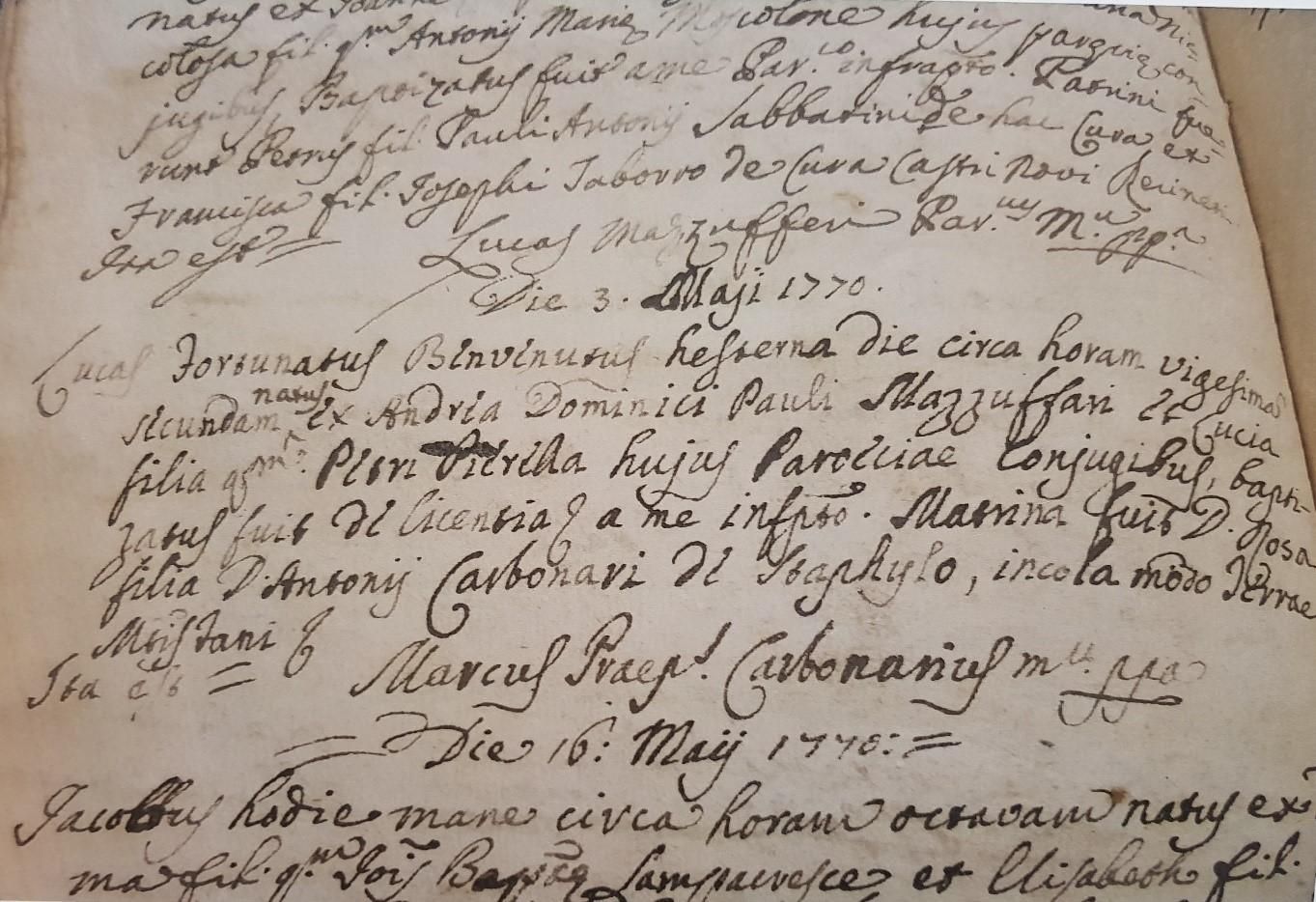
Latin in Italian family history is a parish-book language. Baptisms, marriages, and burials kept by the parochus, the parish priest, are where these words live. Civil acts of birth, marriage, and death are Italian. If you are on Antenati in a nati or morti register, use the Italian word list and the reading guides for births, marriages, and deaths. Open this page when the film is a church book, as described on the church records page.
Spelling is less stable than a textbook. Clerks and priests mixed i and j. You will see ejus and eius, Junii and Iunii, cujus and cuius, conjuges and coniuges. Treat those pairs as the same word. Older hands also swap shapes that look like u and v. Read the sentence pattern first, then the letters.
What a parish entry is doing
A baptism entry says that on a certain day a child, born of named parents, was baptized, and it names the godparents. A marriage entry says two people contracted marriage. A burial entry says someone died and was buried. The verbs that carry those jobs are in the table: natus or nata, baptizatus or baptizata, matrimonium, obiit, sepultus or sepulta.
The date often runs die (on the day), an ordinal, mensis (of the month), a month in the genitive, anno (in the year), then the year in ordinal words. Hodie means today. Heri means yesterday. They work like Italian oggi and ieri: they are relative to the day the priest is writing. A child nata heri and baptizata hodie was born the day before the baptism. Copy both.
Invented example. Die sexta mensis Martii anno millesimo octingentesimo octogesimo quarto nata et baptizata est Rosa, filia Antonii Bellini et Catharinae Greco, conjugum. Patrinus fuit Marcus Russo. This is a teaching sentence, not a real entry. It says: on the sixth day of March, in the year 1884, Rosa was born and baptized, daughter of Antonio Bellini and Caterina Greco, spouses. The godfather was Marco Russo. A real entry will add the parish, the godmother, and often the grandparents or a street. This one only shows the skeleton.
Names are often Latinized, and the father’s name is often in the genitive because the child is filius or filia “of” him. Antonii is the genitive of Antonius, the Latin form of Antonio. Catharinae is the genitive of Catharina. Copy the form on the page, and add the Italian form in brackets when you already know it from a civil act. Some priests wrote Italian given names inside a Latin sentence. Do not “correct” those into Latin.
The list
| Latin | English | Where it helps |
|---|---|---|
| natus | born, masculine | baptism or burial |
| nata | born, feminine | baptism or burial |
| baptizatus | baptized, masculine | baptism |
| baptizata | baptized, feminine | baptism |
| filius | son | of the father, genitive |
| filia | daughter | of the father, genitive |
| pater | father | parents |
| mater | mother | parents |
| conjuges | spouses | parents as a couple; also coniuges |
| matrimonium | marriage | the wedding entry |
| obiit | died | burial entry |
| sepultus | buried, masculine | burial |
| sepulta | buried, feminine | burial |
| parochus | parish priest | the writer of the book |
| patrinus | godfather | baptism sponsor |
| matrina | godmother | baptism sponsor |
| die | on the day | date formula |
| mensis | of the month | before the month genitive |
| anno | in the year | date formula |
| hodie | today | relative date |
| heri | yesterday | relative date |
| Januarii | of January | month genitive |
| Februarii | of February | month genitive |
| Martii | of March | month genitive |
| Aprilis | of April | month genitive |
| Maii | of May | month genitive |
| Junii | of June | month genitive; also Iunii |
| Julii | of July | month genitive |
| Augusti | of August | month genitive |
| Septembris | of September | month genitive |
| Octobris | of October | month genitive |
| Novembris | of November | month genitive |
| Decembris | of December | month genitive |
| primus | first | ordinal for the day |
| secunda | second | day of the month, feminine with die |
| tertia | third | day |
| quarta | fourth | day |
| quinta | fifth | day |
| sexta | sixth | day |
| septima | seventh | day |
| octava | eighth | day |
| nona | ninth | day |
| decima | tenth | day |
| vigesima | twentieth | day |
| tricesima | thirtieth | day |
| millesimo | thousandth | year, with octingentesimo |
| octingentesimo | eight hundredth | 1800s in the year formula |
| octogesimo | eightieth | 80 inside the year |
| nonagesimo | ninetieth | 90 inside the year |
| uxor | wife | marriage and burial |
| vidua | widow | burial or marriage |
| viduus | widower | burial or marriage |
| infans | infant | burial of a child |
| legitimi | legitimate, genitive phrase | thori legitimi, copy as written |
| patrini | godparents | plural |
| obstetrix | midwife | when she is named |
| nomen | name | the child’s name |
| predictus | the aforesaid | also praedictus; a person already named |
| ejusdem | of the same | also eiusdem; the same month or place |
| circa | about | an approximate age or date |
| in ecclesia | in the church | place of the rite |
| in domo | in the house | a baptism or death at home |
Month genitives in a real date
The month is rarely in the dictionary form Martius. It is in the genitive after mensis or after the day: Martii, Maii, Decembris. Learn the twelve genitives in the table rather than the nominative forms. Die decima quinta mensis Maii is the fifteenth day of May. Quinta decima is the same idea with the words reversed. Priests used both orders.
Junii and Iunii are the i/j pair you will meet every summer. Januarii can show a j that looks like an i, or the reverse. Read the neighboring entries. A run of baptisms in one month repeats the same month word. The clear one teaches the messy one.
The year millesimo octingentesimo octogesimo quarto is 1884: thousandth, eight-hundredth, eightieth, fourth. Millesimo octingentesimo octogesimo alone is 1880, the same number as Italian mille ottocento ottanta. Millesimo nongentesimo moves into the 1900s. Abbreviation is constant. A priest who writes a shorthand year still has a page heading or a marginal year in numerals. Use that heading. Record the conflict if the numeral and the words disagree.
Godparents, parents, and the wife
Patrinus and matrina are the sponsors at baptism. They are not the parents. Pater and mater are the parents. Filius and filia tie the child to them. Conjuges or coniuges describes the parents as a married pair when the priest says so. If that word is absent, do not supply it. Copy the names and the words that are there.

Church of San Martino, interior, Naples. Photochrom Print Collection, Library of Congress, between 1890 and 1900. Public domain.
Some books use susceptor or compater for the godfather and a matching feminine for the godmother. If you see those instead of patrinus and matrina, treat them as sponsors and say which word the book used. The role is what you needed. The exact noun belongs in the transcription.
Uxor is wife. On a burial, vir or maritus may mark a husband, and vidua a widow. A burial that calls a woman vidua Josephi tells you she was the widow of Giuseppe. That is a lead to his burial and to their marriage. It is not a renaming. Her own name is still the name in the entry.
Parochus is the priest. You do not put him in the family. You use his sentence as the frame, the way you use ufficiale dello stato civile on a civil act. Obstetrix, the midwife, is named in some baptisms. She is a participant, not a grandmother, unless the entry also gives her a relationship.
From the parish line to the civil act
For a year inside the civil-registration era, the same child may have an Italian birth act and a Latin baptism. The general ranges, from the FamilySearch civil-registration overview, are only a guide to when the town hall book exists: roughly 1806–1815 in some Napoleonic areas; the Kingdom of Naples from January 1809; Bourbon reintroduction in 1816; Sicily in 1820 for that style; the unified series generally from 1866; Rome province from 1871. They are general. Check the archive’s current listing. Where both records exist, keep both notes. The baptism may name godparents the birth act never mentions. The birth act may name ages and a street the baptism skips.
Find parish films through the FamilySearch Italy guide, by town and, if needed, by diocese. Antenati is built for the state-archive civil series and the conscription material described on its own site. A missing baptism there is not a missing baptism in the parish. If the film does not exist, the parish letter is the request. The comune letter is the wrong address for a book that never lived at the town hall.
The not-online guide still applies: confirm the gap in the listing you actually searched, try the other catalog, then write. Say baptism, marriage, or burial, and give the parents, as in filia Antonii et Catharinae.
A short transcription habit
Write the date two ways in your note: the Latin as read, and the calendar date you believe it is, with a question mark if the ordinal was unclear. Then the child’s name, the father, the mother, the godfather, the godmother. Then the act’s own word for the event, baptizata or sepultus or matrimonium contraxerunt, so a later reader can see you did not turn a burial into a baptism by force of habit.
Invented example, continued. Log the Rosa sentence as 6 March 1884, father Antonio Bellini, mother Caterina Greco, godfather Marco Russo. A real log adds the image number and the parish title. Leave the practice sentence out of the citation.
Label the source “parish” or “civil” on every line. The death reading guide explains the civil side, where the dichiarante may be a neighbor and the burial may be absent.
Place names inside Latin entries can be in Latin, Italian, or a local form. Confirm the comune in the hometown guide before you browse. The region pages help when a diocese covered towns that later sat in more than one province. The beginners’ guide keeps the order straight: identify the town from later records, including a passenger list when that is the clue you have, then choose the book, then read with the list that matches the book.
The kit carries this list next to the Italian one so a mixed evening, civil birth plus parish baptism, does not depend on memory for heri and ieri. They mean the same thing in two rooms. The rooms stay different, and so do the notes.
Sources
Questions readers actually ask
Where will I see this Latin?
In parish books of baptism, marriage, and burial. Civil birth, marriage, and death acts are in Italian. If the page says ufficiale dello stato civile, you want the Italian word list.
Why do month names end in -i or -is?
Dates use the genitive, mensis Maii, meaning of the month of May. Januarii through Decembris in the table are those forms. The spelling shifts between i and j.
What is a patrinus?
The godfather named in a baptism. Matrina is the godmother. They are sponsors, not the parents. Filius and filia point to the parents, who are pater and mater.