
Surnames
Southern Italian family names
How to use a southern Italian family name as a research clue, and why the name still does not identify the town.
Affiliate disclosure.Some links on this page go to genealogy companies. If you buy through them, we may earn a commission, at no extra cost to you. We recommend a site only where it helps this kind of research. Read the full affiliate disclosure.
Southern Italian family names are the surnames people hope will explain a voyage. The hope makes sense. A great many of the lists and the stories that reach English-speaking researchers point south, and the last names on those lists share familiar shapes: a particle, a saint, a trade, a nickname, a town-word. The shapes are real features of Italian naming. They are not a filing system. The south was not one registry, and it is not one archive now.
This page says how to use the name without pretending it identifies the town. The origins page defines the patterns. The distribution maps define the telephone tools. The Sicilian surnames page handles the island, including the refusal to sort spellings into Greek, Arabic, Norman or Spanish bins. The regions hub handles the archives. Read those when you need the detail. Stay here for the mistake that treats “southern” as a place.
The south is a direction and a set of catalogs
The launch guides cover Sicily, Calabria, Campania, Abruzzo and Basilicata. Each one names its provinces and its state archives, and each one has a local trap: Sicily’s later start for civil registration, Calabria’s newer provinces and the two Reggios, Campania’s port, Abruzzo’s older English name and the split custody of Pescara records, Basilicata’s alias Lucania. A last name does not tell you which trap you are in. A place string does.
Other regions in the south are not published on this site until a page can be specific about archives and old names. If a gazetteer puts the town in Puglia, or somewhere else without a guide, you still follow the town. You do not force it into Campania because the last name “looks southern” and Campania has a page.
FamilySearch’s overview of important Italian research resources gives the general ranges. Napoleonic-style civil registration in the Kingdom of Naples dates from 1809, with a Bourbon continuation from 1816. Sicily did not get that style of registration until 1820. Unified civil registration begins generally in 1866. A southern birth can fall in any of those series depending on the place and the year. The range tells you what kind of book to expect. Antenati tells you whether the book is online. The Italy Genealogy wiki is the broader record map.
Patterns, without a southern exception
Di, De and D’ are patronymic particles. They mean the word is built on a personal name. They do not mean the family is southern, and they do not mean the family is noble. Ferraro and Pastore, as words, refer to a worker in iron and a shepherd. Those are dictionary senses. They are not proof that a southern ancestor held that job. A toponymic surname may echo a southern town and belong to a household that never lived there, or the reverse. Nicknames translate into traits the ancestor need not have had. The origins page freezes these warnings in one place so this page does not have to pretend the south invented a different linguistics.
A commercial coat of arms sold for a spelling is not evidence of nobility in the south or anywhere else. Heraldry belonged to particular grants. A shop that detects “southern Italian family name” and offers a shield has detected a market. Close it and copy the spelling variants onto a worksheet instead.
Maps are allowed to suggest a province, and nothing further
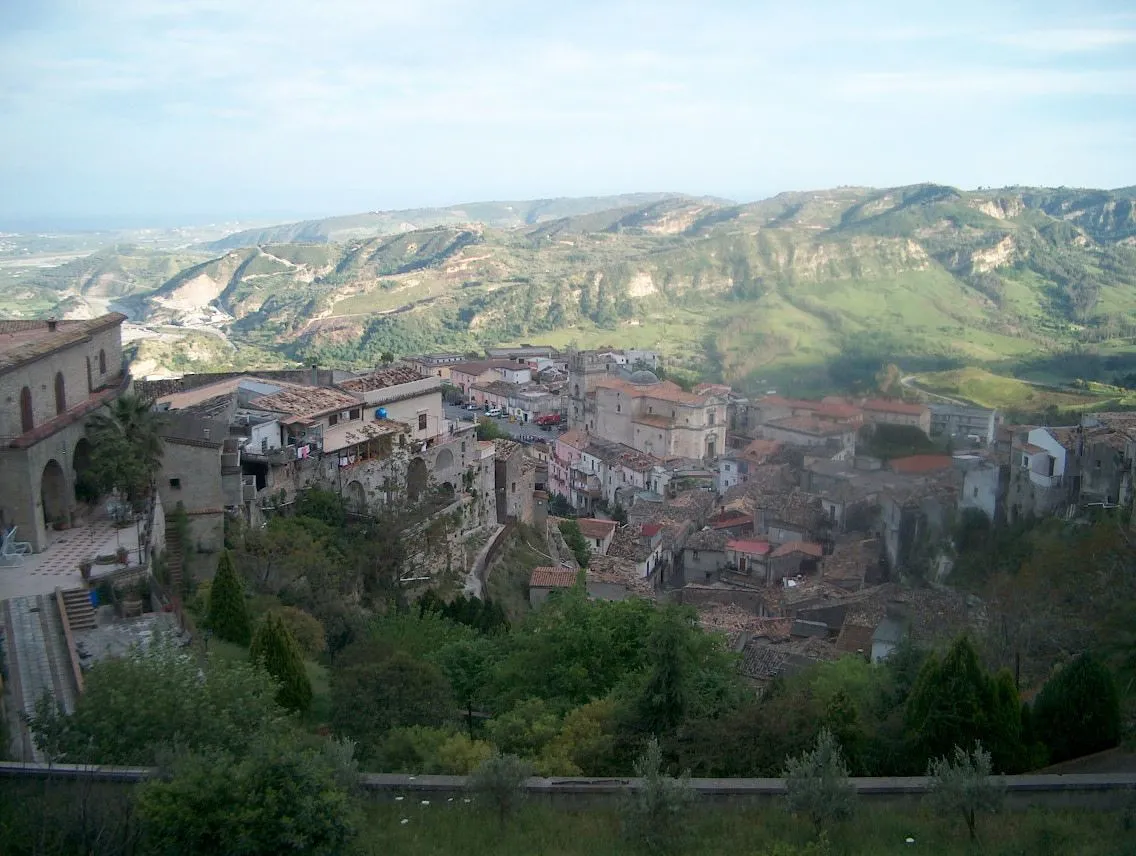
A village in a valley in Calabria. Photograph released to the public domain by Wikimedia Commons user Drork.
Gens is built from private telephone listings grouped by comune; its instructions describe a database representing over 20 million private lines. Cognomix says it maps about 180,000 last names corresponding to 20,985,000 families, and that the figures are families, not individuals. Mappa dei Cognomi says it was inspired by Gens, used telephone directories from the 1990s, and is not a current population map. None of these is a historical census of the 1800s. A cluster is a place to look, not proof of one ancestor’s town.
For a southern research problem the maps help in one situation only. You have a story or a DNA label or a very vague document that says south, and you want to know whether the spelling is concentrated in one southern province or scattered everywhere. Concentration tells you where a newly found place-name is more plausible. Scatter tells you the last name will not narrow anything, which is worth knowing. Neither result lets you skip the hometown guide. And a cluster in Lombardy beside a cluster in the south may be later migration. The 1990s are not the voyage.
Naples is the last-name problem in disguise
Southern names get called Neapolitan because the port was Napoli and because English speakers used Naples as a synonym for the south. The Campania guide is the full split between port, city and province. It belongs on a last-name page because the last name is what people search after they have accepted the synonym. They type the name plus Naples and retrieve strangers. The strangers may be real people in the city of Napoli. They are not your family unless the town and the parents match.
A list of “southern Italian family names” that is only a column of spellings, with no comune and no act, is the same error in bulk. This site does not publish a ranking of those spellings and does not invent a count of how common each one is. If you need a frequency, use the map sites and quote their definitions of what they counted. Then go back to a person.
DNA labels are coarser than the regions
Autosomal tests sold by Ancestry, MyHeritage, FamilyTreeDNA and Living DNA can report a southern Italian label, or a broader Italian label, depending on the company and on the version of its model. The southern versus northern page explains why those labels move and why they do not name a comune. They also do not prove a province. Cousin matches are the genealogical product. A match in another country, which is one reason people choose MyHeritage, may have a tree that already cites a town in Abruzzo or Sicily. Test the town. Do not adopt it because the match’s public tree looks confident.
Y-DNA can be relevant to the last name along an unbroken paternal line and says nothing about the other ancestors, many of whom may be the ones who were southern. Do not buy a Y-DNA test to answer “was the family southern?” The autosomal label is already a coarse answer to that question, and the paper is a better one. The test comparison matches the product to the job. 23andMe is mentioned on that page only editorially. Its affiliate program is paused, and a commission is not the point of this paragraph. Its labels are models too.
Invented example
Invented example. Three siblings in Pennsylvania agree the name is “a southern name” and that their grandmother said Naples. One cousin’s autosomal test shows a southern label and a match whose tree says Salerno. A telephone map shows the spelling in Salerno province, in Sicily and in a scatter of northern listings. None of this identifies the comune. The southern label is coarse. The match is a lead. The map is a late directory. The word Naples may be the port.
A death certificate for the immigrant, found the same week, says he was born in Buccino. Buccino is a comune in the province of Salerno. Now the match and the map are consistent with a document, and the document is what you follow. You open the Archivio di Stato di Salerno for Buccino. You do not open the city of Napoli, and you do not open a Sicilian archive because the map had a second cluster. If Buccino’s year is missing, you use FamilySearch and then a letter to that comune about one event. The kit is the letter and the log, after the town is known. The last name, throughout, was only the string that let you recognize the man on the certificate.
The order that keeps the south from swallowing the search
Collect the spellings. Find a place in a destination-country record. Identify the comune and the province. Read the region guide if one exists. Browse Antenati and FamilySearch. Use a map or a DNA match only to decide which document to look for next, or to test a town a cousin already wrote down. The beginner guide writes that order without the romance. Southern family names are allowed to be interesting. They are not allowed to be the town.
Sources
Questions readers actually ask
What counts as a southern Italian last name?
In genealogy, it counts as a surname you are trying to trace in the south, not as a separate species of name. The south is a set of regions with different state archives. This site has launch guides for Sicily, Calabria, Campania, Abruzzo and Basilicata. Other southern regions are not given pages until a page can be specific. The patterns of the names are the ordinary Italian ones: particles such as Di, De and D', place-words, occupational words, nicknames. A name can be common in the south and also present in the north because people moved, or because the same word became a last name in more than one place. Frequency is not identity. A telephone map can suggest where to look. It cannot label the name southern for all time.
Why do so many southern families seem to be "from Naples"?
Because Naples was a port, and because "Naples" became a shorthand for the south in the country of arrival. The city of Napoli has its own registers. The province of Napoli has others. Avellino, Benevento, Caserta and Salerno are separate provinces with their own archives, and Calabria, Sicily, Abruzzo and Basilicata are not Napoli at all. A passenger list can show Napoli as the port of departure and a village as the last residence. The village is the birthplace candidate. The Campania guide walks through that split. A last-name list titled "Neapolitan families" does not repair a missing town, and it often mixes the port with the whole mainland south.
Can DNA tell southern Italian ancestry apart from northern?
Only as a coarse label, and not as a town or a province. Companies revise the models behind those labels. A southern result does not choose Sicily over Campania, and it does not prove that every ancestor was southern. A northern label has the same limit. Cousin matches are more useful than the label, because a match may have a tree that names a comune you can check. Y-DNA speaks only to an unbroken paternal line and says nothing about the other ancestors. Read the southern-and-northern DNA page before you buy a test for this question, and keep looking for the town in paper records. The label will not open Antenati.