
DNA
Ancestry vs MyHeritage for Italian research
How Ancestry and MyHeritage differ for Italian research, covering record collections and DNA matches, with Antenati still free.

Affiliate disclosure.Some links on this page go to genealogy companies. If you buy through them, we may earn a commission, at no extra cost to you. We recommend a site only where it helps this kind of research. Read the full affiliate disclosure.
Ancestry and MyHeritage are both worth understanding for Italian research, and neither one is the place to start. They sell record subscriptions and they sell autosomal DNA tests. Those are four products, not a duel. Antenati remains free, and the portal’s research guide is still the explanation of how Italian civil registers are browsed by archive and town. This page compares the two companies on the jobs they actually do: Italian record collections, and DNA matches. It does not crown a winner. It does not quote a price, and it does not quote an ethnicity breakdown.
If you have not yet identified the comune, neither subscription will do it for you. The hometown guide and the beginner guide are the sequence. Come back here when the question is which paid door helps with a province you already have, or which match list your cousins are likely to be in.
Record collections, not a private Italy
Both companies have published Italian civil images for many provinces. The images often come from the same digitizing work that appears on Antenati and on FamilySearch. What you are buying, when you are buying records, is another index, another viewer, and the trees users have attached. You are not buying a secret register of a town the state archive never filmed.
That fact decides the comparison. If Antenati already shows the year, you can read the act there and cite it. A paid index is helpful when it finds the act faster, or when the free name search is empty because the volume was not indexed on the portal. If Antenati does not show the year, check the FamilySearch catalog before you assume a subscription has it. FamilySearch account creation is free, and some images are limited to a FamilySearch Center or an affiliate library. A lock is not a hint to pay a third company. It is a hint to read the access note. The free-records guide lists what you can do without a subscription. The website comparison puts Findmypast and the newspaper sites in the same frame, so this page can stay on the two companies people actually pit against each other.
Use Ancestry’s record side when you are already inside an American research problem that Ancestry indexes well: a New York passenger list, a census, a tree your cousins edit. The Ellis Island guide explains the manifests themselves. The list, not the website, is the evidence. Use MyHeritage’s record side when a collection or a user tree you care about is there, including trees built by relatives in Europe. Do not switch provinces because one site returned a namesake. A namesake in the wrong comune is the ordinary failure of a last-name search. The southern surnames page is the warning. Naples the port is not a birthplace, on either website.
When the two sites disagree about a date or a town, open the image on both if you can, and open Antenati. Indexes are transcriptions. The act is the record. Women’s family names in the Italian act are their own family names. If a tree on either site has replaced the mother with the father’s surname, the tree is wrong even when the subscription was expensive.
DNA matches, which is a different purchase
AncestryDNA is Ancestry’s autosomal test: cousin matches, and the trees sitting behind many of those matches. MyHeritage DNA is MyHeritage’s autosomal test: cousin matches, in a database often used by European testers. The best-test page sets both of them next to FamilyTreeDNA and Living DNA so the choice is about the job. Here the choice is narrower. You are asking which of these two match lists helps an Italian problem.
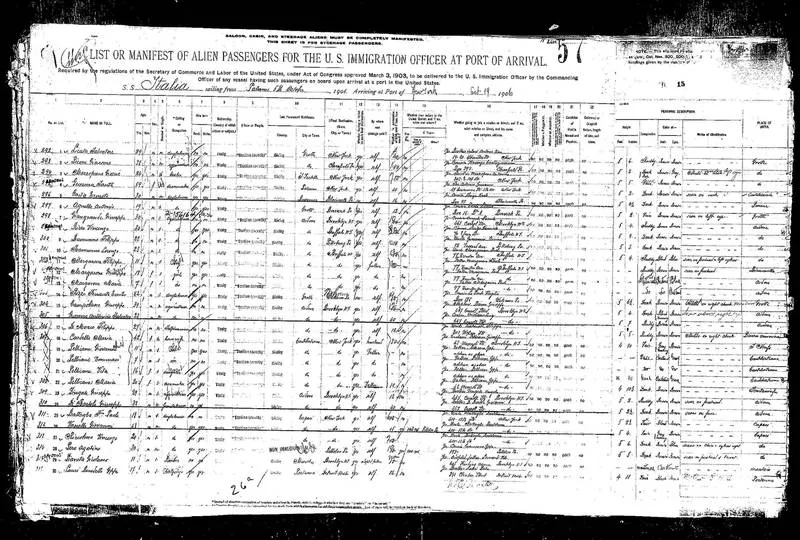
Ellis Island passenger manifest for a group recorded as Italy (South), including towns in Sicily. The file title says 1903; the Commons date field says 19 October 1906. Public domain.
An American family, with cousins who have tested because they wanted ethnicity maps and family trees, is often visible at Ancestry. A family that still has branches in Italy, or in another European country, is a reason to look at MyHeritage, because that is where those testers have often chosen to be. Both statements are tendencies about where people test. They are not a count of users, and this page does not invent one. If you know where your actual cousins tested, follow them. A theoretical database is less useful than the aunt who already uploaded.
Neither test names a comune. The ethnicity-style labels are models the companies revise. A southern Italian label and a northern Italian label are coarse, and they do not prove a province. The label page explains that limit. What you want from the test, if you want anything, is a match whose tree or message names a town you can then find in a gazetteer. The match is a person. The town is still a hypothesis until the registers agree.
A record subscription does not include the DNA matches. A DNA kit does not include every record collection. Promotions bundle them. The bundle is a sales arrangement. Write down which part you needed before you accept the bundle. If you needed the passenger list and the list is on a free site, you do not need either kit. The Statue of Liberty—Ellis Island Foundation’s arrival search is linked from the passenger-list guide. Antenati does not ask for a swab.
Trees are shared notebooks, not archives
Both sites encourage trees. Trees are how matches become useful, and they are how mistakes spread. A tree that cites an Antenati act, with the archive, the comune and the year, is a lead you can check in an evening. A tree that cites another tree is a rumor with a login. Italian research is full of duplicate towns and of the word Naples used for a port. A copied tree will repeat those errors faster than a manuscript did. On either company, open the citation. If there is no image and no archive, the node is not a finding. The regions hub is what you use when the citation names a province this site has written about.
Shared matches and messages are the part that justifies a test when the paper is stuck between two cousins’ versions of the town. Ask which document they saw. Offer the spelling on the manifest. Do not argue from the color of a DNA map. If they have a letter from the comune, ask for the town and the year, then look at the same year yourself.
23andMe, FamilyTreeDNA, and the companies this page is not judging
This comparison is Ancestry and MyHeritage because that is the question. It is not a full catalog of laboratories. FamilyTreeDNA’s Family Finder, Y-DNA and mitochondrial tests are the direct-line tools described on the best-test page. Living DNA’s autosomal regional report is a model, not a town. 23andMe publishes an autosomal report; its affiliate program is paused, and this site does not earn a commission from a purchase there. None of those facts makes Ancestry or MyHeritage the winner of this page. They mark the edges of the comparison so a reader does not think the two logos are the whole market.
Invented example
Invented example. A researcher has a paid Ancestry account, an untested DNA kit in a drawer, and a great-grandmother whose passenger list says last residence “S. Fele” and port Napoli. A gazetteer search for that string, compared with a petition that says “San Fele,” identifies San Fele as a comune in the province of Potenza. Antenati’s Archivio di Stato di Potenza listing includes the year. The researcher does not need MyHeritage or Ancestry to read that birth. She needs the Basilicata guide and an evening of browsing.
The DNA question is separate. Her cousin in Argentina tested at MyHeritage and has a tree that also says San Fele. That is a reason to look at MyHeritage DNA, or at whatever upload path MyHeritage currently documents, if she wants that cousin as a match. It is not a reason to doubt San Fele, which already rests on two paper sources. AncestryDNA would be a reason if the American cousins she cannot find had tested there. Buying both kits on the same afternoon, before she knows where anyone tested, would be a purchase without a question. The subscription she already has is enough for the American census. Antenati is enough for the birth.
How to spend in order
Read the free portals for the town you have. Use Ancestry or MyHeritage records when an index or a tree on that site cites a source you can verify. Use AncestryDNA when the match list you need is the American one. Use MyHeritage DNA when the match list you need is the one European relatives actually joined. Keep the ethnicity maps off the birthplace line. If a page, including this one, seems to push a checkout, the test is still optional. The act in the state archive is the thing the comparison cannot replace.
Sources
Questions readers actually ask
Is Ancestry or MyHeritage better for Italian genealogy?
Neither one is the winner. They are two subscriptions, and they do different work beside the free portals. Ancestry combines a large American tree-and-record site with an autosomal test, AncestryDNA, that produces cousin matches. MyHeritage combines records with an autosomal test that also produces matches, and it is often used by European testers, which matters when the cousins you need did not emigrate to the United States. For Italian civil registers, both companies host images for many provinces, often from the same filming projects you can browse free on Antenati. A subscription does not create a year that was never filmed. Start on Antenati and FamilySearch. Add one or both subscriptions when you have a reason: an index, a tree, or a match list you cannot see elsewhere.
Do I need both DNA tests if I already pay for one site?
You need the database that contains the cousins. A subscription to records is not a DNA test, and a DNA test is not a record subscription, even when the same company sells both. If your known relatives tested at Ancestry, an AncestryDNA test is how you match them there. If relatives in Italy or elsewhere in Europe tested at MyHeritage, that is a reason to test or to check whether a file upload is currently offered. This page does not promise that uploads are accepted, free, or permanent. Read each company's current help. Paying for both record sites and both tests is reasonable only when each one has something you have already seen a sample of. It is not a default.
Will either company replace Antenati?
No. The Portale Antenati is the Ministry of Culture's site for civil registers and related material from the state archives. Its research guide explains name search and browsing, and access is the portal's own free service. Ancestry and MyHeritage are commercial copies and indexes layered on top of filmed records, plus trees and DNA. Use them as extra doors. When an image on a paid site and an image on Antenati disagree, prefer the register you can cite, and read the act rather than the index line. FamilySearch is a third door, with a free account and, for some images, a lock to a FamilySearch Center or an affiliate library. None of the doors is a birthplace by itself.