
Surnames
Sicilian surnames
How to research a Sicilian surname without treating a spelling as proof of a Greek, Arabic, Norman, or Spanish origin.
Affiliate disclosure.Some links on this page go to genealogy companies. If you buy through them, we may earn a commission, at no extra cost to you. We recommend a site only where it helps this kind of research. Read the full affiliate disclosure.
Sicilian surnames are a search people make when they have an island and a spelling and they want the spelling to do the work of a town. It will not. A last name can be frequent on the island, rare on the island, or frequent in a single province in a set of telephone listings. None of those facts is a birth. The birth is an act in a comune, filed toward a state archive that follows the province. The Sicily guide is the map of those archives. This page is about not letting the last name replace it.
The provinces you will eventually have to name are Agrigento, Caltanissetta, Catania, Enna, Messina, Palermo, Ragusa, Siracusa and Trapani. The archives are the Archivio di Stato of those same places. You open them from Esplora gli Archivi, not from a surname dictionary. If you do not yet have a province, you are not ready for that list. You are ready for a record in the country of arrival. The hometown guide turns the place string on that record into a municipality.
What the historical layers actually justify
Sicily’s history includes Greek, Arabic, Norman and Spanish periods. That is a real historical sequence, and it is why some surname dictionaries discuss those layers. A dictionary can say that a word resembles a word used in one of those periods, or that a scholar has proposed a derivation. You may read that discussion. You may not promote it into a finding about your family.
This page does not label a list of last names as Arabic in origin, or Greek, or Norman, or Spanish. The reason is not politeness. The reason is that a spelling does not prove an origin. The same letters can be explained in more than one way, the explanation can be about a word rather than about a household, and two households with the spelling need records before anyone claims they share a source. If a website offers a column of names under an ethnic heading, ask which acts were read. If the answer is the shape of the word, you have a linguistic note, and you should keep it in the linguistic note pile.
The origins page goes through the patterns that are safe to name without assigning a family: patronymic particles Di, De and D’; toponymic words; occupational words, with Ferraro and Pastore as meanings of the words and not as proof of a job; and nicknames. Those patterns occur in Sicily as they occur elsewhere. A particle does not make a name “more Sicilian.” A crest sold for the spelling does not make it noble. Heraldry belonged to particular grants, not to every person with the spelling.
Distribution maps, limited to a lead
Gens, Cognomix and Mappa dei Cognomi can show whether a spelling clustered in Sicilian provinces in the telephone data they describe. The distribution guide quotes the figures those sites give for themselves: Gens’s instructions describe a database representing over 20 million private lines; Cognomix says it maps about 180,000 last names corresponding to 20,985,000 families, and that the figures are families, not individuals; Mappa dei Cognomi says it used telephone directories from the 1990s and is not a current population map. None of that is a census of the 1800s, and none of it is a list of who left Palermo.
Use a Sicilian cluster this way. If you already suspect the island, and the map shows the spelling concentrated in one province and scarce elsewhere, that province is a reasonable place to focus when you are choosing which American document to chase for a town name. If the map shows the spelling in Sicily and in Calabria and in the north, the last name will not choose for you. Follow the document that names a town. A cluster is a place to look, not proof of one ancestor’s town.
The records that make a last name Sicilian in your tree
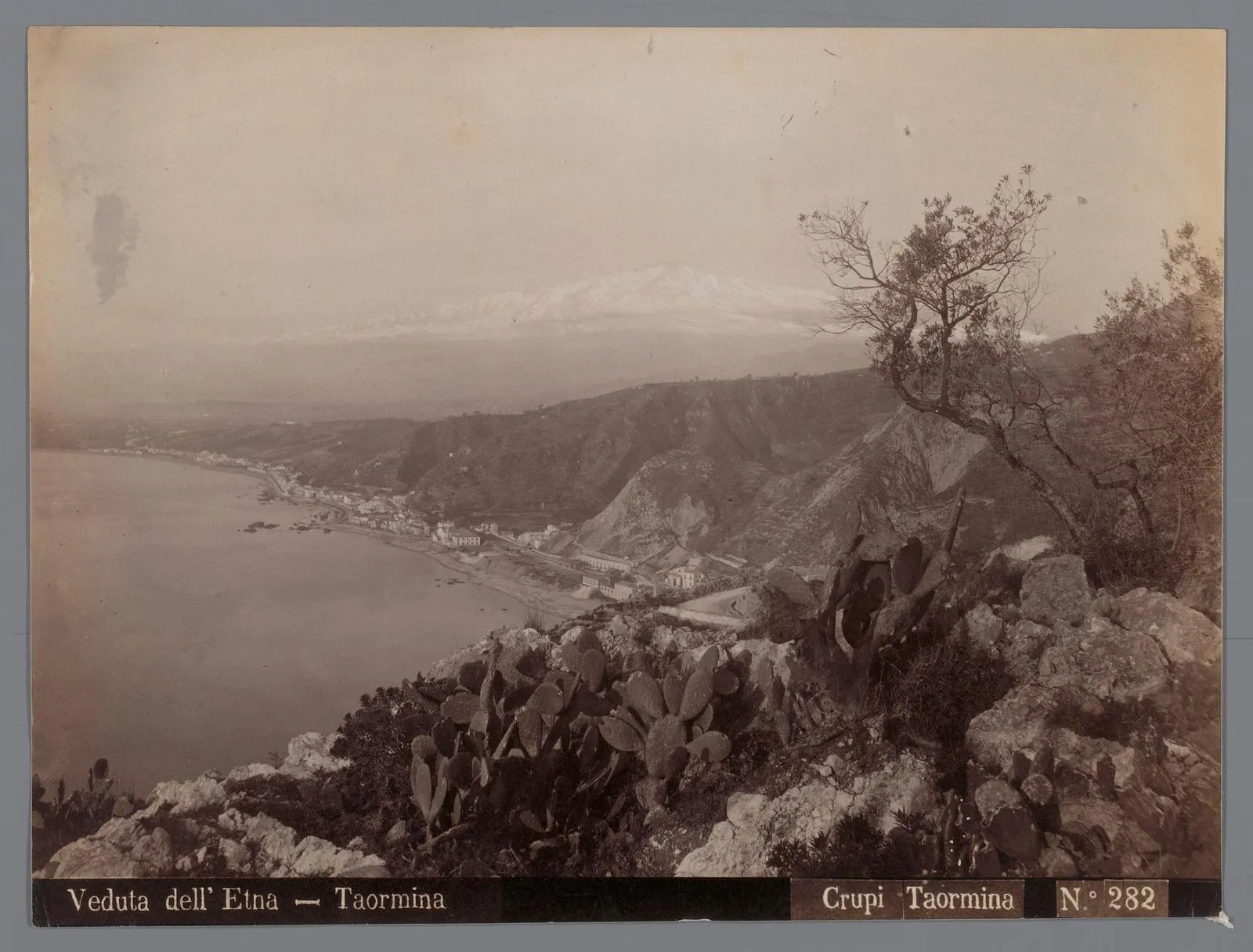
View of Mount Etna from Taormina, catalogue number 0282, by Giovanni Crupi.
A surname becomes Sicilian in a genealogy when an identified person is born, married or buried in a Sicilian comune. FamilySearch’s overview of important Italian research resources says Sicily did not get Napoleonic-style civil registration until 1820, and that unified civil registration begins generally in 1866. Those ranges tell you which series to expect. The listing on Antenati tells you which years of which town were filmed from which archive. The FamilySearch wiki for Sicily lists collection titles. Some images are open at home and some are limited to a FamilySearch Center or an affiliate library.
Palermo on a list may be the port. The Sicily guide separates the port, the city and the province. A last-name search inside the city of Palermo, undertaken because the ship said Palermo, is the usual way to miss a town in the province of Trapani or Agrigento. Read the last residence. Then browse that comune. Name search is only as good as the index. The portal’s research guide, linked from the Antenati walkthrough, is the reminder to browse when the index is empty.
Before 1820, and in gaps, the parish may be the only registration. There is no island-wide last-name index of baptisms that this page can send you to as a substitute. Identify the town first.
DNA, if the paper is stuck
An autosomal test from Ancestry, MyHeritage, FamilyTreeDNA or Living DNA can produce cousin matches. A match whose tree cites a Sicilian town is a lead you can test in that town’s registers. The lead is not a finding until the acts connect. Living DNA’s regional report, and the ethnicity-style labels on the other tests, are models the companies revise. They do not name a comune. A southern label does not choose Sicily over Calabria. The comparison of tests describes each product by the research job it does. The southern and northern labels page explains why those labels are coarse. This page does not quote a share of anything.
Y-DNA is the test that can be relevant to a last name, and only along an unbroken paternal line. It says nothing about the other ancestors. It does not prove a province. A woman who wants that kind of evidence needs a male relative in the direct paternal line to take the test. A match on that test still has to be tied to paper before anyone names a town. 23andMe publishes an autosomal report as well; its affiliate program is paused, and this site does not earn a commission from it. Mentioning it is not a recommendation to treat its labels as an archive.
Invented example
Invented example. A blog lists a spelling under the heading of Arabic last names of Sicily and adds a crest. The researcher’s grandfather’s death certificate says he was born in “Sicily,” and a passenger list for a man of the same age and wife’s name says last residence “Caltagirone.” Caltagirone is a comune in the province of Catania. The blog has not read his birth. The crest is a product. The historical fact that Sicily had an Arabic period does not attach that period to this spelling in this family. You open the Archivio di Stato di Catania for Caltagirone and for the year on the list. You ignore the ethnic heading. If the images are missing, you check FamilySearch and then the comune. You do not write to an office asking it to confirm an Arabic origin. It records births, marriages and deaths.
If the list had said only “Sicily,” the blog would still not be evidence. You would look for another record, and you might note a distribution cluster without promoting the darkest town into a birthplace.
Where this sits among the other surname pages
The surname hub links the origins page, the map page, this page and the southern page so they are not used as substitutes for one another. Southern Italy includes Sicily and is larger than Sicily. A “southern” label on a DNA report or in a family story still needs the island to be distinguished from the mainland, which is a document’s job. The beginner guide is the order: place, archive, year, act, parents. A Sicilian surname is what you type into the index after that place is known. It is not how you learn the place.
Sources
Questions readers actually ask
Can a list of Sicilian surnames tell me if my name is of Arabic origin?
No, and this site will not publish that kind of list. Sicily's history includes Greek, Arabic, Norman and Spanish periods, and some surname dictionaries discuss those layers. A discussion is not an identification. A modern spelling does not prove which layer, if any, produced a particular family, and the same spelling can occur in more than one town with no shared paper trail. Sorting names into ethnic bins is how surname websites sound specific without opening a register. If you want to know where your family lived, you need a comune and a civil or parish act. The Sicily guide explains the archives. The origins guide explains what a word-pattern can and cannot mean.
Are Sicilian surnames different from other Italian surnames?
They are Italian surnames that happen to be associated, in your research, with the island. The patterns are the usual ones: patronymic particles such as Di, De and D', place-words, occupational words such as Ferraro or Pastore in their dictionary sense, and nicknames. None of those patterns proves a province. What is different is the record landscape. FamilySearch's overview says Sicily did not get Napoleonic-style civil registration until 1820, later than the southern mainland, and that unified civil registration begins generally in 1866. You search by province and archive, not by a last-name list. A name that is also common in Calabria is not "really Sicilian" or "really Calabrian" until the acts say where the household was.
Will a DNA test show that a last name is Sicilian?
It will not label a surname, and it will not name a comune or prove a province. An autosomal test can connect you with cousins, and a cousin's tree may mention a Sicilian town you can test in the registers. A Y-DNA test is relevant to a last name only along an unbroken line of fathers and sons, and it says nothing about the other ancestors. A regional label such as a southern or Sicilian cluster is a model the company can revise. It is coarse. Read the page on southern and northern labels before you treat a color on a map as an archive. Antenati remains the place the birth is read, and it does not require a test.