
U.S. and emigration records
Italian immigration records in the United States
A practical map of U.S. records that document Italian immigrants: passenger lists, naturalization files, newspapers, death records, and the SS-5.
Affiliate disclosure.Some links on this page go to genealogy companies. If you buy through them, we may earn a commission, at no extra cost to you. We recommend a site only where it helps this kind of research. Read the full affiliate disclosure.
Italian immigration records, for a family historian in the United States, are the papers created after someone left Italy and dealt with American institutions. They are not one archive. They are a handful of record types that sometimes name a town, often name an age, and occasionally name a ship. This page is the map. The linked pages tell you how to read each type. The history of Italian immigration to America is the background narrative. This page does not estimate how many people came, in which decade, or from which region. Those totals are not required to find one person, and a wrong total does not change the next search.
The goal is a place string you can test: a comune, or a frazione that belongs to a comune. Until you have that, Italian civil registers are a blind browse. The beginner guide puts the American search first for that reason.
Passenger lists
The arrival list is usually the first source. For New York from 1892 to 1954, use the Ellis Island passenger-list guide and the free doors on the Ellis Island records page. The Statue of Liberty—Ellis Island Foundation’s Arrival Records Collection is the primary free search. For 1855 to 1890, use the Castle Garden guide. The National Archives summarizes passenger arrival records on its immigration page.
What you hope to read is the last residence. What you often get, especially on earlier lists, is a country or a port. Copy the line from the image, not from an index. Note the ship, the date, the age, and anyone on a neighboring line with the same last name. Then stop calling the index a record.
Other ports matter. Boston, Philadelphia, Baltimore, and New Orleans kept arrival lists. If the census or the family story does not actually say New York, search the port they do name. A failed New York search is not proof the person never sailed. It is proof you have not yet found a New York list.
Ancestry indexes many of these lists, including a long New York passenger and crew collection. A subscription is optional. It is another index, not the only copy. If you use it, still open the image.
Naturalization files
The declaration of intention and the petition are the court papers most likely to add a birthplace, a birth date, an arrival, a spouse, and children. They do not always do so. Before 1906 the forms are inconsistent and often name only a country. After 1906 the federal forms are more detailed, and a town is more often on the page. The naturalization guide walks through that difference, the New York indexes of the Italian Genealogical Group, and the limits of any one website.
The National Archives naturalization page is the federal overview. Search the court where the person lived, not a generic national box, when the national box fails. Log the courts you have actually checked.
A petition’s arrival date should be taken back to the passenger list. If the two dates disagree, keep both in the notes. People rounded years. The list is the better witness to the voyage. The petition is often the better witness to the birthplace, and sometimes it is silent.
Newspapers
Newspapers mention immigrants when someone died, got married, opened a shop, or was listed among passengers on a ship the paper cared about. Two collections cover different ground, and neither is complete.
Chronicling America, at the Library of Congress, is free. Search the American spelling and the Italian spelling. Search a wife’s name if the husband’s name is common. Limit by state if you know where they lived. A hit in a small-town paper can be more useful than a hit in a big-city daily, because the small paper had room for a birthplace.
Newspapers.com is a paid newspaper site. This page has an affiliate relationship with it. Use it when the free library does not include the paper that covered your town, or when you want a second index of pages that were filmed from different libraries. Do not assume a paid search replaces Chronicling America. Papers move in and out of collections. A miss in one is a reason to try the other, not a reason to conclude nobody wrote an obituary.
Read an obituary as a statement by the living. A son may have known the village. A funeral director’s notice may name only the American city. Copy the sentence that names a place in Italy, and copy who is said to survive the deceased, because a brother “in the old country” is a lead even without a town. Then test the place. The hometown guide is that test. If the obituary says Sicily and nothing smaller, the Sicily page is background for later, not a search strategy by itself. The same is true of Campania.
Death records
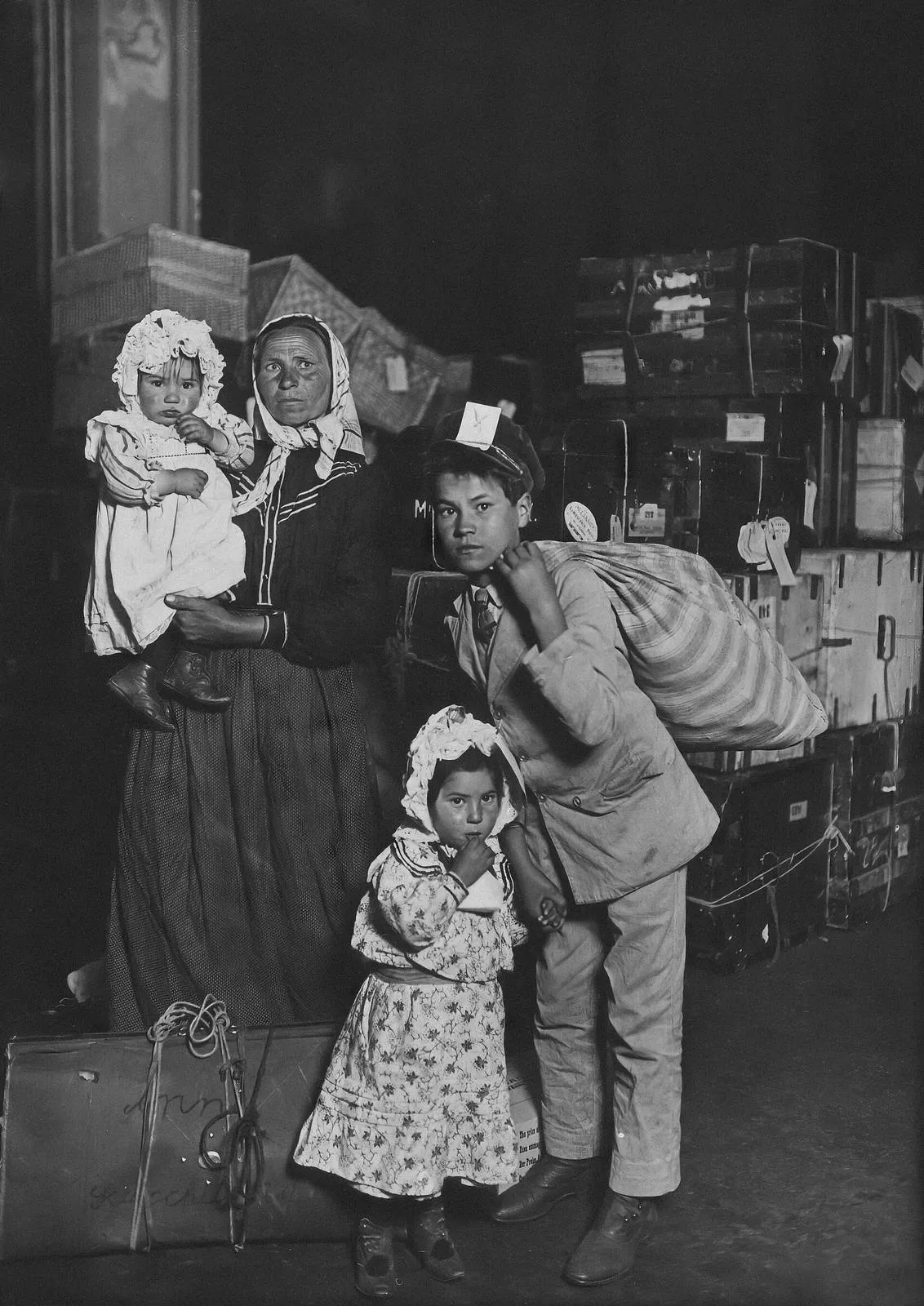
Italian family in the baggage room at Ellis Island, 1905. Photograph by Lewis Hine. The Commons author field spells the surname Hines. Public domain.
A death certificate is a state or local vital record. The questions vary by state and by year. Some forms ask for the deceased’s birthplace and parents. Some ask for little more than a date and an address. Order the certificate from the office that actually holds it, and read the informant’s name. The informant is the person who supplied the facts. A child who never heard the village will not produce it at the funeral. A wife who came from the same town might.
Do not “improve” a birthplace on a death certificate to match a family story. If the certificate says Naples and the obituary says a small town, keep both and find a third source. Death records are also how you learn a date of death, which you need before you request a Social Security application, and which you may need to tell two men of the same name apart.
Church burial registers in the American parish can name a birthplace when the civil certificate does not. That is a local search, based on the address you already have. It is not a substitute for the Italian parish, which comes after the town is known.
The Social Security application
For a person who has died, the Social Security Administration explains how to request the SS-5, the application for a Social Security number, on its FOIA request page. The current fee is whatever that page and Form SSA-711 say when you apply. Do not copy a fee from a blog. This page does not state a fee. Follow the form’s instructions about whose record you may request.
An SS-5 often includes a date of birth, a place of birth, and the parents’ names, and a particular form can leave any of those lines blank. Parents’ names are the prize when the passenger list never asked. A mother’s maiden name is the bridge to her family. A place of birth is subject to the same caution as every other place string: copy it, then test it. People wrote the province they thought an American clerk wanted.
You generally need enough identifying detail to pick the right person, and you need the person to be dead. The SSA page is the rule. If the page and the form conflict with advice you heard at a society meeting, follow the page.
The census as a finder, not a birthplace
The federal census is not an immigration record in the narrow sense, and it rarely names a comune. It earns a place on this map because it supplies a year of immigration and a naturalization mark that tell you which passenger list and which court to search. Use 1900, 1910, 1920, and 1930 for those questions when the household is enumerated there. Treat the year as a range. Treat the mark as a hint that a declaration or a petition might exist, not as proof of what a court file contains.
The census also shows neighbors. An Italian couple next door is not a relative because they are Italian. They are a clue only if a later record connects them. Do not build a town hypothesis from a neighbor’s last name. The surname hub explains how little a surname proves about a place.
An order that fits a few evenings
Evening one: passenger list, using the free Foundation search if the arrival may be New York. Transcribe the image or log the miss.
Evening two: naturalization, declaration and petition, in the counties where the census puts the person. Copy any town exactly.
Evening three: Chronicling America, then Newspapers.com if you use it, aimed at an obituary. Request the death certificate if you do not have it.
Evening four: if the person died after Social Security numbers existed and the town is still unknown, request the SS-5 and pay the fee the form lists.
When any evening produces a place, pause and run it through the hometown guide. Then browse Antenati and FamilySearch for that comune. If the year is not online, use the not-online guide and write one letter, using the comune template. Records of leaving Italy, as opposed to arriving in the United States, are a different problem. They are on the emigration page.
Sources
Questions readers actually ask
Which single record will name the town in Italy?
There is no single record that always does it. A passenger list may give a last residence, which might be the town, a province, or a port. A petition after 1906 may give a birthplace and still might say only Italy. An obituary may name a village the list omitted, or it may name a region and nothing smaller. A Social Security application for a person who has died may name parents and a birthplace, and the line may also be blank. Search in an order and stop upgrading guesses. The practical order on this page is the passenger list, the naturalization file, the newspaper, the death record, and the SS-5. The first one that yields a place string you can test is the one that earns the next hour. The hometown guide is where that string is tested against a real comune.
The family says he came through Ellis Island. Where do I start?
Start by dating the arrival. Ellis Island was an immigration station from 1892 to 1954. An earlier New York arrival belongs with Castle Garden or with the customs lists, not with the island. Search the Foundation's Arrival Records Collection for free, and read any image you find using the passenger-list guide. If the name fails, take the immigration year from a census only as a range and search again. If New York still fails, try the port someone in the family actually names, and read the National Archives immigration page so you know which lists exist. A story that says Ellis Island is often a story that means New York, or simply means America. The history page is background. The list, if you find it, is the evidence.
Are newspaper archives worth it if I already have a manifest?
Yes, when the manifest does not name a town, and sometimes even when it does. An obituary, a death notice, or a short item about a society or a funeral can name a birthplace, a surviving brother in Italy, or a home address that leads you to a church. Chronicling America is free and does not include every paper. Newspapers.com is a paid collection and also does not include every paper. Search both if you can, under the American spelling and the Italian spelling. A manifest that says Palermo and an obituary that says a small town in Sicily are not in conflict until you read them. Palermo may be the port. The small town may be the comune. Keep both strings and test the small town first in the civil registers.