
U.S. and emigration records
Free Ellis Island records searches
Where to search Ellis Island arrival records for free: the Foundation, FamilySearch, and NARA, plus when a paid index helps.
Affiliate disclosure.Some links on this page go to genealogy companies. If you buy through them, we may earn a commission, at no extra cost to you. We recommend a site only where it helps this kind of research. Read the full affiliate disclosure.
You can search a large share of New York arrival records without buying a subscription. The work is knowing which free door is the primary one, which door is only a second query of an older database, and when a paid index is a convenience rather than a different set of people. This page is about where to search. The passenger-list page is about how to read the line once you have it, including the last-residence column that may name an Italian town.
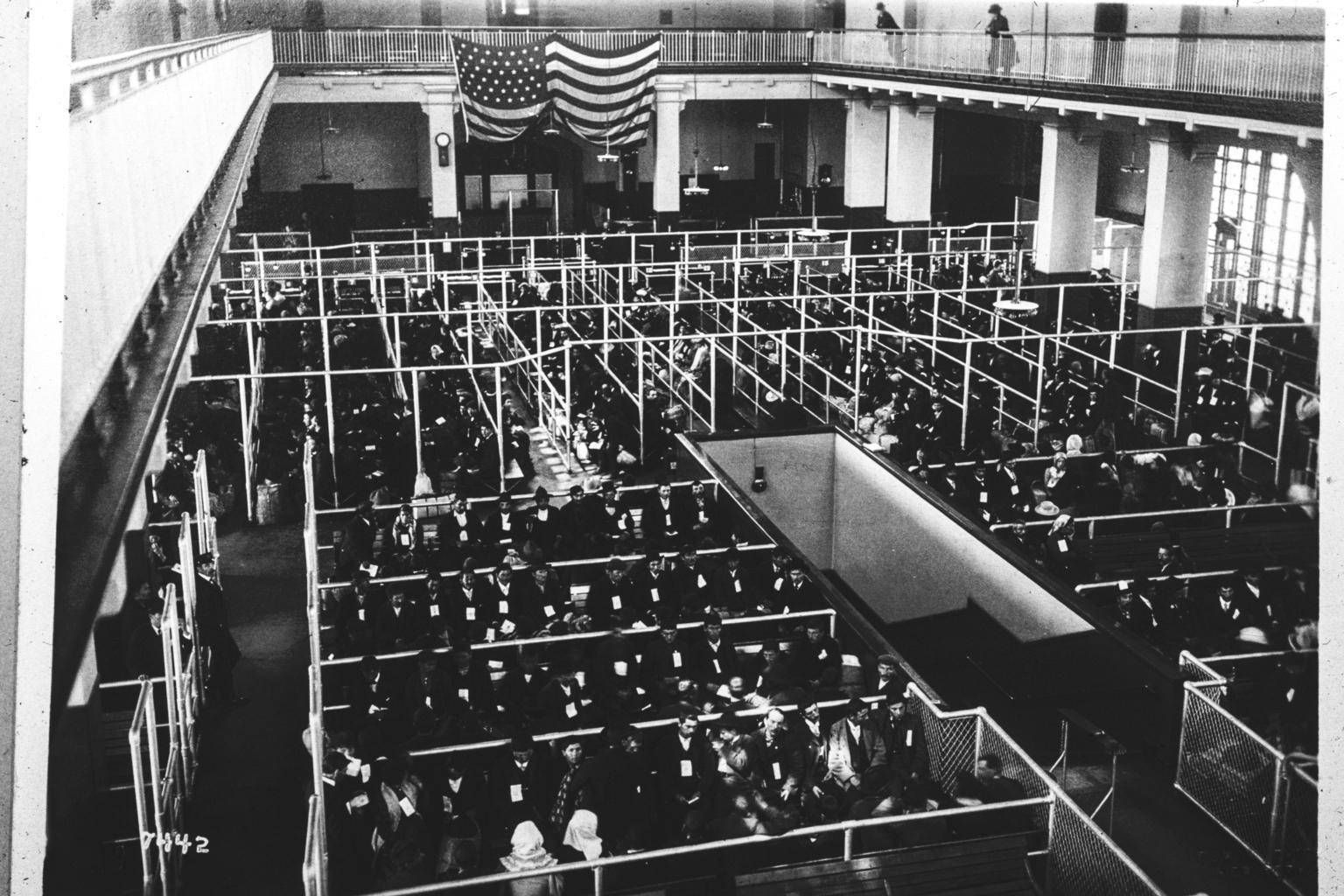
Ellis Island was an immigration station from 1892 to 1954. People who arrived at New York before that were not Ellis Island passengers. The Castle Garden page covers the earlier station and the customs lists tied to it. The history page is the narrative context. Nothing below depends on a count of how many people passed the island.
The primary free door
Start with the Statue of Liberty—Ellis Island Foundation’s Arrival Records Collection. The Foundation describes passenger manifests for Ellis Island and the Port of New York, and a wider set of arrival records. The search is free. The form’s own instructions treat the fields as optional, which is what you want when you know a name and only a rough year.
Search the Italian given name and the last name. If that fails, search the surname with an age and without the given name. American names were often applied later. Add a ship only when a record or a newspaper gives you the name. The current form includes a place for a ship name. Leaving it blank is better than typing a ship from a family story you have not checked.
If you saved a passenger ID from an older session, read the notice on the search page. The Foundation’s page has said that passenger IDs saved before April 1, 2026 are no longer valid, and that you should search by name to find the person again. A dead ID is a bookkeeping change, not a genealogical conclusion.
The Foundation’s Ellis Island page is the historical overview of the station. Use it when you need to remember what the island was. Use the arrival search when you need a manifest. When a result looks plausible, open the image the same day. Indexes omit columns and misread towns. The worksheet log should say which site you searched, the name you typed, and whether you opened an image.
FamilySearch, without a collection number
FamilySearch is free to register. It is not an affiliate of this site, and linking to it is not a paid recommendation. For New York arrivals, use it in two ways.
First, read the wiki orientation at Italy Emigration and Immigration. That page is a map of emigration and immigration sources. It will point you at the kinds of lists researchers use. Follow its links and its cautions, and expect the wiki to be updated. A paragraph you remember from a class handout is not as current as the wiki article in the browser.
Second, search the FamilySearch catalog for the port and for words such as passenger lists or arrival lists. Open the catalog entry that matches the port and the years you need, then browse or search inside that entry. This guide does not give a collection number. Numbers circulating in old posts are easy to mis-copy, and a wrong number wastes an evening. The catalog title in front of you, with its year range and its note about where the images can be viewed, is the instruction that matters.
Some images are viewable with an ordinary login at home. Some are marked for a FamilySearch Center or an affiliate library. That restriction is real. If the viewer says so, a home session will not remove it. The FamilySearch Italy guide explains the same kind of access note for Italian civil registers. The note on the passenger image works the same way: read it, and plan the viewing place accordingly.
FamilySearch and the Foundation can both fail to show a person the other one finds, because the indexes are not the same project. Search the second site before you conclude the arrival was never listed. Then read the image, using the method on the passenger-list page. A hit that you do not open is only a name.
The National Archives
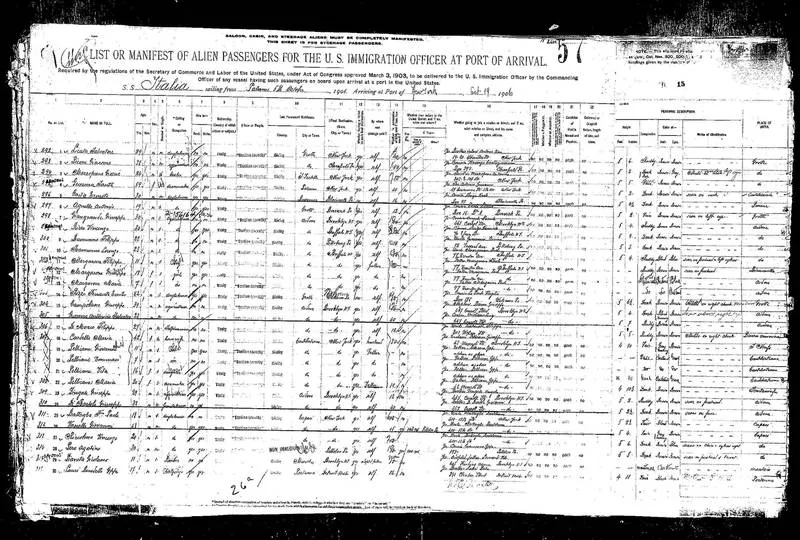
Ellis Island passenger manifest for a group recorded as Italy (South), including towns in Sicily. The file title says 1903; the Commons date field says 19 October 1906. Public domain.
The National Archives explains passenger arrival records on its immigration research page. Federal passenger lists are archival records. Many were microfilmed, and many of those films have been digitized on more than one website. NARA’s page is where you check how arrival records are described, which is a different job from typing a last name into a box.
Use that page when a website’s index stops at a year you care about, or when you need to understand whether you are looking at a customs list, an immigration station list, or a later crew list. Crew lists are a common point of confusion. A seaman who appears on a crew list is not, by that fact alone, an immigrant who intended to stay. Read the heading of the document. If your ancestor was a sailor, the crew list may still be the right document. If your ancestor was a passenger, filter or browse until you are on a passenger manifest.
NARA’s research guide will not always be a line-by-line name search for every port. Treat it as the official explanation of the records, then use the Foundation, the FamilySearch catalog, or a library to reach a name. When you cite the list, cite the ship, the date, and the line, and name the website where you saw the image.
Morse as a secondary tool
Stephen P. Morse built One-Step forms that search Ellis Island database material in alternate ways. Start with his introduction. The gold form was built for the Ellis Island database years 1892 through 1924. It is useful when a last name is badly mangled and you want another set of boxes aimed at that older database.
It is not the primary door. If the upstream site has changed, the form may not return results. Researchers sometimes spend hours changing wildcards on a form that is no longer attached to a live index. If Morse comes back empty, search the Foundation’s Arrival Records Collection before you rewrite the family’s story. An empty secondary form does not prove absence. A passenger who arrived after 1924 can also be outside the gold form’s window while still being inside the Foundation’s wider arrival search. Check the year you are hunting before you blame the spelling.
What a subscription index adds
Ancestry hosts New York, U.S., Arriving Passenger and Crew Lists (including Castle Garden and Ellis Island), 1820–1957. That collection is a subscription. It is not the only copy of these lists. The year span is wider than the old Ellis Island database window of 1892 to 1924, and the title includes crew lists and Castle Garden years. People who already have an Ancestry subscription often find the search boxes convenient, especially when they are combining a passenger search with a census or a naturalization index on the same site.
A paid index can be faster, and it can transcribe a town differently from the Foundation’s index. Neither transcription replaces the image. If you do not have a subscription, start with the Foundation and FamilySearch. If you do, search collection 7488 as well, then open the image. This site may earn a commission if you buy through an Ancestry link. Free searches still come first when they cover the list you need.
A search order that stays short
Use this order for one person, and write each step on the log even when the step fails.
- Foundation Arrival Records Collection, Italian given name and last name, with a year range if you have one.
- The same search with the surname alone, or with a traveling companion’s name.
- FamilySearch catalog for that port and those years. Open an image if the catalog leads you to one.
- Morse gold form only if the arrival falls in 1892 through 1924 and the Foundation search needs another query style. If the form errors or returns nothing, go back to the Foundation.
- Ancestry collection 7488 if you already have access, or if the free indexes have failed and you choose to use a subscription.
- Another port, if New York is a guess rather than a fact. The NARA immigration page is the overview of passenger arrivals beyond a single island.
Stop when you have an image and a transcription, or when you have honestly searched the doors that match the year. Then read the line on the passenger-list page. Last residence may be a town, a province, or a port. The hometown test is the comune guide. A list that names only a country still gives you an age and a date to carry into naturalization records.
People the Ellis Island search will not hold
Not every Italian immigrant passed Ellis Island. Arrivals before the station opened, arrivals at other American ports, and entries across a land border are different records. A relative who came after the station closed in 1954 will not be in an Ellis Island manifest. The immigration records guide is the wider map, including newspapers and the Social Security application, for cases where the manifest is missing or mute about the town.
If the family story names a ship and a year and every door above fails, look for the ship in a newspaper rather than forcing the last name. Chronicling America is free. A shipping notice can confirm that a vessel docked when the story says it did, which tells you whether to browse that voyage’s images. It rarely replaces the manifest. It often tells you which manifest to browse when the name index has defeated you.
Sources
- Statue of Liberty—Ellis Island Foundation, Arrival Records Collection
- Statue of Liberty—Ellis Island Foundation, Ellis Island
- Stephen P. Morse, One-Step Ellis Island search forms
- Stephen P. Morse, Ellis Island gold form
- National Archives, Immigration Records
- FamilySearch Wiki, Italy Emigration and Immigration
- Ancestry, New York arriving passenger and crew lists, 1820–1957
Questions readers actually ask
Is the Foundation search the same database as the old Ellis Island site?
Use the Foundation's current Arrival Records Collection as the free door, and do not assume an old bookmark still queries the same index. The Foundation describes passenger manifests for Ellis Island and the Port of New York and a wider set of arrival records. Ellis Island itself was an immigration station from 1892 to 1954. The Morse gold form was built for a narrower window, the Ellis Island database years 1892 through 1924, and it can fail if the upstream site has changed. If a tutorial sends you to a retired web address, retype the name on statueofliberty.org rather than concluding the passenger is missing. Passenger IDs saved before April 1, 2026 were marked no longer valid on the Foundation's search page. Search by name again.
FamilySearch and the Foundation both seem to have New York lists. Which do I use?
Use both if the first one fails, and do not treat them as rivals with different passengers. Start with the Foundation when you want a free name search aimed at arrival records. Use FamilySearch when you are already in the catalog, when you need to browse a voyage you have identified, or when an image note tells you the pictures are available at a FamilySearch Center or affiliate library. This page does not cite a collection number, because numbers in old blog posts go stale. Search the catalog for the port and the words passenger or arrival, and read the wiki page on Italian emigration and immigration for orientation. Whichever site shows you a hit, open the image. The reading method is the same and is written out on the passenger-list page.
If I already pay for Ancestry, should I ignore the free sites?
No. Search the subscription index and the free index. Ancestry's New York arriving passenger and crew lists, collection 7488, cover 1820 through 1957 and include Castle Garden and Ellis Island years. The index was created separately, so a spelling that fails in one box can succeed in the other. The images are another copy of port lists, not a private set of passengers. FamilySearch is not an affiliate of this site. Ancestry is, and a box on this page says so. Paying for a search does not change the rule about the image. When the two indexes disagree about a town, the manifest page decides. If both indexes miss the person, try a companion's name, another port, or a year taken from a census before you decide there was no list.