
U.S. and emigration records
Italian emigration records
Italy has no single nationwide emigration register that replaces arrival lists. Start in the destination country, then use the town's civil records.
Affiliate disclosure.Some links on this page go to genealogy companies. If you buy through them, we may earn a commission, at no extra cost to you. We recommend a site only where it helps this kind of research. Read the full affiliate disclosure.
Italian emigration records sound like a single series: a book in which the state wrote down everyone who left. That book, as a nationwide register you could search instead of an arrival list, does not exist. Researchers who wait for it stay stuck on a last name. The practical path runs the other direction. Find the person in the country where they landed, read any place of origin that record gives, and only then open Italian civil records for that town.
The FamilySearch wiki page on Italy Emigration and Immigration is the best single orientation to the kinds of lists that do exist, on both sides of the ocean. Use it as a map that the wiki maintainers can update. Use this page for the order of work and for the traps in Italian military lists. The immigration records guide is the United States version of the first half of that order. If the family sailed to New York, the Ellis Island and Castle Garden pages are the arrival detail. The National Archives immigration overview covers passenger arrivals in American custody.
Why the arrival list comes first
The destination country had a reason to list people getting off a ship or crossing a border. Those lists vary in quality, and many name only a country. They are still the document that places a person on a voyage. An Italian office did not create a matching line for every one of those arrivals. Searching Italy first, with a last name and a decade, is how people end up browsing the wrong province.
Collect the arrival entry, the age, the ship or the port, and any last residence exactly as written. If the residence is a port or a province, say so in your notes. The hometown guide is how you test a string once you have one. If you do not have one, stay in the destination records: a naturalization file, a death record, a newspaper, a child’s birth. The immigration page puts the American versions of those in order. Other countries have their own equivalents. The principle does not change.
Ancestry has digitized many passenger lists for the United States and for other destinations. It is a subscription, and it is not the only copy of a list that a national archive also holds. Search it when you have access, and prefer the image to the index. This site has an affiliate relationship with Ancestry. The relationship is not a reason to skip a free archive in the destination country.
What Italy actually kept
Once a town is known, Italian research becomes ordinary civil registration. You want the person’s birth, the parents’ marriage, and the births of siblings or of children born before the family left. Those acts were written because someone was born or married, not because someone emigrated. They are still the records that prove the family. The birth records overview and the Antenati guide are the way into films the state archives have released. FamilySearch often holds the same volumes under a different catalog. If the year is missing online, the not-online guide and the letter to the comune are the next step. Ask for one act for family history.
Some prefectures and local offices kept files about people who requested permission to leave. Those files can name a destination and a year. They are not complete, they are not national, and they do not replace the arrival list. Look for them only after you know the province, and only if that archive’s finding aid describes a series you can request. A hopeful letter that asks an office to “search all emigrants named Greco” will not be answered with a family tree. The beginner guide is blunt about this, and it is right.
Parish registers can show a household that stops appearing in baptisms and burials. That silence is not an emigration record. People also stopped appearing because they moved to the next comune or because the priest skipped a year. Use absence as a question, not as a date of departure.
Conscription lists and notes of absence
The liste di leva, the conscription lists, are the Italian series people most often hope will say “went to America.” Many of them are on the Portale Antenati beside the civil registers. They list young men called for military service. A note in the margin or in a column may say that a man was absent, that he had emigrated, or that he was canceled for a reason the clerk recorded. That note is worth transcribing in full.
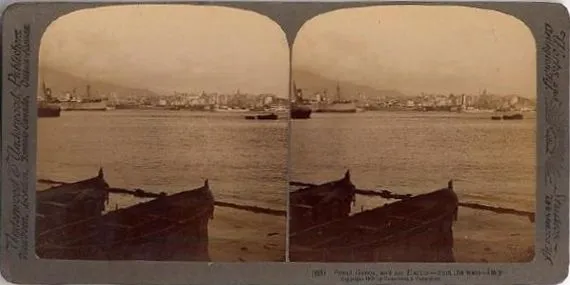
Genoa and its harbor, from the west. Stereo card by Underwood & Underwood, 1900. Public domain in the United States.
It is not a departure register. The list was not designed to record every person who left. A man who left before he was called may be missing, may be present with a note, or may be present with no note at all. A man who left and returned may look like anyone else. Women are not on the list. Children are not on the list. A brother who stayed may be the only sibling you find, which tells you about him and not about the sister who sailed.
Do not claim that a silent conscription list proves someone never left, and do not claim that a missing name proves he did. Write what you saw: “list of [year] opened, name not found” or “name found, annotated emigrated, no destination.” If a destination is written, treat it as a lead to the arrival archive in that place. Invented example: a note that says only “emigrato” beside a man’s name confirms that the clerk recorded an absence of that kind. It does not name a ship, a year of sailing, or a city. Pair it with the arrival list if you can find one. If you cannot, you still have his birth in that town, which is the fact the list was never meant to replace.
Antenati’s coverage of these lists is whatever each archive has put online. Do not assume every comune’s leve are filmed because the neighboring town’s are. The not-online guide applies to military lists as much as to births.
Argentina, Brazil, Canada, and Australia
People ask about these four destinations constantly. The answer is the same for each. The arrival record, when it survives, is an archive or a published series in that country. It is not a tab in an Italian national emigration register. Search the destination’s passenger lists and the finding aids the FamilySearch wiki points to. Then come back to the Italian town the arrival record, a marriage, or a death record names.
A tree built by cousins who stayed in Italy, or by cousins whose grandparents landed in Buenos Aires, São Paulo, Toronto, or Melbourne, can be the hint that breaks a stalemate. MyHeritage is useful for that because families in Europe and in Latin America have posted trees there. This site has an affiliate relationship with MyHeritage. Use the tree as a hint, not as proof. A profile with no sources is a sentence someone typed. Write down the town it suggests, the parents it names, and the contact if one is public. Then look for a record that says the same thing: an arrival list, a civil act, or a church entry. If the tree and the records disagree, follow the records.
Ancestry trees deserve the same skepticism and the same courtesy. They are leads. The image of a register is the evidence. DNA matches can show that a cousin in another country is related. They cannot, by themselves, name the comune. Use them to decide which cousin’s paper trail to read first.
Women, children, and people who do not appear
Emigration research that starts from military lists will miss the people those lists ignore. A wife may be on the passenger list under her maiden name and in no Italian “departure” file at all. Her birth act in her parents’ town is the record that identifies her. A child born in Italy and raised abroad is on a birth act and on a parent’s arrival list, not on a conscription list from the year the parent was eighteen.
People also left from a town that was not the town of birth. The last residence on a manifest and the birthplace on a petition can differ. Search the birth town for the birth, and search the last residence for a marriage or for the births of the oldest children. The surname pages will not resolve that split. Two places in the records will.
If you never find a list of the departure, you can still write an honest account. The birth act shows where the person started. The arrival list shows where they entered the next country. The gap between those documents is the voyage, even when no Italian clerk wrote a line about it. Fill the gap with a record, or leave it open. Do not fill it with a database that does not exist.
When the town is solid and a specific act is not online, one letter is enough to start. Use the parish letter only when the event is a baptism or a marriage in a parish book. Use the comune letter for a civil act. Keep the replies on the worksheet log. The kit gathers those letters and the logs into one download if you want them as files. The research order stays the one on this page: destination first, town second, Italian register third.
Sources
Questions readers actually ask
Is there an Italian emigration database that lists everyone who left?
No neat nationwide register does that job. Italy did not leave one master list that replaces the arrival record created in the country where the person landed. Some provincial and local offices kept papers about people who asked permission to leave. Those series are local, they are incomplete, and they are a second step after you know a town and a province. Conscription lists sometimes note that a man was absent or had gone abroad, and sometimes they note nothing. They were lists for military service, not a census of departures. Women and children are outside them. Start with the passenger list or border record in the destination country. Use Italian registers after a town is known. The FamilySearch wiki on Italy emigration and immigration is the orientation for which destination lists researchers have described.
The family went to Argentina or Brazil, not the United States. Where is the list?
The arrival archive is in that country, not in a single Italian office and not on this website. The same is true for Canada and Australia, which are the other destinations people ask about most often. Search the passenger lists, border records, or published indexes that the destination country maintains, and use the FamilySearch emigration wiki as a map of what has been described. A cousin's tree on MyHeritage, including a tree built by family in Latin America or in Italy, can suggest a town. Treat the suggestion as a hint. Prove it with an arrival entry that names the place, or with a civil act in that place that names the right parents. Ancestry's collections are another place those destination lists sometimes appear. A hint without a record is a lead you write down, not a birthplace you publish.
We know the town. What in Italy records the departure?
Often nothing that says "left on this ship." What you can document in the town is the life before departure and, sometimes, a note that someone was gone. Look for the person's birth act, the parents' marriage, the births of children born before the voyage, and a marriage if it happened in the town. On Antenati, open the conscription list for the right year if the archive filmed one, and read any note of absence without treating silence as proof. A death act for a parent may name a child as absent or as living elsewhere, and it may not. If the civil year you need is not online, write to the comune for that one act using the letter template, and say the request is for family history. The emigration fact itself usually remains the arrival list in the other country.