
DNA
Southern and northern Italian DNA results
What southern and northern Italian DNA labels can suggest, and why they do not name a town, a province, or a comune.
Affiliate disclosure.Some links on this page go to genealogy companies. If you buy through them, we may earn a commission, at no extra cost to you. We recommend a site only where it helps this kind of research. Read the full affiliate disclosure.
A southern Italian DNA result and a northern Italian DNA result are labels on a model. They are not birthplaces. The companies that print them, including Ancestry, MyHeritage, FamilyTreeDNA, Living DNA and 23andMe, compare a customer’s sample with reference sets and then name clusters in language the customer might recognize. “Southern Italy” and “Northern Italy” are that kind of language. They are coarse. They do not name a comune. They do not prove a province. The companies revise the models, so a label can change without any new ancestor having been discovered.
This page explains how to use the labels without letting them file your tree. It does not quote the figures on the screen. Those figures move, and a quoted breakdown would pretend this site had measured your family. The test comparison chooses a product by the research job. The Ancestry and MyHeritage comparison covers records and match lists without declaring a winner. Stay here for the north-south picture itself.
What the label is allowed to suggest
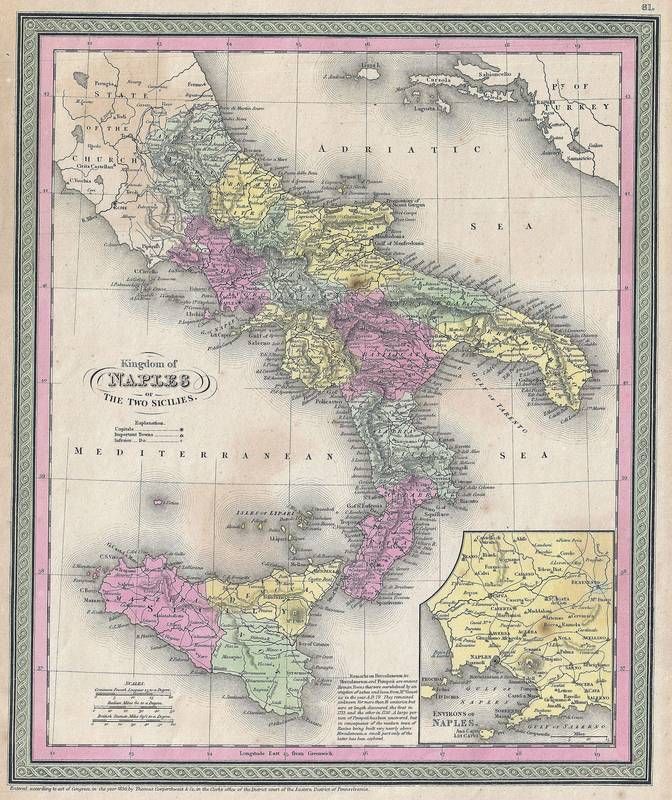
A southern label is allowed to suggest that you should not ignore the southern regions when you are hunting a town of origin. A northern label is allowed to suggest the same thing about the north. A report that shows both is allowed to suggest that one story, “we were from Naples,” may be incomplete, because Italians moved inside the peninsula and because emigrants married people from other places after they left. None of these suggestions identifies a household. Naples on a label, or in a family story, is still often a port. The Campania guide and the southern surnames page exist because that word swallows Avellino, Benevento, Salerno, Calabria and places that are not Campania at all.
The launch region guides, collected on the regions hub, cover Sicily, Calabria, Campania, Abruzzo and Basilicata. A southern label does not choose among them. Sicily is an island with its own general start for civil registration, which FamilySearch’s research overview places in 1820, later than the Kingdom of Naples mainland. The label will not apply that distinction. You apply it after a document names a Sicilian comune, using the Sicily guide. A northern label likewise will not choose among regions this site has not yet given their own pages. The method there is still the comune, then the archive, on Antenati.
Why two companies disagree
Each company chooses reference samples, decides how small a cluster may be, and chooses a name. One screen may say “Southern Italy.” Another may say “Italy” and leave the south inside the larger word. Another may separate an island cluster, or fold it back, in a later update. Living DNA’s product, for this purpose, is an autosomal regional report, which is the same kind of model under a different brand. FamilyTreeDNA’s autosomal test, Family Finder, has its own presentation. None of these choices is a census, and none of them is a finding about your great-grandmother’s birth.
When the screens disagree, do not average them and do not accuse the lower number of being a defective kit. This page does not discuss those numbers at all. Write down the words, note the date you saw them, and expect the words to move. A blog post that freezes a map from a particular year is a description of that year. It is not a key to the archives.
23andMe belongs in this explanation because readers compare it with the others. Its affiliate program is paused. Mentioning the company is not an offer, and this site does not earn a commission if you buy a kit there. Its Italian labels are models too. They do not name a comune. This site does not discuss medical reports from 23andMe or from anyone else.
What cousin matches can add, and what they cannot
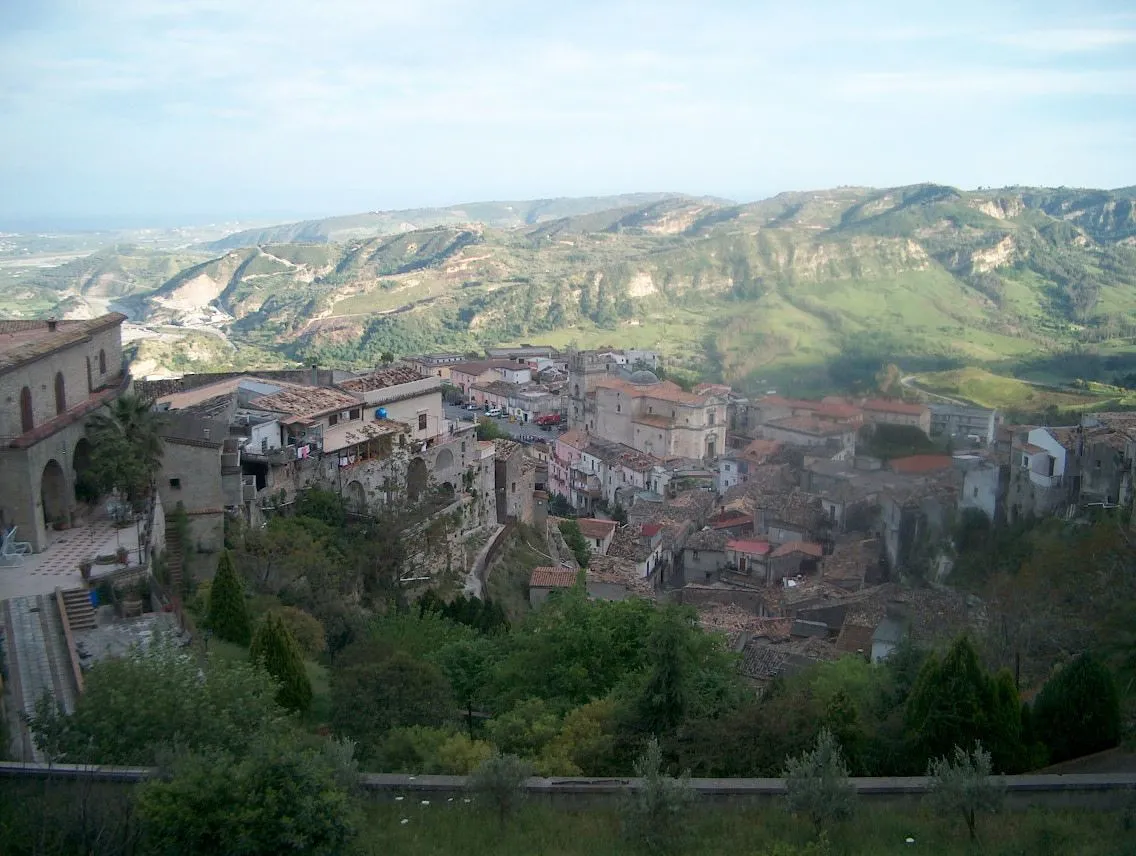
A village in a valley in Calabria. Photograph released to the public domain by Wikimedia Commons user Drork.
The genealogical value of an autosomal test is the match list on AncestryDNA, MyHeritage, Family Finder at FamilyTreeDNA, and whatever match tools the other companies currently offer. A match with a tree that cites a town is a lead. A lead in the north and a label that says south can both be true, because the match may be through a different line from the one the label is crudely summarizing, or the label may be too blunt to see a northern line at all. Follow the documented town into the registers. If the acts connect, the label was never the evidence. If the acts do not connect, the match’s tree was wrong, which happens often with Italian towns that share a saint’s name.
MyHeritage is often used by European testers. That is a reason a southern or northern label there may sit next to a match who still lives in the province your label cannot name. The match is the reason to write to the person. The label is not the text of the message. Ask what document they have. Offer to look the year up on Antenati, which does not require them to share a kit.
Y-DNA does not color the peninsula
Y-DNA is inherited on an unbroken paternal line. It can be relevant to a last name, in the way the origins page discusses surnames as words and the paternal line discusses people. It says nothing about the other ancestors. A southern autosomal label and a Y-DNA result are not two measurements of the same fact. One is a blunt summary of recent autosomal patterns. The other is a single line. Neither proves a province. A surname distribution map, built from telephone listings and explained on the map page, is a third, still different fact. Do not stack the three and call the stack a birthplace.
If the paternal line is the question, FamilyTreeDNA is the company among these that sells Y-DNA as well as an autosomal test. A woman interested in her father’s line needs a male relative on that line to test. The result still has to be tied to paper. Mitochondrial DNA, the direct maternal line, is the parallel product and has the same limit: one line, no comune.
Paper is the thing the label cannot update
FamilySearch’s Italy Genealogy wiki and Antenati remain the way a southern or northern place becomes a household. Unified civil registration begins generally in 1866, in the overview FamilySearch publishes and that the region pages cite. Kingdom of Naples civil registration, for the mainland south, is dated in that same overview from 1809, with a Bourbon continuation from 1816. Those ranges do not come from a DNA company, and a DNA company will not apply them to your label. You apply them after the hometown guide has produced a municipality.
A passenger list can name the town the label cannot. So can a petition. So can an obituary. The Ellis Island guide is for one New York station, not for every arrival. People left in other decades and through other ports. A DNA label does not know which.
Invented example. A report paints a large southern cluster and a smaller northern cluster. The tester’s father always said the family was from “the north,” and a great-aunt’s funeral card says the mother’s parents were from “Calabria.” The southern label is compatible with Calabria and also with several other regions. The northern label is compatible with the father’s story and also with noise in the model. Neither paint names a town. A cousin match on MyHeritage has a tree citing Acri, in the province of Cosenza, on the maternal side, with a link to a civil image. That citation is the lead worth an evening. The Calabria guide tells you Acri is not Reggio Emilia and that the archive is the Archivio di Stato di Cosenza if the gazetteer agrees. You open the image. You do not move the father to Calabria because the southern paint was larger, and you do not discard Calabria because a northern paint also appeared. The father still needs his own record.
How to write it in the tree
Put the company, the date, and the words of the label in a note if you want to remember what you saw. Put the comune in the birthplace field only when a record names it. If the models change next year, edit the note. You will not have to edit the birthplace, because you never let the label become one. That is the whole discipline. The south and the north are real geographies. The buttons with those names are a company’s current summary. The beginner guide is what you do with a geography once a person, rather than a model, has been attached to it.
Sources
Questions readers actually ask
Does a southern Italian DNA result mean my family was from Sicily?
No. A southern label is a coarse output of a company's reference model. It does not choose Sicily over Calabria, Campania, Abruzzo, Basilicata, or another southern region, and it does not name a comune inside any of them. Sicily's history and its archives are specific, which is why this site has a separate Sicily guide, but the specificity is in the records, not in the label. Companies also revise the boundaries and the names of these clusters. A screenshot from last year can use a different phrase from the screen you see now. Treat the label as a hint that a southern record search is not absurd. Then find a town in a passenger list, a petition, or a cousin's documented tree, and open that town.
Why do Ancestry, MyHeritage, and 23andMe disagree about north and south?
Because each company builds and updates its own model, with its own reference samples and its own names for clusters. Disagreement is what you should expect, not a sign that one laboratory mistyped your sample. This page does not print the figures those screens show, and it does not average them. 23andMe is mentioned only so the disagreement is understandable; its affiliate program is paused, and this site does not earn a commission from it. AncestryDNA and MyHeritage DNA are autosomal tests with match lists, which is the part that can help a genealogy. The north-or-south paint is the part that cannot file a civil register. If two models disagree, write "models disagree" in the notes and go to the matches and the paper.
Can Y-DNA tell northern from southern Italian ancestry?
Y-DNA follows an unbroken line of fathers and sons. It can be relevant to a last name along that line, and it says nothing about the other ancestors. A paternal line from one end of the peninsula does not describe the mother's family, or the father's mother. It also does not prove a province. A haplogroup is not a comune. If the research question is "were we southern?", an autosomal label is already a coarse hint about the recent mixture those tests try to see, and a birth act is the actual answer for one person. Order Y-DNA when the question is the father's last name and you have, or can find, a man in that direct line to test. Do not order it to color in the regions hub.