
Books and history
Best Italian genealogy books
Which Italian genealogy books are worth buying, and which free guides to read before you spend money on any of them.

Affiliate disclosure.Some links on this page go to genealogy companies. If you buy through them, we may earn a commission, at no extra cost to you. We recommend a site only where it helps this kind of research. Read the full affiliate disclosure.
The best Italian genealogy book is the one that answers the question you are stuck on, after you have read the free pages that are updated when the portals change. This page names three real books and refuses the rest of the market: crest albums, noble-origin lists, and anything that promises a town from a spelling. It does not score the three books against each other. It does not invent an identification number, and it does not quote a price.
Read these before you buy anything. The FamilySearch wiki article Italy Genealogy is the maintained overview of record types, archives and strategies. The Portale Antenati’s guida alla ricerca is the maintained explanation of how to search the civil registers the Ministry of Culture has put online. The Antenati walkthrough and the beginner guide on this site turn that logic into a sequence. If those pages get you into the right comune, you may not need a book at all. Buy a book when you want a sustained explanation of record types or of passenger lists that a single web page does not replace.
Finding Italian Roots
John Philip Colletta’s Finding Italian Roots: The Complete Guide for Americans, second edition, was published in 2003. The publisher’s page for that edition is on Genealogical.com: Finding Italian Roots, second edition. The title tells you the audience. It is a guide for Americans doing Italian research, not a transcription of one town’s registers and not a list of last names. Use the publisher’s page for the current description of what the edition contains. This site will not invent a table of contents or a page count.
What you can expect from a book with that aim is the order Americans actually need: how to get a place of origin from records in the United States, how civil and church records in Italy differ, and how to approach an office when the film stops. Those tasks have not gone away since 2003. The screenshots, if the edition has them, have. Treat any website address in the book as a historical clue and look the institution up under its present name. Antenati is the present door for many of the civil registers Colletta would have sent you to archives to see on film.
The hometown guide is the piece of that order this site has written out at length. If you buy Colletta, let him teach the judgment and let the current portals teach the clicks. If you do not buy him, the beginner guide is the free path through the same judgment.
Italian Genealogical Records
Trafford R. Cole’s Italian Genealogical Records: How to Use Italian Civil, Ecclesiastical & Other Records in Family History Research is the book to open when the question is what the records are. The publisher discusses the book at Turner Publishing. A 1995 Ancestry edition also exists. This page does not invent an identification number for either edition, and it does not claim that one printing is identical to the other. Use the Turner page, and the edition you actually hold, for bibliographic details.
Cole is useful because Italian research fails on record types more often than it fails on patriotism. A civil birth act, a baptism, a marriage with its packet of supporting papers, a death, a military list and a notarial act are different objects, created by different institutions, often with different ages and occupations for the same person. A guide that walks through those objects will still be right when the viewer that displays them has been redesigned twice. Use it beside the image, not instead of the image. When Cole and a cataloger’s title disagree about which archive holds a year, believe the catalog you can see this week, and use the book to understand what you are seeing.
The ecclesiastical half is the half the free portals cover less evenly. Antenati is strongest as a civil-register portal. Parish books are local. A chapter that tells you how a parish register is organized will outlast a blog post about a single diocese’s filming project. It will not tell you that your parish has been filmed. The FamilySearch catalog tells you that, town by town.
They Came in Ships
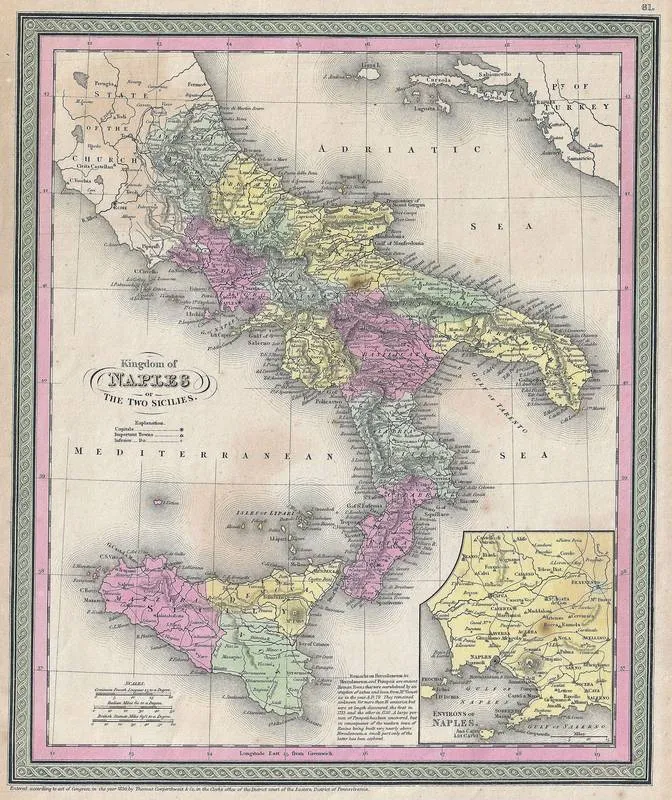
Map of southern Italy and Sicily by S. A. Mitchell, plate 61 in the 1853 New Universal Atlas. Public domain.
John Philip Colletta’s They Came in Ships is a guide to passenger-arrival records. It is not an Italy-only book. This page omits an edition year on purpose, because several printings exist and a guessed year would be a false citation. Use the title and the author, and the copy you have, if you cite it. The reason it belongs on an Italian genealogy shelf is that so many Italian searches begin with a manifest and then go wrong: the port copied as a birthplace, the index copied instead of the image, the wrong decade’s station assumed because a relative said Ellis Island.
The Ellis Island guide, the Castle Garden guide and the history page are the free versions of that caution for Italian research in particular. Colletta’s ship book is the longer treatment of arrival records as a type, including the habits of lists that are not Italian at all. Buy it when passenger records are the stuck point and you want a book-length explanation. Do not buy it expecting Sicilian civil registers. It is not that book. Finding Italian Roots is the one aimed at the Italian problem as a whole. They Came in Ships is the one aimed at the voyage.
What a printed book cannot keep current
Buttons, collection titles and image locks change. FamilySearch moves a film from “viewable at home” to “viewable at a center,” or the reverse. Antenati adds a year. A subscription site retitles a database. A book from 1995 or 2003 cannot track that, and it should not be scolded for the failure. Read books for structure. Read the FamilySearch Italy guide and the Antenati guide for access. If you only have patience for one evening, spend it on the free wiki and the portal, not on a purchase.
Books also go out of date in a quieter way. Boundaries of provinces change. A town discussed under an old province may now be filed under a newer one. The Calabria and Abruzzo pages on this site flag Crotone, Vibo Valentia and Pescara without asking you to memorize a year of legislation. A book that uses the provinces of its printing date is not wrong about the records created then. It is incomplete about the catalog you are clicking now. Check the gazetteer.
What not to buy
Do not buy a coat of arms matched to a spelling. Heraldry belonged to particular grants, not to every person with the letters, and the surname origins page is the explanation. Do not buy a volume that lists “Italian names” with a noble anecdote and no records. Do not buy a book that offers to tell you the town from the last name alone. The distribution maps are free telephone-directory tools, and even they are not a birthplace. A book that does less than those maps, and charges for a crest, is a souvenir.
Be wary of compilations that reprint passenger lists you can already search at the Ellis Island Foundation or in the National Archives, with a new introduction and a high price. The reprint can be convenient. It is not a new source. Read the underlying list.
Where copies turn up
Readers can often find these titles through a library, a genealogical society shelf, a used-book shop, or Amazon. This page may earn a commission if you buy through an Amazon link, at no extra cost you would not have paid at the retail price Amazon sets. The commission does not decide which book is described, and it does not attach to the free wiki or to Antenati. This page does not invent Amazon product codes. Search by the author’s name and the title. Confirm that you are looking at Colletta’s second edition of Finding Italian Roots if that is the edition you want, using the Genealogical.com page as the bibliographic check. Confirm Cole’s title on the Turner page. For They Came in Ships, confirm the author, because similar titles exist in the passenger-list genre.
A library copy is a perfectly good copy. Nothing in the research requires you to own the paper. The worksheets and the kit are this site’s own folders for letters and logs, which are a different kind of purchase from a narrative book. Use them if you want templates. Use Colletta or Cole if you want a book that explains why the templates are worded as requests for one event rather than as demands for a last name.
The order, if you do all of it, is short. Wiki, Antenati guide, then the book that matches the hole in your search, then back to the image. A shelf of unread genealogy books has never identified a comune. One chapter, read beside the register it describes, sometimes has.
Sources
Questions readers actually ask
Which book should I buy first for Italian genealogy?
Buy none until you have used the free FamilySearch Italy Genealogy wiki and the Antenati research guide. Those two pages are current in a way a printed book cannot be, because portals change their buttons and a book keeps the buttons it was printed with. After that, the choice depends on the stuck point. John Philip Colletta's Finding Italian Roots, second edition, 2003, is a guide for Americans tracing Italian families, and the publisher's page is on Genealogical.com. Trafford R. Cole's Italian Genealogical Records is the book to read when you want civil, church and other record types explained. Colletta's They Came in Ships is a passenger-arrival guide, not an Italy-only book, and it belongs on the shelf when the manifest is the problem. "First" means the book that matches the problem, after the free guides, not a ranked prize.
Are the click-by-click instructions in older books still right?
The record types are still right. The websites often are not. Cole's discussion of how civil, ecclesiastical and other records work will still teach you what an act is supposed to contain. A 1995 Ancestry edition of that book exists alongside the edition discussed on the Turner Publishing page, and neither edition can describe Antenati's current menus. Colletta's 2003 edition likewise predates later redesigns of the portals. Use the books for the logic: which office created the record, which copy might have been filmed, how a passenger list differs from a birth act. Use the Antenati walkthrough and the FamilySearch Italy guide on this site for the clicks. If a book and a portal disagree about a button, believe the portal. If they disagree about what a marriage attachment is, believe the book and then look at the attachment.
Should I buy a last name or coat-of-arms book?
Not as a research tool. A commercial coat of arms sold for a spelling is not evidence of nobility. Heraldry belonged to particular grants, not to every person who shares the letters. A surname dictionary can be worth reading when it explains a word and stops. It is not worth buying when it assigns your spelling to a province, a noble house and a village without an act. The origins page on this site covers the patterns and the refusal. Spend the money, if you spend it, on Colletta or Cole, or spend nothing and use the wiki. Amazon is one place copies of ordinary books turn up. A listing there is not a peer review, and this page does not quote a price or a product code.